

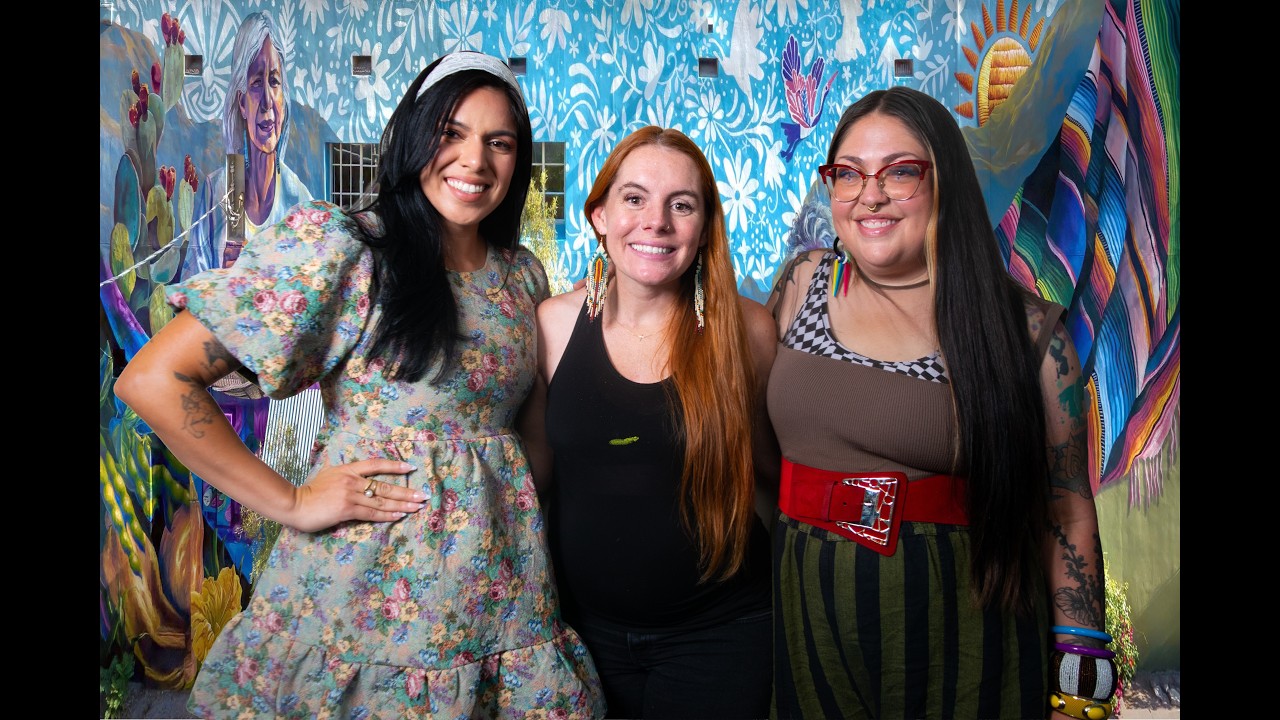
Threads of Tucson: Jessica Gonzales, Camila Ibarra & Pen Macias Weave Women’s Stories Into Public Art
Episode Highlights
- 🎨 The Story Behind Threads of Tucson
Jessica Gonzales, Camila Ibarra, and Pen Macias share how their collaborative mural, Threads of Tucson, Woven by Women, came together in the El Presidio neighborhood. - 🧵 Women as the Weavers of Tucson’s Culture
The artists explain how the mural honors mothers, abuelas, daughters, Indigenous women, and everyday cultural keepers who pass Tucson’s traditions from one generation to the next. - 🌵 A Living Tapestry of Tucson History
From Mission Garden and the Santa Cruz River to monsoon imagery, Mexican textile patterns, and the Three Sisters crops, the mural layers Tucson’s cultural and environmental history into one public artwork. - 👀 Hidden Details and Local Easter Eggs
The mural includes meaningful surprises, including references to the Stork’s Nest maternity ward and design elements inspired by original wallpaper uncovered in the historic building next door. - 🤝 Three Artists, One Seamless Vision
Jessica, Camila, and Pen discuss what it took to merge three distinct artistic voices into one cohesive mural through trust, planning, feedback, and collaboration. - 🥽 Old Stories, New Tools
The artists reveal how augmented reality goggles helped them scale and transfer the mural design onto the wall, blending Tucson history with modern mural-making technology. - 🏙️ Public Art That Belongs to Its Neighborhood
The conversation explores how Threads of Tucson connects to El Presidio, the surrounding alley, and the larger story of Tucson’s urban core. - ✨ A Milestone for Tucson Muralists
The artists reflect on how this project stretched them creatively, deepened their craft, and became a meaningful moment in their careers.
Episode Description
In this episode of Life Along the Streetcar, host Tom Heath brings together three of Tucson’s most celebrated muralists — Jessica Gonzales, Camila Ibarra, and Pen Macias — for a conversation about the making of Threads of Tucson, Woven by Women, a collaborative public art project in the historic El Presidio neighborhood.
The mural is more than a beautiful addition to Tucson’s urban core. It is a visual story about the women who carry culture forward — through food, family, memory, textiles, land, and tradition. In the episode, Jessica, Camila, and Pen share how three individual artistic visions came together to create one seamless work of Tucson public art, and how the mural became a tribute to the women whose everyday lives have shaped the city’s identity.
From Indigenous heritage and Mexican textile traditions to Mission Garden, the Santa Cruz River, monsoon imagery, tamales, and hidden references to the Stork’s Nest maternity ward, Threads of Tucson invites people to slow down, look closer, and recognize the many stories woven into the city around them.
Women Weaving Tucson’s Culture Across Generations
At the heart of Threads of Tucson is a simple but powerful idea: women have always been central to the way Tucson’s culture is created, preserved, and passed on.
Rather than focusing only on famous historical figures, the artists wanted the mural to reflect the women people know in their own lives — mothers, grandmothers, daughters, neighbors, elders, and cultural keepers. The mural honors the women who teach traditions not through monuments or textbooks, but through lived experience: preparing food, sharing stories, caring for families, creating art, and holding community memory.
One of the most emotional images in the mural shows a young girl making tamales with her abuela. It is a deeply Tucson moment, but also a universal one. Many people can look at that scene and see their own family, their own kitchen, their own memories of learning culture from the women who raised them.
The mural also begins with a tribute to Indigenous women and the original communities of this region, acknowledging that Tucson’s story stretches far beyond the modern city. From there, the work moves through generations and traditions, showing how women continue to shape the cultural fabric of Southern Arizona.
In this conversation, Jessica, Camila, and Pen reveal that the mural’s women-centered theme was not simply assigned to them. It emerged naturally from who they are as artists and from the opportunity to work together as three women creating public art in Tucson. That shared perspective became the emotional foundation of the project.
A Living Tapestry of Tucson Public Art
The title Threads of Tucson is not just poetic — it describes the structure and spirit of the mural itself.
Textiles, fabric, stitching, and woven patterns flow throughout the artwork, tying together different scenes, cultures, landscapes, and memories. The mural works like a tapestry, where each detail contributes to a larger story. Nothing is random. Every image, pattern, and symbol has a purpose.
The artists discuss how the design process began with conversation, then developed through individual concepts that eventually fit together like puzzle pieces. What could have looked like three separate artistic styles instead became one unified piece, thanks to careful planning, a shared color palette, trust, and a willingness to adapt.
That textile imagery also gives the mural its deeper meaning. Tucson is not one single story. It is many stories woven together: Indigenous traditions, Mexican heritage, neighborhood history, agricultural memory, family rituals, desert seasons, and the everyday lives of people who make the city what it is.
The mural includes references to the Three Sisters — corn, squash, and beans — along with Mexican stitching traditions, fabric elements, and an Otomi-inspired sky design. The artists even incorporated hidden details from original wallpaper uncovered inside the nearby Stork’s Nest building, once a maternity ward where many Tucsonans were born.
Those hidden elements turn the mural into something people can return to again and again. From far away, it is striking and colorful. Up close, it becomes a discovery experience. The more you look, the more Tucson you find.
El Presidio, Mission Garden, and the Neighborhood History Behind the Wall
Like the best public art, Threads of Tucson belongs to its location.
Set in the El Presidio neighborhood, the mural connects directly to the history and geography of Tucson’s urban core. It references Mission Garden, the Santa Cruz River, monsoon clouds, mountains, food traditions, and the cultural layers that have shaped the area over centuries.
The mural also physically interacts with its surroundings. The artists had to respond to the wall, the alley, the tree in front of the building, and the way people would encounter the work from different directions. One of the mural’s most memorable features is the way it wraps around the corner, pulling viewers into the space and encouraging them to explore beyond the first glance.
That sense of invitation is part of what makes the piece so effective. It does not simply decorate a wall. It activates a place. It asks people to pay attention to the neighborhood, to the histories embedded in the built environment, and to the artists who are helping make those histories visible.
In the episode, the artists also share some of the behind-the-scenes realities of creating a mural at this scale — from using augmented reality goggles to project and trace the design, to solving logistical challenges with lifts, trees, ladders, and on-site adjustments. Those details reveal the blend of artistry, technology, planning, and problem-solving required to bring public art to life.
For Jessica Gonzales, Camila Ibarra, and Pen Macias, Threads of Tucson became more than a commission. It became a milestone — a project that stretched them creatively, deepened their appreciation for collaboration, and reminded them of the power of art to tell stories that belong to an entire community.
Listen to the Full Conversation
Threads of Tucson: Jessica Gonzales, Camila Ibarra & Pen Macias Weave Women’s Stories Into Public Art is a celebration of Tucson muralists, women’s history, public art, and the cultural memory of the city’s urban core.
Listen to the full episode to hear how Jessica, Camila, and Pen brought this remarkable mural to life, what each element means, and why Threads of Tucson, Woven by Women has already become such a meaningful part of Tucson’s public art landscape.
Explore more stories from Tucson’s urban core at LifeAlongTheStreetcar.org, and follow Life Along the Streetcar for more conversations with the people, places, artists, entrepreneurs, and community leaders shaping the path from Sentinel Peak to the University of Arizona.
After you listen, take a walk through El Presidio, see the mural in person, and look closely. Tucson’s stories are woven into the wall.
Transcript & Show Notes
Threads of Tucson: Jessica Gonzales, Camila Ibarra & Pen Macias Weave Women’s Stories Into Public Art
Show Notes & Enhanced Conversation Transcript
Episode: Life Along the Streetcar
Host: Tom Heath
Guests: Jessica Gonzales, Camila Ibarra & Pen Macias
Featured Public Art: Threads of Tucson, Woven by Women
Location: El Presidio neighborhood, Tucson, Arizona
Editor’s Note: This transcript has been lightly formatted for readability while preserving the authentic conversation. Chapter headings, editorial notes, and pull-quote suggestions have been added to help readers navigate the discussion. Guest speaker labels are inferred from the transcript context and should be verified before final publication.
Episode Overview
In this episode of Life Along the Streetcar, host Tom Heath sits down with three of Tucson’s standout muralists — Jessica Gonzales, Camila Ibarra, and Pen Macias — to discuss their collaborative mural, Threads of Tucson, Woven by Women.
Located in the historic El Presidio neighborhood, the mural celebrates the women, traditions, cultures, and communities that have shaped Tucson’s story. The conversation explores how the project came together, how three distinct artistic voices merged into one cohesive work, and how the mural uses textiles, food traditions, Indigenous history, Mexican cultural references, Mission Garden, the Santa Cruz River, monsoon imagery, and hidden neighborhood details to tell a layered story of place.
The artists also discuss the trust required in collaboration, the creative use of augmented reality goggles to scale the design, and why this project became a meaningful milestone in their artistic careers.
Chapter Guide
00:00 — Three Tucson Muralists in One Room
Tom introduces Jessica, Camila, and Pen as three of Tucson’s top muralists and sets the stage for a conversation about collaboration, public art, and the cultural meaning behind Threads of Tucson.
01:23 — How the Project Came Together
The artists explain how Rio Nuevo reached out, how quickly they responded, and how the idea of three women muralists working together created both excitement and creative pressure.
03:05 — From a Blank Wall to Threads of Tucson
The mural’s official title is introduced, and the artists explain how the concept evolved from a broad historic prompt into a women-centered visual story.
05:44 — Designing a Seamless Collaborative Mural
The artists describe the month-long design process, how they built on each other’s ideas, and how their individual concepts came together like puzzle pieces.
08:06 — Color, Planning, and Creative Trust
The conversation moves into the logistics of public art: color palettes, task delegation, feedback, and the professional trust needed to make a shared mural look like one unified work.
11:20 — Augmented Reality and the Mural-Making Process
The artists explain how AR goggles helped them scale the design onto the wall, blending new technology with traditional mural-making craft.
14:01 — The Stories Hidden in the Wall
The artists walk through the mural’s imagery, including Indigenous women, abuelas, tamales, textiles, Mission Garden, monsoon imagery, the Three Sisters crops, the Santa Cruz River, and references to the Stork’s Nest maternity ward.
19:51 — Wrapping the Mural Around the Neighborhood
The group discusses how the mural extends around the corner, pulling people into the alley and creating a sense of movement through the El Presidio neighborhood.
21:02 — The Team Behind the Wall
The artists give credit to Dakin/Duncan for his support on the project, including physically challenging and behind-the-scenes tasks.
21:56 — Public Attention and Artistic Growth
The artists reflect on the attention the mural has received and how working together pushed them creatively.
28:02 — Collaboration, Confidence, and What Comes Next
The conversation closes with reflections on what the project taught them about collaboration, trust, creative standards, and future possibilities.
31:07 — Tucson Gallery Signing Event
Tom previews an opportunity for the public to meet the artists, get prints signed, and connect with the mural’s creators.
Pull-Quote Suggestions
“We want you to look at this wall and see the women who have woven your culture.”
“Tucson is not one story. It is many stories woven together.”
“The more you look, the more Tucson you find.”
“We all went into this with no egos in the way.”
“This mural became a milestone in my creative walk.”
Enhanced Conversation Transcript
Chapter 1: Three Tucson Muralists in One Room
Tom Heath:
Welcome back to another episode of Life Along the Streetcar, where we cover the social, cultural, and economic impacts of the urban core, which we define from Sentinel Peak to the University of Arizona.
Each week, we try to have a different guest — or guests — on the show to talk about some of the cool things happening. And today is sort of the star-power episode. This is the episode where the universe has collided and brought all these fabulous, talented people into one room.
I’ve talked with each of you individually, but Jessica, Camila, and Pen — some of our top muralists in Tucson — are all here. This is exciting for me.
Artist:
I’m excited.
Tom Heath:
When I heard about this project and they said the three women working on this mural, I was like, “Oh, they absolutely nailed it.”
You all knew each other a little bit through the art world. Were you connected prior to this mural, or did you just sort of know each other?
Artist:
I think we’d all spent a little bit of time with each other, but in very small amounts. We were more acquainted before.
Tom Heath:
That makes sense. And when this project came about — and we’ll talk about the project — what were your first thoughts?
Chapter 2: How the Project Came Together
Artist:
Janae from Rio Nuevo reached out to us to ask if we wanted to collaborate, the three of us. I responded in about two seconds.
Tom Heath:
What did you respond?
Artist:
Absolutely.
Artist:
If I have to, sure.
Artist:
Then from there, we met up to talk more about the project.
Tom Heath:
And when you got the call — because you had gotten the call about the 250 project, and I know that was exciting for you — what was this like?
Artist:
When they reached out to us, they did it as a group text. So we all got the news at the exact same moment, and we could see everyone’s responses.
To be honest, I was intimidated because I love these two so much. I was like, “What am I bringing to the table that they couldn’t already do?” But we have a great dynamic, and it worked out really well.
Tom Heath:
So you got approached for this mural, and it’s in the El Presidio neighborhood. What was the original ask? Did they say, “We want you to go paint on a wall?” What did they tell you?
Artist:
You nailed it. “Go paint on a wall.”
Tom Heath:
No direction? No guidance?
Artist:
I think the only criteria was that it had to be historic.
Artist:
Historic, and it had to be a piece that had a lot to take in — something you could look at up close and see new things. Not one big, solid image, but something with a lot of Easter eggs and elements to it.
Editorial Note:
This is a key setup moment for the episode. The prompt was broad — historic, detailed, and layered — which allowed the artists to develop a mural that was not just decorative, but deeply connected to Tucson’s cultural memory.
Chapter 3: From a Blank Wall to Threads of Tucson
Tom Heath:
So with that specific of a request, it was pretty easy to determine what you were going to paint?
How do you get from “paint on a wall with detail” to what you came up with — this fabulous women’s mural? What is the official name?
Artist:
It’s called Threads of Tucson, Woven by Women.
Tom Heath:
Threads of Tucson, Woven by Women. So how do you get from a blank wall to that?
Artist:
A lot of crickets first.
Artist:
It was a lot to chew on. It really was.
We had collaborative meetings where we threw ideas together, and then we gave ourselves a few weeks. We each came up with a concept, and they melded together seamlessly.
Tom Heath:
So what we see on the wall was originally three different ideas that you figured out how to bring together?
Artist:
Yeah.
Artist:
I think it really naturally, organically, and quickly happened that it was going to be about women because of the team.
Artist:
We have something in common.
Tom Heath:
You are women. Okay.
When I’ve talked with each of you individually, that idea of women in Tucson and sharing that story came through in each interview. So when this came out, it was a no-brainer for me.
But I thought you were given the task of creating a mural that celebrates the women in Tucson. I didn’t realize that it came from your individual concepts. Did you have a conversation at the beginning like, “This is going to be about women,” or did you each come up with ideas and see what happened?
Artist:
I think we discussed that this was something we all had in common. And that’s what makes the mural so cool — it’s created by three women. So it was a good opportunity to celebrate women.
Tom Heath:
And then you get together, look at each other’s work, and it just fit together?
Artist:
Yeah, it fit together like puzzle pieces.
Tom Heath:
So it’s not like three separate pieces that you just colored together?
Artist:
Right. We all did our own, but there were common themes in each of our individual ideas. Things just worked together.
It took us maybe three rounds to really tighten it up, but surprisingly, it came together pretty easily.
Chapter 4: Designing a Seamless Collaborative Mural
Tom Heath:
Time-wise, when did you get the idea versus when you were asked to paint it? Are we talking days, weeks, months?
Artist:
I think it took about a month to create the design.
Whenever we met, it was pure discussion. Then from there, it was, “Okay, Jessica, do this part. Once you have that part done, I’ll do this part.”
We were building on the design one at a time instead of all working on it at once after we had a direction. I think that allowed it to be a lot more seamless.
Tom Heath:
Is what we see on the wall what was envisioned? I know a lot of times when I’ve talked to different muralists, they have the concept, but once it gets on the wall, they start tweaking and adjusting. Is what’s on the wall pretty much what you came up with?
Artist:
I think it’s pretty consistent with the design, but there’s so much more detail on the wall.
When we got there and saw how good the other artists were doing, it was like, “I’m not going to be the one to have a weaker piece on this wall.” So we really took our time.
There’s a lot more detail and more love put into the actual painting.
Artist:
There was a lot of problem-solving along the way, too. For instance, there’s a big tree in front of the wall that we did not design for originally.
We had to figure it out as we went and talk about it, sketch it out on our iPads on site, and figure out what made the most sense. That’s one example, but there were a couple of places where we did a little editing. Mostly, though, it’s very close to what we designed.
Tom Heath:
I can imagine the three of you coming out all excited, and then, “Oh, here’s a tree.”
Artist:
That was a huge engineering piece — figuring out how to get the lift behind the tree. There was a lot of maneuvering just to access the area back there.
Editorial Note:
This section is especially useful for readers who love behind-the-scenes stories. It shows that public art is not just creativity; it is planning, logistics, engineering, adaptation, and teamwork.
Chapter 5: Color, Planning, and Creative Trust
Tom Heath:
I want to talk about the details of the mural, because I know there was a lot of thought into every piece. But first, the logistics of painting something like this.
With the collaboration, how do you stay on the same page? Color-wise, palette-wise — everything looks like it was done by a single artist. It doesn’t look like different styles melded together. How does that happen? Do you change your style, or were all three of you just perfectly in sync?
Artist:
That’s a great question.
Artist:
I think it’s amazing how much planning went into it and how successful we were at staying consistent.
Before painting the mural, we met up, and Jessica created a color palette. We mixed colors to match the palette, so when we were on site, we had the exact colors we were using.
There was no guessing what tone of yellow we were going to use. That stayed consistent.
That same day, we delegated tasks. We decided who was going to paint what, so throughout the process, we knew what we were going to do. When we arrived each day, there were no questions about it.
Tom Heath:
If you’re doing a mural as a solo project, is that different? Do you play with colors on the wall, or do you go in with a strong idea of what the colors are going to be?
Artist:
I usually go in with a really strong idea. I probably overmix. I mix things I could be blending on the wall, but just to be prepared, I have a full array of colors.
Tom Heath:
You just said you mix things and you could be blending. To me, I didn’t know those were different things.
Artist:
Mixing ahead of time means you take colors and create the color before painting. Blending is doing two colors together on the wall and swirling them together as you paint.
Tom Heath:
This is me learning.
Artist:
We did both.
Artist:
It was also helpful to have the other eyes. If I painted something and thought, “I don’t know, can someone please come look at this?” the other artists could pinpoint what needed help.
Tom Heath:
What’s that like? You don’t want to be judgmental, but if you see something, was there complete honesty right away? Or was it more like, “That looks good, but maybe…”
Artist:
I think we’re all professionals, and we were okay with it.
I’m totally comfortable hearing someone say, “I think this shadow could be different.” I appreciate that because I’d much rather get that feedback than have it not be right. I never felt precious about what I was doing.
Artist:
I feel like we all went into this with no egos in the way.
We were very open-minded to different creative processes. And we valued our teammates. That’s ultimately what that means. All the feedback we gave and received came from a place of valuing each other.
Tom Heath:
Did that happen naturally, organically, right away? With three different talents, it seems like you might tread lightly at first.
Artist:
We were all committed to it being the best it could be.
Artist:
I think we meshed seamlessly.
Pull-Quote Suggestion:
“We all went into this with no egos in the way.”
Chapter 6: Augmented Reality and the Mural-Making Process
Tom Heath:
I saw Big Boy, the photographer, posted a photo of the three of you wearing your Oculus goggles. What was that? Were you playing games when you were supposed to be getting to know each other?
Artist:
That came later.
Artist:
There were too many days where we just went and had fun.
Artist:
It was a great way to spend the summer.
Tom Heath:
But the goggles were part of the process, right? Were you using them for painting or drawing? What purpose did they serve?
Artist:
It’s a way to save time and get our design up on the wall quickly.
There are a lot of approaches to putting a design on a wall in the right proportions and sizes so it doesn’t look weird. One of them is using goggles. We can pin the design on the wall and trace it up.
Tom Heath:
As you’re doing things on the wall, is it translating to what you’re seeing on the screen?
Artist:
You’re seeing through a camera, so you’re seeing the world around you. Then the outline is superimposed onto the wall, so you can see the lines you’re drawing.
Tom Heath:
So this is not virtual reality; it’s augmented reality.
Artist:
Exactly.
Artist:
You can see what you’re doing, and then you can see the additional design.
Tom Heath:
Can you see as the others are working how it’s coming together?
Artist:
Maybe. We just had to have a lot of faith in each other.
Tom Heath:
You do have to have tremendous faith, because if one person is off slightly, it’s not going to join right.
Artist:
That was new to me. These two had used it before, but I had never used it, so I was not doing great. You could look over at me and see me banging the controllers together, trying to figure it out.
There’s a learning curve, especially when you’re up on a lift and the whole thing wants to move.
Tom Heath:
Jessica, you’re painting the tree.
Artist:
That could have very easily happened.
Editorial Note:
This is a great short-form video or social clip moment. The contrast between old Tucson history and new mural-making technology gives the story a surprising hook.
Chapter 7: The Stories Hidden in the Wall
Tom Heath:
Let’s get into the beautiful work.
At some point, I received several PDFs that explained every piece, why it was there, and where it was going to be placed. Every element has a reason. There’s nothing in there just because it’s random and looks good.
You’re trying to cover the women who weave history, but you’re also telling other stories — the neighborhood, the Spanish influence, and more. Walk us through the mural.
Artist:
Our theme is that women weave our culture throughout Tucson.
We learn traditions from our moms and our moms’ moms, and then we teach them to our kids.
We start with the original community here, with an Indigenous woman. This is the mother of some childhood friends of mine. They’re O’odham.
Tom Heath:
That’s her likeness?
Artist:
Yes. Her name is Rosemary.
One thing I love is that a lot of people say, “Is that Rosemary?” She was really well loved in her community. She lived here in Tucson, and people are excited that she’s there.
She’s wearing a traditional Indigenous scarf.
Then we move into the more Hispanic culture. This is my daughter Gwen and her abuela making tamales together.
Something we hoped for — and heard a lot — was people saying, “That looks like my abuela,” or “Is that my nana?” or “We made tamales together.”
We want you to look at this wall and see the women who have woven your culture.
Tom Heath:
It’s interesting because there are a lot of women connected to Tucson’s history, and you didn’t choose to put an iconic figure in there.
Artist:
That was a decision point.
We did play around with historic women, but we decided to move into our own. We want you to look at this wall and not see only a historic woman. We want you to see the women in your life.
Artist:
We didn’t need it to be one specific person’s story. It should be a broader story and more relatable for a bigger audience.
Tom Heath:
So even though there are actual people represented in the mural, they’re representative of many different communities.
Artist:
Yes. There are beautiful women in our history, but it’s all the women who have created this beautiful, diverse, colorful culture we have here.
Pull-Quote Suggestion:
“We want you to look at this wall and see the women who have woven your culture.”
Chapter 8: Textiles, Mission Garden, Monsoons, and the Santa Cruz River
Tom Heath:
Take it away with your portion. You’re telling the story just like you painted it.
Artist:
Initially, our foundation — which was Jessica’s idea — was to have textiles and fabric being woven throughout the mural. That explains all the different fabric elements going throughout.
From there, we built in all the other elements. The next element was the women representing the cultures.
Then we added whatever we thought would represent those cultures well. We have the Three Sisters — corn, squash, and beans. We have three women celebrating the San Juan celebration, which is a prayer for the monsoon.
Something that was improvised on site was behind the tree. We didn’t design for that area, so we put hills there. I looked at Jessica and said, “It looks kind of dark back there.” She said it showed the women in front of the monsoon, because it really did look monsoon-like back there.
There’s a mountain. Mission Garden is in the center area. We have the Santa Cruz River flowing through and a Ramada for representation.
There’s also stitching that is popular within Mexican fabrics. And we have Easter eggs in the sky: a dog and a butterfly that represent the first maternity ward here in Tucson, which is the building next door.
Tom Heath:
The Stork’s Nest.
So many people were born there until about the 1940s, I think.
Artist:
When we did a tour of downtown, there happened to be construction in that building. They said, “Come on in and look.”
In the construction, they had uncovered part of the original wallpaper from when the Stork’s Nest was in business. We pulled elements from the original wallpaper and hid them in the sky design, which is an Otomi design — another kind of textile.
There are elements from the original wallpaper hidden in there.
Tom Heath:
That is amazing. Obviously, you couldn’t have planned for that, but you had the opportunity.
Artist:
Incredible timing.
Tom Heath:
So you created a monsoon and historic wallpaper.
Artist:
We tried to put as much as we could in there, while still making it flow seamlessly throughout the mural.
Tom Heath:
The neighborhood is represented, the history, the influences. Every piece of it is thoughtful.
Editorial Note:
This chapter is one of the best places to add photos or detail shots of the mural. If the article includes images, consider using close-ups of the tamale-making scene, the textile patterns, the Stork’s Nest references, the Santa Cruz River, and the wraparound section.
Chapter 9: Wrapping the Mural Around the Neighborhood
Tom Heath:
It goes beyond the main wall. It goes around the corner and stretches onto another wall. What was the idea behind that?
Artist:
That was in the scope of the project from the beginning. They told us the spaces we had.
Jessica had the idea of the blanket wrapping around the corner — gently coming up and pulling everybody into the alley.
Tom Heath:
I was talking to someone on one of our tours, and to me, it’s almost like showing this is our foundation and it’s starting to spread out into the neighborhood. You can see it moving outward.
Artist:
And I think it pulls people in.
Tom Heath:
Absolutely. Depending on the direction you’re coming from, you wouldn’t see it at all. So the fact that it’s on that wall makes you think, “What is that?” It pulls you around the corner.
Artist:
That’s the element everyone who stopped by mentioned. They’d say, “Did you know it goes around the corner?” It was a crowd pleaser.
Editorial Note:
This is an important public art point. The mural does not simply sit on a wall; it changes how people move through and notice the neighborhood.
Chapter 10: The Team Behind the Wall
Tom Heath:
There was a fourth member of the team. We have to give a little credit. Dakin was there, right?
Artist:
Dakin was our fourth.
Artist:
He was on the tippy top of a 20-foot extension ladder while we were on the booms, getting as high as he could and painting things.
Artist:
He also did something really important. If there was something gross, he would touch it.
Artist:
He handled it.
Artist:
We were just like, “That’s not my problem.”
Tom Heath:
I always have to give him credit. He likes to be in the background completely, so we’re calling him out. He’s part of this project.
Chapter 11: Public Attention and Artistic Growth
Tom Heath:
This was one of those murals that caught everyone’s attention. You’ve been in the newspaper and on the news. It has gotten so much traction. How does that feel?
Artist:
When I’m doing projects, I get reached out to by media, and I don’t always welcome it because it’s a little hard for me.
But with this project, because it was all three of us, it’s not just about an individual. It’s about all of us and what the project means.
For me, it had its challenges, but it was great to break outside my comfort zone and welcome that in. It was a good growing experience.
Artist:
I feel so proud to be part of this group of women. It was empowering and energizing. To be on this team is such an honor.
Tom Heath:
Has this given you ideas for other projects? Are things brewing behind the scenes, or was it just, “That was great, now we’re going back to normal?”
Artist:
I would do it again if the right opportunity came up. Definitely. Without question.
Tom Heath:
Funders out there, you’re hearing that.
Artist:
Don’t hesitate.
Chapter 12: Protecting the Love of the Craft
Tom Heath:
What is next? How do you go from something like this? Are you all working on projects now? Are there things you can share about your individual careers?
Artist:
I started doing this full time about a year and a half ago. The first year, I was really focused on making sure I could be self-sufficient and support myself through art, so I took on every project I could.
This year, what I’ve learned is that taking on projects I feel passionate about — like this project — is so much more important. It’s about protecting my love for my craft. So I’m saying no to a lot more opportunities.
Tom Heath:
That’s fantastic — that you have the option to say no and that you have enough opportunities to choose.
Artist:
I’m working on it.
Artist:
Your art is the best when you’re following your creative energy. When you take the projects you’re passionate about, that’s when you create the best art, and you get more opportunities to do amazing things.
Tom Heath:
Is there anything creatively driving you right now, or is this a moment of taking a breath? I imagine the energy involved in this was significant because of the collaboration. It may have been more exciting, but also more draining because there was so much mental capacity involved.
Artist:
I think this kind of project is exactly what I want for my career. The smaller projects are the ones that might be more draining to me.
When I really dedicate myself and give a project my all, everything is so much better.
Artist:
That energy comes back. But we’re also in the season where we really don’t want to be working outside, so we’re coming up on summer break anyway.
Artist:
It’s also hard to talk about upcoming projects because there are variables. We’re not sure what we can talk about, and sometimes things ebb and flow. Something might get canceled, and you don’t want to announce something on a hit podcast and then have it disappear.
Chapter 13: A Milestone in the Creative Journey
Tom Heath:
Let me ask a slightly different question.
From this project, does it change how you look at other projects? Does it change how you want to do things differently? How do you artistically move on from something like this?
Artist:
Working with two powerhouses really grew me as an artist because I didn’t want to be the weakest link.
I stretched myself creatively and through my craft, and I learned so much. I’m going to take that into everything I do creatively now.
This project is going to be a milestone in my creative walk.
Tom Heath:
That’s amazing because a year ago you had a milestone with the 250 project.
Artist:
We were talking about that. I can’t believe how much we’ve grown in just the past year.
I look at that project, and it’s something I’m so proud of, but the amount of detail I put into my work now — it’s good to compare.
Artist:
I feel the same in terms of growth and watching the process of two other extremely talented artists work.
Breaking outside of what I would normally do in order to make a successful collaboration meant I used colors I don’t normally use and painted textures I’ve never painted before.
There were a lot of things about this that were completely new to me, and I loved witnessing other people do them. I can see that carrying into more mural work and personal work. Some parts hit personal notes, too.
Pull-Quote Suggestion:
“This project is going to be a milestone in my creative walk.”
Chapter 14: Collaboration, Confidence, and What Comes Next
Tom Heath:
One wrap-up thought about partnerships. Primarily, two of you work on your own, and one of you works with Dakin/Duncan. Does this change that? Do you see more collaborations in your future, or was this a one-off before returning to solo careers?
Artist:
Seeing how successful it was gives me confidence.
I would be really intimidated by a group of three because that’s a lot of cooks in the kitchen. But it was so successful that now I can see how collaboration can be an incredible opportunity if it’s the right fit.
Artist:
It’s nice to be able to talk to people.
This career can be very lonely. I’m always painting murals alone, designing alone, prepping alone. It was nice to have other people there.
Tom Heath:
People you can talk to at your level. There are always people coming by saying, “That’s a pretty picture,” and you engage with them. But to have someone at your level you can talk with — and to get instant feedback instead of finding out after the project is done that something could have been different — that’s probably comforting.
Artist:
I loved it. I loved getting that vote of confidence and knowing there were checks and balances to make sure we got it right.
Artist:
And being able to trust each other’s abilities was really cool.
We were there to provide feedback for each other, but we all knew we were going to do quality work. It was so fun to be on the wall, focus on what you’re doing, then step back and see all these other things done beautifully that you didn’t have to do because somebody else handled them.
Editorial Note:
This section gives the episode a strong emotional close. The mural becomes not only a public artwork, but a story about professional trust, creative friendship, and the value of working alongside people who push you to grow.
Chapter 15: Public Connection and Tucson Gallery Signing Event
Tom Heath:
I appreciate the three of you spending time here. You’ve gotten a lot of notoriety over this, so having all three of you in the same place means a lot.
Artist:
Thanks for all you do for our downtown.
Artist:
You generate a lot of life out here.
Artist:
And for us muralists, too.
Tom Heath:
It’s a good relationship.
I do want to touch on one thing. This interview will air after the event, but we’ll get segments out prior to it. I understand you have an opportunity coming up for people to get their hands on a copy of this mural and maybe have it signed by a few of the artists — and maybe even one of the models, now that I’m finding out we have a superstar here.
Tell us about the event.
Artist:
Monday the 29th at Tucson Gallery from 6 to 9 p.m. The three of us will be sitting down, signing prints, taking pictures, and answering questions.
Tom Heath:
We’ll have information out where people can sign up for that.
A lot of times on my tours, when we drive by and artists happen to be working on a project, and they come over to the bus or hop on the bus, that moment is what people talk about constantly. They get a chance to meet the magic behind it.
At the Rialto, you get that because you’re at ground level and people come by. But to them, you are rock stars, and they are going to love having the opportunity to chat with you.
Artist:
Awesome.
Closing
Tom Heath:
Gwen has been very patient over there, so I think we have to wrap it up.
Ladies, thank you so much.
Guests:
Thank you.
Tom Heath:
This has been another episode of Life Along the Streetcar. I appreciate you joining us today with these three fabulous muralists.
We cover the social, cultural, artistic, and economic developments happening within Tucson’s urban core. Every week, we have music brought to you by Ryanhood, and we thank them for letting us use their song “Dillinger Days.”
James Portis is our producer. My name is Tom Heath, and I have the pleasure of being your host.
I hope you tune in every Sunday for another episode of Life Along the Streetcar. Until next time, stay curious, Tucson.