

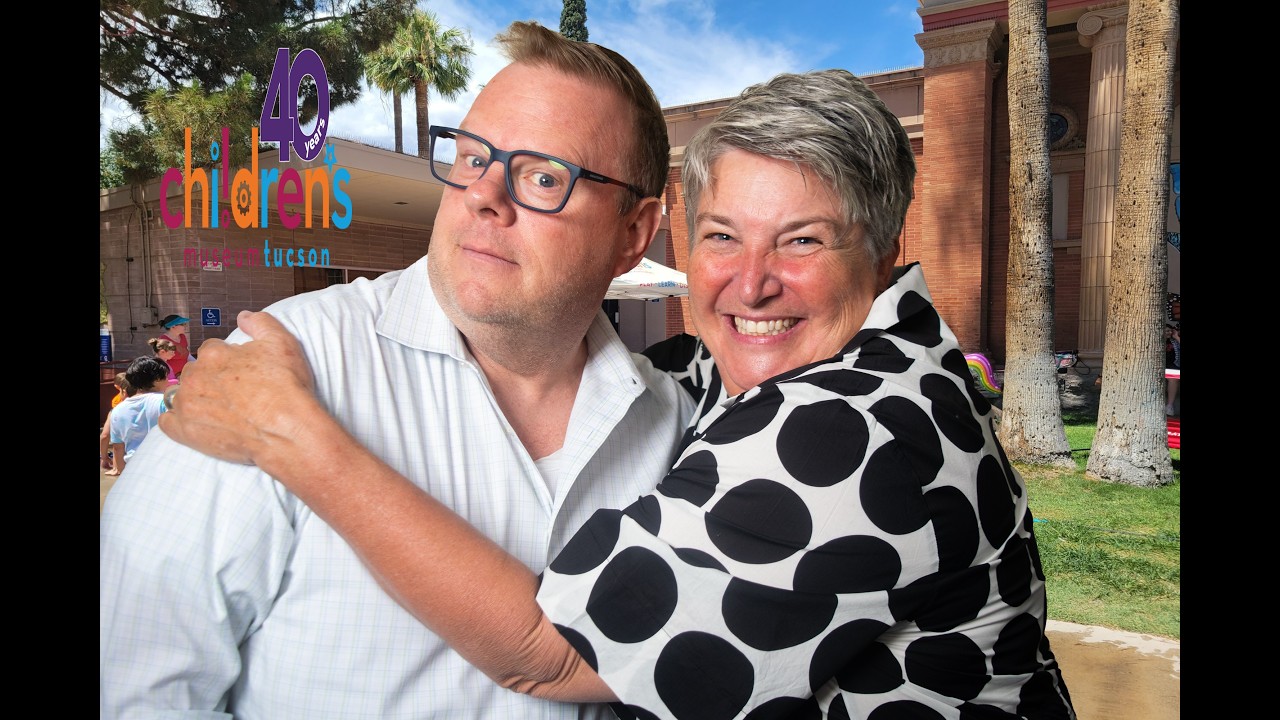
Hilary Van Alsburg on 40 Years of Learning Through Play at Children’s Museum Tucson
Episode Highlights
- 🏛️ 40 Years of Tucson History: Discover how a grassroots effort launched the museum in 1986 and grew into a beloved community institution.
- 🧸 Learning Through Play: Hilary Van Alsburg explains why touching, climbing, creating and experimenting are essential parts of childhood development.
- 🏙️ A Home in Downtown Tucson: Hear how the historic Carnegie Library became the museum’s home—and why remaining in the urban core matters.
- 🌵 Growing Across Tucson: Explore the museum’s expansion into Oro Valley and its creative partnership with Tohono Chul.
- 🏫 Building the Museum’s Next Chapter: Learn how a second downtown building created new space for education, camps, celebrations and community programs.
- 🎟️ Making Play More Accessible: Hear about Discovery Nights, the All Kids Play program and the museum’s efforts to welcome families from across Southern Arizona.
- ✨ The People Behind the Magic: Meet the staff, board members, volunteers and community partners helping Children’s Museum Tucson inspire a new generation.
Episode Description
What happens when children enter a place where “don’t touch” becomes an invitation to climb, create, experiment and explore? At Children’s Museum Tucson, kids are encouraged to follow their curiosity—and, as Executive Director Hilary Van Alsburg explains, that freedom is where meaningful learning begins.
In this episode of Life Along the Streetcar, Tom Heath sits down with Hilary as Children’s Museum Tucson celebrates 40 years of serving Southern Arizona families. Their conversation traces the museum’s journey from a grassroots idea in 1986 to a growing Tucson institution with locations downtown and at Tohono Chul.
Along the way, Hilary shares why play is essential to childhood development, how the museum became part of downtown Tucson’s cultural fabric and why its latest expansion represents a renewed commitment to remaining in the heart of the city.
From a Grassroots Tucson Idea to 40 Years of Community Memories
Children’s Museum Tucson began with a group of determined local women and community organizers who believed Tucson needed a place created especially for children. Evelyn Carswell-Bing, Dorothy Finley, Seale Peterson and many others helped turn that belief into action, launching the organization in 1986 as the Southwest Exploratory Center.
The museum’s name and location evolved during its early years, but its purpose remained remarkably consistent: give children a place where discovery belongs to them. In 1991, the organization moved into the historic Carnegie Library in downtown Tucson, where it has continued to welcome generations of families.
Hilary reflects on what it means to inherit that history while preparing the museum for its next chapter. The anniversary is more than a celebration of longevity. It recognizes the families, educators, donors, volunteers, board members and staff members who have helped make the museum part of Tucson’s shared community memory.
Why Learning Through Play Matters for Tucson’s Children
At the center of the museum’s mission is a simple but powerful idea: play is the work of childhood.
When children walk through the museum’s doors, they quickly recognize that the space was designed for them. They can climb aboard the firetruck, participate in a science experiment, make art, listen to a story or spend hours immersed in imaginative play. Rather than moving through a prescribed itinerary, children are free to take the lead and choose their own adventure.
Hilary explains that these experiences are not separate from learning. Play helps build the curiosity, confidence and foundational skills children need to become lifelong learners. It can introduce them to new ideas, strengthen early literacy and expose them to careers and possibilities they may not have encountered before.
That child-led approach can also require adults to slow down and see the museum differently. A caregiver may be ready to move into the next gallery while a child remains completely absorbed in one activity. Sometimes the most valuable thing an adult can do is allow that curiosity to continue.
Through hands-on exhibits, story times, art projects, science activities, camps, field trips and community programs, the museum creates many different entry points for discovery. Initiatives such as free Thursday Discovery Nights and reduced admission through the All Kids Play program also help more Tucson families experience the museum for themselves.
Growing Across Tucson While Keeping Downtown at the Heart
As the museum’s audience and programming grew, so did the need for additional space. Children’s Museum Oro Valley opened in 2015 and later found a new home at Tohono Chul, where families can experience both a children’s museum and one of Tucson’s distinctive desert gardens. Hilary describes the collaboration as an example of what can happen when two community organizations find a creative way to support one another.
Downtown, growth presented a more difficult question. The museum had outgrown the administrative and educational capacity of the Carnegie Library. Leaders had to consider whether the organization could remain in the urban core or would need to find a larger home somewhere else.
The answer appeared just beyond the museum’s back door.
In 2023, Children’s Museum Tucson purchased a nearby 13,000-square-foot building originally constructed as the Davis Clinic in 1928. The property allowed the organization to expand without abandoning the downtown neighborhood that had shaped its identity. Its upper floor now provides administrative space, while a $1 million grant from Angel Charity for Children helped transform the lower level into three dedicated education and community spaces.
Those rooms now accommodate field trips, birthday parties, school-break camps, summer programs and collaborations with community partners. A solar installation in the neighboring parking area, supported through a grant from the Community Foundation for Southern Arizona and Tucson Electric Power, helps reduce operating costs so more resources can return to the museum’s mission.
Behind that work is a team Hilary calls the museum’s “magic”: 43 staff members, a dedicated board and community volunteers working to reach families throughout Southern Arizona. Their shared goal is to ensure that children from every part of the community recognize that this is their museum.
Children’s Museum Tucson’s first 40 years demonstrate what can grow from a grassroots idea when a community is willing to nurture it. Its next chapter is taking shape through new spaces, stronger partnerships and an enduring commitment to downtown Tucson—but the heart of the work remains the same: giving children the freedom to play, discover and imagine what might be possible.
Listen to the full conversation with Hilary Van Alsburg to learn more about the museum’s history, the importance of learning through play and the people building its future. Then plan a visit, explore its programs, consider volunteering or supporting its work, and share this episode with someone who believes in creating a more curious and connected Tucson.
Subscribe to Life Along the Streetcar for more conversations with the people shaping Tucson’s urban core, from Sentinel Peak and the Mercado to downtown, Fourth Avenue and the University of Arizona.
Transcript & Show Notes
This transcript has been edited for clarity and readability. Timecodes, filler words, repeated phrases, and minor false starts have been removed, while the substance, sequence, tone, and meaning of the conversation have been preserved.
Welcome to Life Along the Streetcar
Tom Heath: Welcome back to another episode of Life Along the Streetcar, where we focus on the social, cultural, and economic impacts happening in Tucson’s urban core. We define that area as stretching from the west side at A Mountain and the Mercado to the University of Arizona, roughly following the path of our modern streetcar.
My name is Tom Heath, and I’m happy to be your host. I’ve been doing this for quite a while, and I’m always excited when people take the time to share their stories, their visions, and the impact they’re making in our community.
Today’s guest is someone who is really going to blow our socks off. Hilary Van Alsburg, you have been a dynamo in our community, and I’m excited that you took a few minutes to join us.
Hilary Van Alsburg: Tom, it’s always nice to talk with you. Thank you for including me.
Tom: Absolutely. You are currently with this little organization called Children’s Museum Tucson?
Hilary: Yes, Children’s Museum Tucson | Oro Valley. We have two locations.
Tom: If you’re not really paying attention, you are slowly taking over this entire community. You’ve got Oro Valley, Tohono Chul, the new building—and you’ve stolen the sun from an entire neighborhood so you can fuel it.
Hilary: We’re excited about our solar installation. That was a great grant to receive, and we’re thrilled about it.
Tom: We’ll get into all of that. We’ve talked before, but it has been a while. I think the last time was just after you had started, when you were getting your feet wet. You came to the Children’s Museum by way of the university.
Hilary: Yes, I was at the University of Arizona Libraries.
Tom: Was that in 2010?
Hilary: I came back to the Children’s Museum as executive director in 2019.
Tom: That’s right—you had been with the museum previously?
Hilary: Yes. I had previously worked at the Children’s Museum in two different capacities: director of philanthropy and learning, and before that, director of development.
Tom: Just when you think you’re out, they pull you back in. Now you’re the head honcho—the executive director—and the one taking responsibility for all this amazing work. But I know you’re surrounded by a great team.
Hilary: I have a great team. You’re right.
Celebrating 40 Years in Downtown Tucson
Tom: The story starts with the downtown location. That’s the flagship in the old library. It’s a small space, right?
Hilary: Well, no—the space is amazing. We’re celebrating our 40th anniversary, and we’re located in the historic Carnegie Library right in the heart of downtown. We’ve been in that building since 1991, so we’ve had a good run downtown. Things have been very positive, and there is so much growth going on. It’s exciting to be at the 40-year mark.
Tom: We previously did a show with someone who had written a biography and done a lot of research on Cele Peterson. She was very instrumental in starting the first iteration of the Children’s Museum. Is that what marks the 40th anniversary?
Hilary: We started in 1986. It took a grassroots movement of really dedicated women and organizers who said, “We need a children’s museum.” Evelyn Carswell-Bing, Dorothy Finley, Cele Peterson, and many others got together and asked, “How are we going to make this happen?”
We started in a different location with a different name, and then things evolved over the first five years.
Tom: What was the original name?
Hilary: We started as the Southwest Children’s Exploratory Center. Then it became Tucson Children’s Museum, and many years later, we changed it to Children’s Museum Tucson.
Tom: There are now many other children’s museums across the country.
Hilary: Many, many.
Tom: Was this a trend in 1986, or was Tucson one of the first?
Hilary: No. I think Brooklyn was the first, followed by Boston Children’s Museum, and they’re over 100 years old. Every midsize or larger community has at least one children’s museum.
Tom: Why?
Hilary: Because they’re amazing. I’m actually on the board of the Association of Children’s Museums.
Tom: Of course you are. You had eight minutes to spare, so why not?
Hilary: It’s so beneficial and exciting to see what other museums are doing. I get to travel around the country, see their innovations, and learn how they’re responding to and benefiting their communities. We learn from one another. It’s a very collaborative industry.
Why Play Is the Work of Childhood
Tom: I can imagine. Not to get too far off track, but in the past, when I’ve tried to get things like financial literacy into schools, I’ve found that when you can convince kids they’re playing and not actually learning, they learn a lot more.
Hilary: Yes. That is our entire mission. Play is the work of childhood. If you think about it, it is workforce development. It is the groundwork children need from the earliest stages of childhood education—the foundation they need to become lifelong learners, do well in school, get excited about future careers, and envision themselves pursuing careers they may not otherwise have encountered. That starts at a very young age.
Tom: If someone hasn’t been to the museum before, walk us through what the experience is like.
Hilary: During the summer, the downtown Children’s Museum is open every day. During the school year, we’re open six days a week and closed on Mondays. You can come for a few hours a couple of times a week or a couple of times a month. You can come for five hours and have the best experience.
We find that children lead the way. This is a place built for them. It’s about them, and they know it. They walk through the front door and realize, “I can touch everything. I can climb on things. I can take part in whatever activity is happening. It’s led by me and for me.”
Parents or caregivers will sometimes say, “Okay, let’s go to another room.” But their child may want to stay in the firetruck for three hours. That’s their imaginative play, and you have to let them take you where they want to be.
Tom: That ability to touch is important. Almost everywhere we go, it’s “Don’t touch that.” Here, it’s “Touch that.”
Hilary: Come in and do whatever you want to do.
Tom: You can see the excitement, especially when it’s someone’s first time. There’s this realization: “What do you mean I can touch things? What do you mean I can climb on this?”
Hilary: Children intuitively know. They come in, and if there’s a science experiment happening, they go to the front because they want to see what’s going on. We have literacy activities, story time, and art projects. There are all kinds of ways for children to decide their own adventure and choose which activity they want to do based on how they’re feeling that day.
Tom: And they’re learning along the way—just don’t tell them they’re learning.
Children’s Museum Oro Valley Finds a Home at Tohono Chul
Tom: When did the Oro Valley location open?
Hilary: We opened in 2015. The Town of Oro Valley and the mayor at the time invited us to open a freestanding children’s museum on Oracle Road. It was a great success, and we loved it.
In 2022, our lease was coming due and the rent was going up significantly, so we were at a crossroads. We had been partnering with Tohono Chul to offer activities at the park and get more families and children excited about being in that gorgeous space.
Tohono Chul had a new executive director at the time, and she and I had been talking about different things we could do. They had a space, and we needed to move. It was a magical combination. We opened at Tohono Chul in January 2023.
Tom: The partnership with Tohono Chul has really blossomed over the years.
Hilary: It’s amazing. It’s a great example of how community partners can come together and creatively develop something that benefits both organizations and the whole community.
Tom: It’s definitely a win in so many ways. You’ve brought a lot of attention to them, and being associated with such a recognizable name has also helped the museum.
Hilary: Tohono Chul is a world-class garden. It’s a beautiful oasis in the middle of our community, with a strong history and mission of its own. We’re pleased to be part of that collaboration and to bring both experiences to families who may never have visited either Children’s Museum Oro Valley or Tohono Chul. We like to say you get to do both things.
Tom: Absolutely.
Expanding Without Leaving the Heart of Downtown
Tom: Now you’ve purchased another building downtown.
Hilary: We did.
Tom: You decided you were going to take over the entire downtown area. Was it formerly the Udall Foundation building?
Hilary: It had been the Udall Foundation building. It was originally built in 1928 as the Davis Clinic, and it has been many different things. The Convention and Visitors Bureau was there as well.
Tom: When was the Carnegie Library built?
Hilary: In 1901. We bought the other building in 2023 after reaching another crossroads. We realized we had outgrown our space at the Carnegie Library. It’s a beautiful historic building, but there wasn’t enough room to accommodate our audience growth, bring on more staff, expand, and do the things we wanted to do.
We reached a pivotal moment: Were we going to leave downtown and find a bigger space elsewhere, or were we going to find a way to stay downtown? Then this building came onto the market.
Tom: It’s literally outside your back door.
Hilary: It is. It’s kitty-corner to the northwest of the current downtown Children’s Museum. It was a Twilight Zone moment. We said, “Oh, would that work?” and called the broker that day.
We had already completed the economic and feasibility studies, so we knew how much space we needed to grow and feasibly serve the community for the next 40 years. This building gave us the perfect way to remain in our beautiful location in the heart of downtown. Finding a way to stay downtown was really important to us, and it magically came together.
Tom: Is it museum space or staff space?
Hilary: It’s both. The building is 13,000 square feet, so it’s quite large. The Carnegie Library we occupy is 17,000 square feet.
Tom: I thought the new building was much smaller, but it’s not.
Hilary: It’s two stories. The upstairs houses our administration. We received a grant from Angel Charity for Children—the largest grant they had ever awarded. They gave us $1 million, which we used to renovate the downstairs and create three large, beautiful education spaces.
The project took about two years. We worked with Swaim Associates Architects and Sundt Construction, and they were great partners. We were very clear from the beginning: Our day job is running a children’s museum, so we would need support figuring out how to make the space what we needed it to be.
Now we have three gorgeous program spaces. We use them for field trips, birthday parties, summer camps, and fall, spring, and rodeo-break camps, along with many other activities.
It’s also a wonderful community space. Partners can come in and use it—TENWEST did a takeover last year. It’s within walking distance of the Children’s Museum, so groups can begin in a dedicated space without competing with the draw and joy of the museum. Then they can walk across and experience both facilities.
Tom: That’s fantastic. And you got a parking lot.
Hilary: Yes.
Tom: Oh my gosh.
Hilary: A parking lot with solar. Isn’t that great?
Turning Tucson Sunshine Into Community Support
Tom: The solar installation seemed to go up fairly recently. There was a lot of construction on Jackson Street, so I didn’t pay much attention. Then I parked over there and thought, “There’s a lot of shade where there wasn’t shade before.” It looked like the entire parking lot had become a solar panel.
Hilary: It’s actually one side of the parking lot. As you mentioned, dedicated parking for staff is a wonderful thing to have. We applied for and received a grant through the Community Foundation for Southern Arizona with support from Tucson Electric Power, which allowed us to install the solar canopy.
It helps offset our electricity bills, returning that money to other things we can do for the Children’s Museum. And, of course, it’s solar.
Tom: You’re right next to TEP, so they also have a demonstration project they can point to and say, “We helped with that.”
Hilary: Yes. They’ve been a great partner since the beginning.
Slime Smash, Discovery Nights, and Accessible Admission
Tom: Enough of the boring stuff. Let’s talk about the fun stuff. This episode will air in August, and at the end of the month, you’ve got slime.
Hilary: Yes.
Tom: What is slime? Tell me about slime.
Hilary: Slime Smash is part of our downtown experience activation. The idea came to us through the Downtown Tucson Partnership. They wanted to create new summer activities that could bring people downtown in ways they may not have experienced before.
We partnered with the other downtown museums and asked, “What should we do?” Many of us got on board. The Tucson Museum of Art and the Presidio Museum are offering activities on the last Fridays of the summer months, and our event is Slime Smash—all things slimy. If you’re a child, that’s very tantalizing.
Tom: If you’re a child.
Hilary: Or if you’re coming with a child.
Tom: It’s the last Friday, August 28. The details will be on your website. There is an admission cost, correct?
Hilary: Yes. Slime Smash is an elevated evening experience with $12 individual admission. We always have discounted admission available as well. Families who receive SNAP or WIC benefits can use the All Kids Play program for half-price admission.
Every Thursday evening throughout the year, we also offer Discovery Nights with free admission. Families can come experience the museum together, and those have been wonderful evenings.
A Renewed Armory Park and an Evening Just for Adults
Tom: It just occurred to me that Armory Park has now been completely renovated. Do you hold activities in the park?
Hilary: We love the park. It’s wonderful to have a dedicated park space. The Children’s Museum has its own lawn where we hold activities, and the community can use Armory Park for its own activities and events.
It was a major investment, and the city spent a lot of time asking neighbors and park users what they really wanted. The top request was a dog park. People also wanted better lighting, improved accessibility, and a renovated stage.
Tom: It’s really beautiful. It just opened, too.
Hilary: Yes, it just opened.
Tom: One problem for me is that I’m an adult. If you’re an adult, you don’t normally get into the Children’s Museum because it’s for children. How can adults get in for a night or evening of play? Do you ever do anything like that?
Hilary: You teed me up nicely for that one, Tom. We have an event called Evening of Play. It’s always held on the first Saturday in October, so this year it’s October 3.
It’s our version of a gala—and we use that term loosely. You can come in a ball gown, or you can come in jeans and boots. It’s a fun fundraiser supporting the Children’s Museum and all our programs throughout the year.
Adults can have a martini, sit on the police motorcycle, take part in different games and activities, enjoy wonderful food and drinks, and play like a kid again at the Children’s Museum.
Tom: Just remember, the police motorcycle is the one at the Children’s Museum. Do not try to sit on any other police motorcycle.
Hilary: Not with the martini.
Tom: Don’t say, “Hilary said I could.”
Hilary: Just ours, and just one night a year.
Programs, Community Events, and the People Behind the Museum
Tom: Where can people find information about all these programs?
Hilary: For Evening of Play—or everything at the Children’s Museum—the website is ChildrensMuseumTucson.org. We also have a great social media presence and partner throughout the year on different community events.
In November, we’ll hold PBS Kids Day in partnership with Arizona Public Media. It will focus on literacy, include plenty of characters, and celebrate the things children enjoy doing.
Tom: And are your social media handles the same—Children’s Museum Tucson?
Hilary: Yes. You can visit ChildrensMuseumTucson.org and easily find our Instagram, Facebook, and TikTok accounts.
Tom: TikTok, huh?
Hilary: Of course.
Tom: You have a bunch of kids running around there. I wanted to talk more about your staff, but we’re getting low on time. Briefly, how many people make all of this happen between the staff and volunteers?
Hilary: I love that question. Let’s not give the team short shrift. They’re the magic. They’re what makes it happen.
We have 43 people on staff and a dedicated board made up of 20 community volunteers, so it’s a big team. We’re focused on early childhood education and on taking programs into the community to reach families in every corner of our region. We want them to recognize that this is their children’s museum. That’s really our mission.
Tom: You have volunteer opportunities as well, correct?
Hilary: Absolutely. You can easily apply to volunteer at the Children’s Museum through the website.
Community Memories and the Next 40 Years
Tom: This is exciting. I think we sometimes treat children’s play as unimportant, but it’s clear from what you’re doing—and from all the people invested in this work—that play is incredibly important to the long-term growth of a community. You are literally on the ground floor making that happen.
I appreciate everything you and your entire staff are doing. I didn’t realize there were more than 40 people on the team. That’s fantastic.
Hilary: Thank you. It’s truly an honor and a privilege to be part of the community and the memories that generations of families have made at the Children’s Museum.
Tom: Hilary Van Alsburg, I appreciate your time today.
This has been another look at Life Along the Streetcar, where we focus on the social, cultural, and economic impacts in our urban core—and it seems like Children’s Museum Tucson touches all three.
Thank you for taking the time to watch and listen. I also want to thank Ryan Hood for allowing us to use the song “Dillinger Days” in every show, adding a little musical vibe. And, of course, none of this happens without James Portis, our executive producer, who does so much behind the scenes to get these conversations out into the world.
My name is Tom Heath. I’m privileged to be your host. I hope you tune in every Sunday for another episode of Life Along the Streetcar.
Until next time, stay curious, Tucson.