

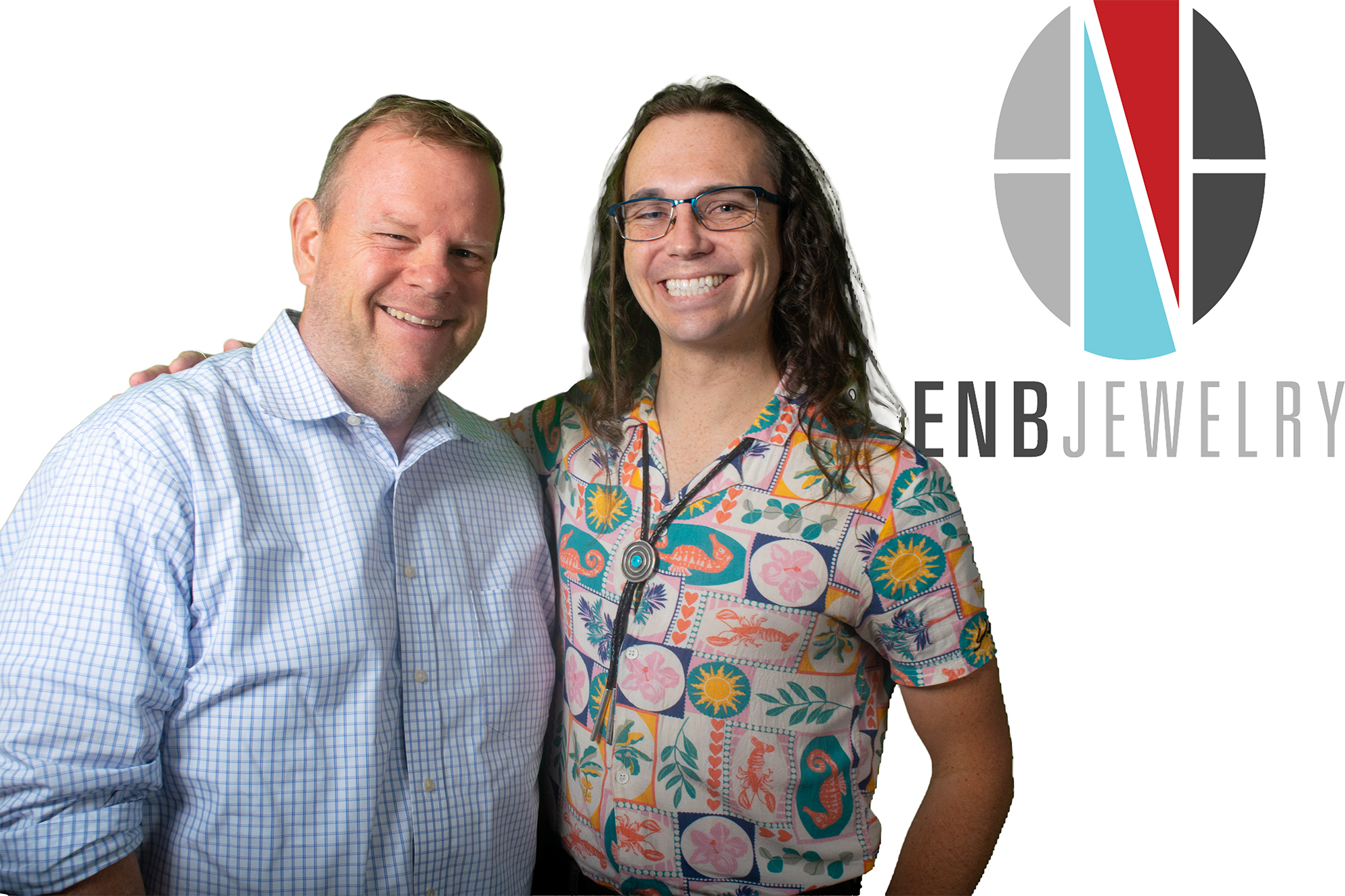
Harmony in Silver – Erik Buckley of ENB Jewelry
Episode Highlights
🔹 Handcrafted from Start to Finish
Erik walks us through his full-circle jewelry-making process — from cutting raw turquoise to final polish — all done by hand in his Tucson studio.
🔹 A High School Art Class That Sparked a Career
Discover how a three-week jewelry segment at Sonoran Science Academy lit the creative fire that still fuels ENB Jewelry today.
🔹 Die-Struck History in Every Piece
Learn how Erik uses 19th-century impression dies and techniques from Potter USA to preserve historic designs and honor vintage artistry.
🔹 Bolo Tie Revival
Erik is on a mission to bring back Arizona’s official neckwear, crafting modern bolo ties with deep Southwestern roots.
🔹 From Gallery Walls to Wearable Art
Sneak peek! Erik’s working on Tucson Gallery-inspired silver landscapes, combining framed artwork and jewelry into unique collectible pieces.
Episode Description
This week on Life Along the Streetcar, we sit down with Erik Buckley, the visionary behind ENB Jewelry, whose handcrafted silver and turquoise pieces embody the artistry and spirit of Tucson’s creative culture. From cutting rough turquoise like a loaf of bread to reviving century-old impression dies, Erik’s work is a living legacy of craftsmanship, heritage, and passion.
🌵 Tucson Roots and an Artistic Legacy
Erik’s journey begins right here in Tucson, where a chance encounter with jewelry-making in a local high school art class lit the creative spark that never faded. His parents, both creatively inclined, his father a poet, his mother a visual artist and former attorney, inspired a life rich in artistic expression.
After experimenting through college and working in a local jewelry supply shop for seven years, Erik took the leap in 2022 to pursue ENB Jewelry full-time. The brand name includes his middle initial “N,” short for “Nakai,” a nod to the Native American flute player R. Carlos Nakai, reflecting a deep appreciation for indigenous music and culture.
🔨 The Craft: From Raw Turquoise to Historic Die Strikes
Erik’s process is an intricate fusion of traditional technique and personal artistry. He starts with raw, baseball-sized chunks of turquoise, slicing and shaping them by hand before setting them in custom silver pieces. Much of his work is done in batches, where each item undergoes multiple stages of cutting, sanding, polishing, and fabrication.
A highlight of his process is die striking, a method that uses 19th-century impression dies to stamp intricate designs into silver. These dies, sourced locally from Potter USA in Tucson, are refurbished antiques that preserve historic jewelry designs from as far back as the mid-1800s. Through this process, Eric is literally pressing history into each one-of-a-kind piece, connecting modern Tucson with artisan traditions from Europe and the American East Coast.
🤠 Bolo Ties, Local Markets & What’s Next
Among his standout creations are bolo ties, Arizona’s official state neckwear. Erik embraces this Southwestern symbol, designing contemporary takes on the bolo that resonate with Tucson’s unique flair. He’s part of a local movement revitalizing this iconic accessory, and he’s proud to share the stage with other local artisans like Spring Winders of Heliotrope.
You can find ENB Jewelry in person at The Tucson Gallery and across seasonal artisan markets, including:
-
Tucson Museum of Art Fall Artisans Market – November 21 weekend
-
Made in Tucson Market – Sunday, November 30
And for those looking ahead, Erik is working on a new collection of Tucson Gallery-inspired silver art, blending framed landscapes and wearable sculpture, a gallery-to-go, if you will.
🎧 Listen, Follow & Celebrate Tucson’s Creative Pulse
Erik Buckley’s story is one of passion, heritage, and the joyful grit of local craftsmanship. Whether you’re a longtime fan of Southwestern art or just discovering Tucson’s artistic heartbeat, this episode is a must-listen.
▶️ Listen now on SoundCloud
📲 Follow us for more Tucson stories: Facebook
🌐 Explore all episodes: lifealongthestreetcar.org
📸 Follow Eric: @enb_jewelry
🎨 Visit The Tucson Gallery: thetucsongallery.com
Transcript (Unedited)
Tom Heath
So welcoming in Erik. Thank you for joining us here today.
Erik Buckley
Thanks so much for having me. So glad to be here.
Tom Heath
I’m excited because I’ve known you for a few years now, but I don’t think I fully understood, like all the things you were doing as we were talking like, oh my gosh, you’re here. You’re like pretty cool.
Erik Buckley
I mean, I, I appreciate that.
Tom Heath
Well, let’s start with some basics here. You, you own a company called ENB jewelry.
Erik Buckley
That’s right.
Tom Heath
And your name is Erik Buckley?
Erik Buckley
Yep.
Tom Heath
What is the end for? What is there? Is there some like Erik the the what was the end?
Erik Buckley
So the end, is my middle initial. It’s, short for or. Sorry. It’s, Nike that’s, named after, a Native AmErikan flute player. My parents, where we’re big fans of his and, and his music, so.
Tom Heath
Okay, well, see, that’s good, because, when you said was your middle name, I was like, oh, that’s boring. But now there’s there’s a backstory to that, too. So are your parents artistic or are they like, a Native AmErikan flute player? Is an interesting sort of, individual name your child after.
Erik Buckley
Yeah, definitely. On the on the unique side. Yeah, they I would say that they are for sure on the, on the artistic side, they both went to, went to school for creative writing or they.
Tom Heath
All right.
Erik Buckley
And, my mom also, has dabbled in different, different visual and, and three dimensional arts. I think she’s thrown some pottery and, and does some painting and stuff, too. Yeah.
Tom Heath
Okay. Which is because what I knew about your mom was she was, she’s recently retired, but she was a, an attorney, right? Yeah. And so I, I don’t always equate attorneys with clay throwers.
Erik Buckley
Yeah. She’s, she’s a pretty well rounded, very good.
Tom Heath
Good with what? And in your dad, what is his artistic outlet?
Erik Buckley
He, is he’s a poet, mostly. That’s that’s sort of been his specialty. A poet and a writer. Yeah. So I, I grew up with both of them as influences, so that was that was pretty great.
Tom Heath
So then E and B jewelry, obviously it’s jewelry and I understand it’s all your stuff. You like make all of your jewelry.
Erik Buckley
Right. Yep. So, you know, these days I do get a little bit of, a little bit of a hand from my wife, Abby. So it’s got a shout out.
Tom Heath
Abby. Yeah. Again, a shout out to Abby.
Erik Buckley
Yeah. She’s the best. So, it’s it’s not me doing 100% of the work on it, but. But it still is almost all me. And. Yeah. So a lot of it is, is turquoise and silver. So it’s, it’s a pretty involved process that starts with, getting, you know, baseball sized chunks of rough turquoise, cutting it all up like, it’s, like it’s a loaf of bread.
Tom Heath
Oh, so you don’t even get the. You do, you do all these do the stones and everything.
Erik Buckley
Oh, top, top to bottom. Tom, I.
Tom Heath
Didn’t realize,
Erik Buckley
Yeah.
Tom Heath
That’s the things I should know after doing it for three years.
Erik Buckley
Hey. That’s okay. Learn. We learn something new every day. I know I’m missing stuff on you work.
Tom Heath
So what was the what was the genesis of this? As were you? Was it rock collecting like gems and minerals, or was it jewelry? Was it like, how do you get into deciding you’re going to start dealing with with steel and rocks and stuff?
Erik Buckley
Tom Heath
So what steel and rocks and stuff. I just made your business out. Really? Really. You got beautiful stuff like stones and rocks anyway. But what got you into all this stuff?
Erik Buckley
So I was I was really, really fortunate enough to, go to a little high school here in town that had an amazing, art teacher. And, so in, in my first year of high school art class, we had about three weeks of instruction on jewelry making, about a week. And a half of it was pewter casting.
Erik Buckley
We carved out and plaster of Paris, and then poured in molten, molten pewter, and then, the next week and a half of it was silver fabrication. So it was, it was the same techniques that I’m using, working every day today. Yeah.
Tom Heath
The local high school here in Tucson. Yeah.
Erik Buckley
It was, it was a little charter school, Sonoran Science Academy up on the northwest side. Okay. Yeah.
Tom Heath
Interesting. So the Sonoran Science Academy gets you involved with the the arts and and then, like, when did it become a career? When did it stop being a hobby?
Erik Buckley
It officially stopped being a hobby. Shoot, it was, probably about three now, probably probably about four years ago. Now. I, it was, a bit of a process getting there. I had it as a hobby through my college, that I ended up figuring out was not for me. And so I really decided to dive in, focus on the art.
Tom Heath
We’re going to be an attorney.
Erik Buckley
You know. Sorry, mom.
Tom Heath
No, I was just wondering, you.
Erik Buckley
Know, I let my two brothers do that. Okay. Yeah. But so I, I had it as a hobby while I was in college. And then I got a job at a little supply shop here in town. Okay, so I was selling silver sheet, silver wires, tools for making jewelry. And, then I had about, seven year stint doing that before I, before I finally decided.
Erik Buckley
All right, let’s let’s give my my craft a fair shot. So I really dove in. That was, if I’m remembering. Right, 2022. Okay. About February or so.
Tom Heath
So, things are going well.
Erik Buckley
Things are going well. This is this is the full time gig now.
Tom Heath
So it’s amazing when you get to talk to someone who’s passion turns into, you know, their livelihood, and then it’s it’s just there’s a nice balance in that. Yeah. And I know this is I’ve heard people ask you this question and I kind of know the answer, but like when you’re looking at some of your jewelry, like how many hours do you put into it?
Tom Heath
I know it’s not. I guess it’s the process. It’s not start to finish like you don’t say, okay, I’m going to make a ring and I’m going to cut off this turquoise and I’m going to sand and I’m going to polish it and then make the silver. You you’re doing stages, right?
Erik Buckley
Yeah. So, you know, being trying to make a business out of this, I’m trying to figure out the, the most efficient ways to do it. And what I’ve found so far is that what works pretty well for me is, doing sort of a batch process. So I’ll do, I’ll take 12 to 20 pieces at a time, whether it’s, whether it’s little turquoise stones that I’m grinding on the, on the grinding wheels, and, and shaping and polishing those.
Erik Buckley
Or if I’m making, making a bunch of rings out of them, I, I usually start with, with, like I said, about 12 to 20 pieces, and, and do each individual step to the whole batch of them before I move on.
Tom Heath
Okay. So then I mean like 12 pieces. What is a timeline on a batch?
Erik Buckley
At the time, yeah, I.
Tom Heath
Know it varies based upon a lot of factors, but just in general, to try to get an idea of the investment of time you have in each one of these pieces.
Erik Buckley
Yeah. So, the timeline on the batch, it can take me if I’m, if I’m really going through it, I can, I can finish it in under a week. Sometimes it’ll take me, take me 2 or 3 weeks.
Tom Heath
Oh, wow. So, I mean, it could be a significant amount of time into.
Erik Buckley
Yeah. Okay. Yeah, absolutely.
Tom Heath
So, so you’re going to say hours and you’re talking about weeks, right?
Erik Buckley
With and you know, that’s that’s big batches. For each individual piece. They I’d say they take me for the really simple ones. I can break some of those out, in under an hour. But most of my pieces, are in the 2 to 4 hour range. Some I have, I’ve topped over 40, I think.
Tom Heath
40 hours on a single piece. Yep.
Erik Buckley
Yep. So it’s, Yeah, really, really an iterative process on on a bunch of them. So I end up having to come back to it and, and make minor adjustments here and there. Yeah.
Tom Heath
So some of the things that I’ve noticed, I mean, there’s some things that obviously stand out to me because you’ve got the rings and the stones, but you’re also and you’re wearing one today if you’re if you’re watching the video. So you make ties, you know, like the bolo ties.
Erik Buckley
I sure do.
Tom Heath
Where does that come from? Like, why what does that.
Erik Buckley
It’s our state. It’s our official state neck neckwear here and here in Arizona.
Tom Heath
Is it official? Yeah.
Erik Buckley
Really? It really is not.
Tom Heath
The things I learned on this show. Yeah.
Erik Buckley
So, I, I really like to, I like to sort of, pay tribute to that, and, it just feels like a really, really hyper local thing. I know that it’s like a general southwestern, sort of, sort of history to it, but, but there’s something about Tucson that that really has just embraced the bolo tie, and, I don’t know, I’m I’m trying to do my best to bring it back to.
Erik Buckley
Yeah.
Tom Heath
Okay. I’m gonna start the bolo tie fashion and restart it.
Erik Buckley
Exactly. I mean, I I’m not even the only one here in town. I’ve got a I’ve got to give do two shout outs to, to folks like spring winders, a heliotrope. She’s, cranking out a bunch of those bolo ties. Okay. But, yeah.
Tom Heath
And it’s a bolo tie revolution here. I just I haven’t quite gotten there. Personally, I think it’s because from from the Midwest, I haven’t fully embraced. It’s only been here 30 some years. I’m quite embraced. Yeah.
Erik Buckley
That’s okay. It it took my dad about that long. So you’re about to for it to,
Tom Heath
Well, if I, if I poet’s going to wear a tie. Shall I do that too? And then your work. It’s it’s mostly silver.
Erik Buckley
Right, right. Yeah.
Tom Heath
Is there a difference of working with silver and other metals, or is that just like, why, why, why haven’t you done other metals? Or do you plan to do other metals or like what’s the differences.
Erik Buckley
So a lot of a lot of metals do work pretty similarly. Some of them have their, you know, minor intricacies, but, generally working with like copper, brass and silver, they, they’re all pretty similar, in terms of how they work. So that part is really nice. I used a bunch of copper and brass while I was learning, but, at the end of the day, copper and brass, when you use it in jewelry ends up turning people green.
Erik Buckley
And that’s not.
Tom Heath
My that’s not a good thing.
Erik Buckley
Yeah, that’s a jam. But.
Tom Heath
I did not know that either.
Erik Buckley
Yeah. And, gold is really beautiful to work with it. It’s super nice and nice and easy even, even nicer than silver. It’s just so darn expensive.
Tom Heath
Got it, got it. So maybe, the next day. So sell a few more Bolo ties, then we can move into the, the gold realm. Yeah, with with the envy.
Erik Buckley
Yeah, exactly. So I save my gold for custom work these days? Yeah.
Tom Heath
One of the things. And again, there’s things that I’m learning off air. But you were sharing with me, this process of of. You’ll have to explain to me again. But you use, like, stamps, like you stamping, and you’re using these molds that are a couple hundred years old.
Erik Buckley
Yeah. So, so this is a die striking process.
Tom Heath
Eye strain. That’s what I was looking for. Yeah. Okay.
Erik Buckley
And and those little stamps, that that I’ve shown you, those are called impression dyes. And those are made using, using original hubs that were that were carved by jewelers, as far back as, like I said, a couple hundred years ago, like mid 1800s, and, those were some of those were in places like Munich, Paris, London, some we had, out on the East Coast in, New York, new Jersey, Rhode Island, where we’re really, sort of our, our centers for it here in the US.
Erik Buckley
And so a lot of the designs that I have, so far came from, early night early to mid 1900s from from the East coast there. And.
Tom Heath
So two questions like, how did you come across this and then how do you like, where do you find this material?
Erik Buckley
So we’re really fortunate enough, here in town to have an incredible shop, called Potter USA. That’s led by Kevin Potter. He is a former jeweler. I mean, current jeweler. But, it’s not his specialty these days. And, he’s also a, toolmaker.
Tom Heath
So I’ll just ask you that. Yeah. Yeah, I’ll just ask you again about the, how you find how you got into it and how you find that stuff. We’ll go back to Mr. Potter story.
Tom Heath
Sorry about.
Tom Heath
The cluster.
Tom Heath
Oh.
Tom Heath
So about that.
Erik Buckley
No, it.
Tom Heath
Was.
Tom Heath
Even worse question. Yep. I’m just going to ask him about the, how how you get involved with it and then how you find those stamps. Good. Yeah. So then how, like, how do you get into this, this type of production and then, like, how do you find materials to, to, to work with that are two, three years old.
Erik Buckley
So we’re really fortunate enough here in town to have local store called Potter USA. And it’s, it’s led by Kevin Potter. He’s a jeweler turned, machine shop owner, toolmaker. He he’s kind of a jack of all trades kind of guy. And so he has been, over the past couple of decades, going around to, retired jewelers or retiring jewelers, and picking up these old tools that otherwise would have been destined for the scrapyard.
Erik Buckley
And he has been, repairing the, the ones that have needed repair, and, started reproducing them into, into these usable dyes to, to give them a new life.
Tom Heath
But these are some of the original dyes that were used for for decades. He’s not recreating them. He’s using he’s collecting and refurbishing these older dyes. So any older, whatever they called.
Erik Buckley
Right. So, so the original positive carvings, are called hubs. Okay. And those were the ones that the jewelers originally carved. And sometimes they were used as a two piece set, with the, with the positive and the negative. Man, sometimes it was, well, these days he’s reproducing them into, into negatives that he that he sells out to, out to other jewelers.
Erik Buckley
And, and then you use a softer material, whether it’s like something like urethane or paper, and you can actually press, just using the negative impression that he that he’s reproducing. You can then use that to, to press the, silver sheet, into that and, and recreate the design.
Tom Heath
And it’s amazing to me. So then the, the stuff that people are walking around with, that maybe a ring that you created as a design that may have been created in new Jersey in the 1900s and, and you’re walking around with it today. Yep. It’s fascinating.
Erik Buckley
Yeah, exactly. So, you know, it’s, it’s jewelry from a generation ago, two generations ago that, otherwise would have been, would have been sort of lost.
Tom Heath
To that without someone like Mr. Potter that wants to preserve that history or someone like yourself that wants to then engage with that. That’s fantastic.
Erik Buckley
Yeah. Yeah, it’s it’s pretty great being, being a part of that, that little jewelry community that’s doing that.
Tom Heath
How do I like, how do people find you? Are you are you Instagramming? Are you Facebooking? Are you taking or talking? Like what? What? Where do people find you?
Erik Buckley
Right now I am neither taking nor talking. Okay, but I am on Instagram. Okay. My my Instagram handle is e n b underscore jewelry.
Tom Heath
Okay.
Erik Buckley
And I also have a website and it’s e and B jewelry.com. But aside from that, yeah, I, I have my space inside the Tucson gallery.
Tom Heath
Yes.
Erik Buckley
And, we also do, we also do pop up markets from time to time to.
Tom Heath
Well, this is the this is the pop up mark market season. So this is going to be airing at the first weekend in November. What do you have like 30 between the in November and the end of the year.
Erik Buckley
So hopefully not 30. Okay. My, my next two coming up are going to be the, Tucson Museum of Art Fall Artisans Market. That’s the, the Friday, Saturday, Sunday weekend of November 21st.
Tom Heath
Okay.
Erik Buckley
And then, the one after that, I believe is going to be, the made in Tucson market. And that, if I’m remembering off the top of my head should be November 30th, last Sunday in November, the the Sunday after Thanksgiving.
Tom Heath
Yeah, I’m in Tucson market. And it’s just really grown in popularity over the years too, with, not and just so many local artisans.
Erik Buckley
Yeah, it’s, it’s become, a really great one that the community shows up for really beautifully.
Tom Heath
So what are the things that you’re your mind probably is always working on something that isn’t ready for public consumption yet. Like what? What what are you what are you working on right now that we’re going to see? In 2026 that, that you’re hoping to unveil to us.
Erik Buckley
So, the, the pieces that I’m currently working on, I just started, in the past couple of weeks are going to be, Tucson gallery inspired.
Tom Heath
Ooh. I’m like more this goes.
Erik Buckley
They’ll be silver picture frames. With my my silver landscapes on the inside.
Tom Heath
Oh, wow. So you’ll have a it’ll be like a, like a display art piece. Yeah.
Erik Buckley
So, I’ll, I’ll probably figure out. I’m hoping to figure out, a way to, have it as either a wall art or, or a piece that you can take out with you.
Tom Heath
This is just just grab something off the shelf. It’s just a whole display, a photo of, of artwork. And just grab one and put on a necklace and head out.
Erik Buckley
Yeah. Exactly. Yeah. So I those, those are pieces that I’m, I’m hoping to have, some fun with.
Tom Heath
Fantastic. Anything, anything coming up that that we haven’t talked about or anything that you feel like we need to get out. Any anything I’m missing about how fabulous your work is?
Erik Buckley
I think you’re pretty good at your job. I, it seems to me like you, like you’ve covered our base is pretty well.
Tom Heath
Well, fantastic. This Erik Buckley, PNB jewelry, part of the the Tucson gallery, but also find them in markets. Throughout the, throughout the holiday season here. And, be on the lookout for some some new items for Mr. Buckley. I’m excited about.
Erik Buckley
That. Thanks, Tom. Really appreciate it.
Tom Heath
Well.
Tom Heath
Our guest today on life on the Street car is Erik Buckley. He’s the owner of PNB jewelry. Can find him inside the Tucson gallery. And I’m going to find out some other places as well. The original interview aired on Downtown Radio 99.1 FM, as it does every Sunday at 11 a.m., and then it’s rebroadcast with potentially a few a few more insights here on the, the lifelong The Street Car podcast.
Tom Heath
So sit in and relax and enjoy the conversation with Erik.
Tom Heath
Our guest today has been Erik Buckley of Envy Jewelry. Always fascinated have local artists in on life along the street car we’re excited to share his story and kind of looking forward to where the future goes. If you want more information on Erik or any of the other guests we’ve had on life on the Street car, head over to our website.
Tom Heath
Life along the Street Car, Dawg. And, you’ll find past episodes with audio video. There’s a contact button there, information on our book. We’re also very active on Instagram and Facebook under, Tucson. Life along the street car. I was going to give you my other my other handle there, but life along the street car or Spotify, the SoundCloud, all the audio platforms as well.
Tom Heath
I appreciate your time today. Hopefully tune in next week for another episode of Lifelong Street Car. And until then, stay curious to Tucson.