
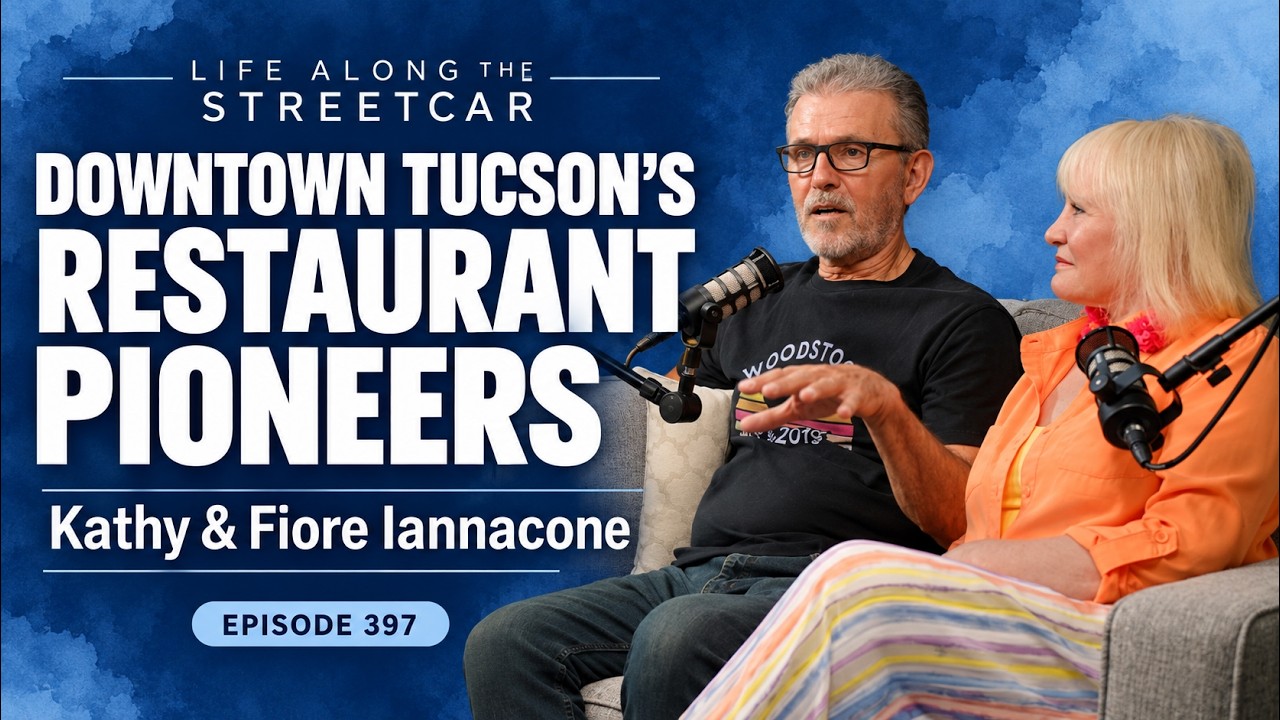
Downtown Tucson Restaurant Pioneers: Kathy and Fiore Iannacone
Episode Highlights
- 🎙️ Kathy and Fiore Iannacone discuss more than 30 years in Tucson’s food business and their commitment to downtown.
- 📍 Old Pueblo Eatery on Congress was their first downtown restaurant, followed by Italian Kitchen in the adjacent former Fox Theater ticket-booth space.
- 📝 Fiore traces his start in the pizza business to a bicycle ride near Park Avenue and 6th Street, where the smell of pizza led him to The Pizza Pub.
- 🚋 Cafe Renaissance combined scratch-made food, espresso, cappuccino, rotating art, and music videos in downtown Tucson beginning in 1994.
- 📍 The couple recall Via Piatra, Enoteca, and the challenge of introducing evening dining and live music before downtown had a larger nighttime crowd.
- 📝 Kathy worked with Molly McCaslin on revisions to the downtown A-frame sign code and helped organize business owners through the Downtown Business Association.
- 🎙️ Kathy explains how her study of nutrition and a personal health journey led to Urban Fresh, designed around plant-based food and nutrition education.
- 📍 Urban Fresh continues under Dana and Chauncey, with the original concept and recipes still informing its menu, juices, and smoothies.
Episode Description
Downtown Tucson’s restaurant story includes people who opened their doors when the surrounding blocks were far quieter than they are today. Kathy and Fiore Iannacone join Tom Heath to look back on a run of downtown ventures shaped by Italian food, homemade cooking, coffee, art, music, and a willingness to keep trying new ideas.
Their conversation moves beyond a list of restaurant names. It considers what it meant to invest in the urban core during years of change, work alongside other business owners, and build places that invited people to linger over a meal or discover something unfamiliar. From Old Pueblo Eatery to Urban Fresh, the Iannacones’ experiences trace a practical, personal side of downtown Tucson’s evolution.
Choosing Downtown Tucson When the Momentum Was Elsewhere
Fiore and Kathy Iannacone came west from New York after Fiore had spent time at Cochise College in Douglas and made weekend trips to Tucson. They were drawn by the mountains, blue skies, fresh air, and a cost of living that made a new start feel possible. Their shared affection for food eventually became the foundation for decades in the restaurant business, but downtown was a deliberate choice rather than an obvious one.
They describe arriving at a time when people and businesses were moving away from the central city toward shopping centers and malls. In their view, the effects of urban renewal had left downtown with major gaps and without a clear development plan. Still, the prospect of new downtown construction, including One South Church and its planned sister building, gave them reason to believe the area could grow again. They chose to be part of that uncertain future.
Their first downtown restaurant was Old Pueblo Eatery on Congress, a pizzeria that expanded into an adjacent space connected with the Fox Theater ticket booth and became Italian Kitchen. Fiore’s own path into pizza began well before that: bicycling near Park Avenue and 6th Street on the way to the University of Arizona, he caught the scent of pizza from The Pizza Pub. He began delivering pizzas there, became close with the owners, and later had an opportunity to become a minority partner in a restaurant on South 12th Avenue. A passing aroma, in this case, became the start of a profession.
Restaurants Built Around Scratch Cooking and a Social Downtown
Pizza may have opened the door, but the Iannacones wanted their restaurants to be known for more than one item. Kathy describes a commitment to food made from scratch: salads, sandwiches, pastas, specials, desserts, and New York cheesecake prepared with an emphasis on homemade food and good ingredients. That approach followed them as their concepts expanded beyond a pizzeria.
Cafe Renaissance, which opened in 1994, brought espresso, cappuccino, sandwiches, rotating artwork, and music videos to a space that included the back entrance of the Fox Theater. It was part of a wider effort to give downtown diners more reasons to come in, meet up, and stay awhile. Kathy and Fiore recall that the space later changed hands and identities, but its earlier role reflects an era when a coffee drink, local art, and an evening out could feel like a proposal for the kind of downtown they hoped to see.
Their later restaurants included Via Piatra, a regional Italian restaurant in Pioneer Plaza, and Enoteca at Church and Congress. Via Piatra extended into evening dining at a time they felt downtown was not yet ready for much nighttime business. Enoteca arrived closer to a turning point, with a wine bar, dinner service, events connected to Tucson Convention Center Broadway productions, and music at night. The conversation does not present every venture as easy or perfectly timed. Instead, it shows how the couple kept adjusting the menu, setting, and experience while downtown gradually found more of its evening audience.
Making Room for Businesses, Then Reframing Fresh Food
The Iannacones’ work downtown also took them beyond restaurant walls. Fiore recalls that early debates over A-frame signs made it harder for food businesses to advertise from the sidewalk. Kathy worked with Molly McCaslin on rewriting the sign code, helping establish a more uniform approach to these signs. They also encountered early restrictions around sidewalk cafes, another example of how a familiar part of today’s streetscape was still being negotiated.
Recognizing that independent businesses needed to support one another, they helped bring owners together through the Downtown Business Association. Fiore says he was among the founding 50 members of the Downtown Partnership. Their account is grounded in the everyday work of building a district: gathering people, discussing shared needs, making the case for practical changes, and finding ways to bring customers downtown when there was no established network to do it for them.
Urban Fresh marked a different direction in food, rooted in Kathy’s personal experience with health issues after multiple accidents and her subsequent study of nutrition through IIN. She developed the plant-based concept as a place for organic, nutritious options and education, including cooking classes and teaching. The language mattered: they used “plant-based” because they believed “vegan” could discourage people before they tried the food. They also avoided artificial meats, favoring dishes that did not need to imitate something else.
Even a plant-based kitchen met an unexpected downtown obstacle. The city required a grease trap, and the Iannacones had to install one despite explaining that the food did not involve meat or cheese; avocado was identified as a fat requiring the equipment. After they sold Urban Fresh, Dana and Chauncey continued operating it. Kathy notes that original recipes, juices, smoothies, and the underlying menu concept remain part of its identity. Both guests speak warmly of seeing that vision carried forward.
Conclusion
Kathy and Fiore Iannacone’s downtown experience is a reminder that Tucson’s changing streets have been shaped not only by buildings and plans, but also by people willing to cook, organize, adapt, and keep showing up. Listen to this episode of Life Along the Streetcar for their recollections of restaurant life, civic persistence, and the community connections behind a changing downtown.
Transcript & Show Notes
Editorial note: This conversation has been lightly edited for clarity while preserving its substantive content and original sequence.
Welcome to the Downtown Culinary Conversation
Welcome back to another episode of Life Along the Streetcar, where each week we sit down with movers and shakers in Tucson's urban core, uncovering hidden gems and talking about social, cultural, and economic developments that impact the Tucson area from A Mountain to the University of Arizona. My name is Tom Heath, and I am your host. Today, we've got a cross-section of culture, culinary, and pioneers. We've got some legends in the studio today with Fiore and Kathy Iannacone. Am I saying that right?
Yes.
Excellent. I practiced. Welcome in.
Thank you for having us.
Enrique was sharing a little bit about your background. I knew some of the restaurants you were involved with, but I didn't realize they were all yours. Good heavens, you guys are connected in the culinary world. Why?
Thirty years plus. We love food. Obviously, we're Italian, and most of the restaurants were Italian restaurants.
Except for the last one, which was a vegan restaurant, Urban Fresh, which is still in operation. We love the food business, we love interacting with people, and most of all, we love downtown. Four of our seven restaurants were on Congress; one was on Church, one was on Sixth Avenue, Pioneer; one was on Stone; and one was on North Stone in Pioneer Plaza, called Via Piatra, a regional Italian restaurant. That was 1988.
But that wasn't your first. What was your first restaurant?
Our first one was O Pueblo Eatery, and that was on Congress. Then we expanded into the space next door, which was actually the ticket booth for the Fox Theater, and that became Italian Kitchen.
This is in the early '80s. What possessed you to say a nice Italian restaurant in this environment was going to do well?
It was a pizzeria that we started out with, the O Pueblo Eatery. I grew up in New York, and I lived at a pizzeria, so I loved pizza. We decided we wanted to be part of the revitalization, even though everybody was leaving downtown at the time.
Urban renewal wiped out hundreds of homes downtown, and it was a big mistake for the cities that took the federal money. There wasn't really a master plan for development in Tucson at the time, so things were happening out east. People were moving from downtown into shopping centers and through malls, and we were coming as they were going. But we heard about the Twin Towers they were building downtown, so we were there right as they were starting to build those. We were really excited, and we thought that was going to be the beginning.
One South Church, and the pad, which is now Rendezvous, designed to be a sister building to that. A few floors and a lunch crowd might help.
It took a lot longer than that, actually, but we just kept wanting to be there, be a part of it, and experience what was going to happen downtown.
From New York to Tucson
Are you from Tucson?
We are both from New York. We grew up together, since we were very young. We've been married 52 years, and we've been together since we were 15. We have seven grandchildren and two great-grandchildren, and we're blessed.
What possessed you to leave New York and come to Tucson?
Go West, young man. Manifest destiny. I had an aunt who lived here, and we heard these stories about blue skies and mountains and fresh air. I went to Cochise College in Douglas originally, and I would come up on weekends. I fell in love with Tucson and convinced my bride-to-be to come with us. The cost of living was much better here.
Was it a hard decision?
Not at all. Easy. It was a completely different lifestyle and a different pace, but we were young. In New York, it was so expensive to even get an apartment. We were adventuresome. We wanted to go west, and we never left.
What led you to the pizzeria?
I actually stumbled into it. I was bicycling from Park Avenue to the U of A, where I was going to college at that time. At Sixth Street and Park Avenue, I smelled a slice of pizza. I immediately made the right turn, and there was a restaurant called The Pizza Pub, 1012 East Sixth Street.
I'll never forget it because I started working there a week later, delivering pizzas for $1.35 an hour. Then I became friends with the owners, and we had the opportunity to become partners in one of the new restaurants on South 12th Avenue and Drexel. I was a minority partner, and that's how I got involved in the business.
I've talked to a few people heavily involved in Tucson's culinary scene with very similar stories. They found a connection with an owner of a smaller business, grew with them, and then moved on to something different. The name that rings the most bells for me was Anoteca.
Yes, that was also on Congress, 58 West Congress, at Church and Congress. We relinquished our interest in the ticket booth so they could have a successful remodel of the Fox. They needed more space. Before Anoteca, we had Cafe Renaissance, which was like the first espresso, cappuccino, and sandwiches.
He talks about pizza, which was his passion, but I was the other part of it. Everything was homemade from scratch: salads, sandwiches, pastas, specials, great desserts. Everything was made from scratch, homemade, with the best ingredients. New York cheesecake.
Expanding the Downtown Restaurant Experience
We didn't want to be known for just pizza. It was everything combined. Every restaurant that we did, we expanded a little bit more from that. Eventually, we did Anoteca with a wine bar and dinners. Before that, we did Via Piatra, which we extended into the nighttime business. It was a little too early for nighttime business downtown.
With Anoteca, we were right on the cusp of things happening downtown, still a little too ahead, but we engaged with the Tucson Convention Center when they were doing Broadway plays and hosted events for them. We had music at night before anybody else was really doing music down there. We did a little bit of everything.
The first restaurants were in the late '80s and early '90s, but Anoteca was in the 2000s. You were bringing things to an area with a different cultural flair than what we were experiencing at the time.
Cafe Renaissance was 1994. We were big into music videos, so we had music videos going all the time, and revolving artwork. It was a very nice space.
It was the back entrance to the Fox Theater that we leased as part of the space. They let us use that, and it worked out really well. It is still there. It ultimately became Perche' No, which is there now. Part of that was Cafe Milano. We started the original space with Cafe Renaissance. The other restaurants that followed remodeled that and did different things.
You look back and see all these great iterations, but you mentioned being a little early on some of these. That has to be tough, to know you've got a great idea but the city just isn't quite ready.
One of the problems we had early on was A-frames. You would advertise your wares on the sidewalk, and with food it was very popular in New York to do that. Tucson was not ready. They wanted to start licensing the A-frames. They didn't like the size, the shape, or the color. Kathy got involved with Molly McCaslin, and they rewrote the sign code. It was approved shortly thereafter, and we had a uniform way to advertise our food wares on A-frames downtown.
You were part of the standardization of that. It really did help with business.
Building Support for Downtown Businesses
I think it also helped other businesses get an A-frame so they did not have to go through a variety of checklists. They knew the size and the requirements.
Sidewalk cafes were a thing of the future for Tucson, and they didn't like that idea. They started licensing restaurant owners to use the sidewalk, which generated revenue and helped to create jobs. You would think they would want to give us the space, which was public right-of-way.
That is about being too early. You have the vision, and it is not quite right because what you're describing now would be perfect fits for Tucson. They're probably having success because of your early attempts and putting forth the pattern and the process.
We also realized early on that it would help to rally the troops downtown and get other business owners involved. We formed the Downtown Business Association back then and got all the business owners to gather, meet, and talk about how we could all help each other. We needed help getting the word out and figuring out how to get people downtown. Downtown Tucson Partnership was not there. We were just on our own trying to figure it out.
And it was a tough time because, as you talked about, urban renewal wiped away a lot of the core history and culture.
I was one of the founding 50 members of the Downtown Partnership, and then we moved on from there.
Pioneers. This is amazing. We have the Italian background and restaurants, coffee and sandwiches. Tell me about Urban Fresh, because this was a different concept altogether.
It was kind of a personal journey because I had multiple accidents and was dealing with a health issue. I went back to school and studied nutrition at IIN, Integrative Nutrition. After I graduated, I wanted to give back. We developed Urban Fresh as a portal to teach about nutrition, make everything organic and healthy, and put out better options. I hosted cooking classes and taught at City High and in other settings.
How long did you operate that?
Three or four years. We started with two other people who fell out right away, and then my daughter was involved with me until she moved away.
Urban Fresh and Plant-Based Education
Was vegan a core concept of this as well, not just fresh and organic?
Plant-based. We liked to use the term plant-based back then because vegan scared a lot of people. It was totally vegan, but we just didn't say that out loud. We didn't use artificial meats and things like that, which a lot of people were not aware of.
I have found that I enjoy a plant-based meal more when it is celebrated, not when it tries to mask something else. It is just a really good meal and does not have to mimic something else. Urban Fresh is still happening, and Dana and Chauncey took it over from you. They are still operating very much in the same concept and presenting a very healthy environment to our community.
They're carrying on Cathy's brainchild. It is still the original recipes on their menu, the juices, and the smoothies. I know they do specials, but the original concept is still there.
We commend them for carrying on Cathy's dream.
It seems like the perfect fit. They are carrying on that vision in a way that is their own and moving it forward. Fitting that space and that concept in that space was a real challenge, though.
One of the things the city always required for all new restaurants was a grease trap. When we started Urban Fresh, I tried to explain to the city that there was no grease involved. There were no meats or cheeses. They said, 'No, no, you have avocado, which is a fat.' I said, 'Yeah, but there's no grease.' No way. We had to do a grease trap. We dug out the floor in that little kitchen and put this monstrosity under the floor.
The trials and tribulations.
We wanted to change the county's thought process on this, and we were close to bringing it to the board to explain whole-food, plant-based food, but we didn't make it that far. We sold out to Chauncey and his lovely wife, and the rest is history. It is still a fantastic place downtown for a very healthy, plant-based, all-organic, educational-based meal.
Continuing to Serve Downtown Tucson
What is going on now? Are you running anything? Is there some big announcement about a new location?
I spent 12 years as a board member for the Food Conspiracy Cooperative. I just retired a few years ago, so I'm helping Kathy with all her ventures downtown. The unofficial ambassador to downtown is Kathy, my wife. She puts people together. She's amazing.
Connector. So, Kathy, what are you ambassadoring?
I'm hoping to do whatever I can to help people downtown, like Mr. Bing Productions. I'm very excited for what he's doing and what he is putting together downtown. Any time I can fill a niche, I'm willing to put myself out there to do it. I was recently asked to be on the board of Humanity 360, which is going to launch this month, I believe, or in September. We're doing the first fundraiser at the Don Martini Club, right across the street from Hotel Congress, on September 17th. I'm excited about that because that's what we need now for our youth in schools.
There is definitely a trend here of not just wonderful and wholesome food, but the need to educate and the desire to help other people understand their choices and make better choices. It seems like it has been a big part of your life, and you cannot let that go.
Right.
I'm still willing, if there's a need, to go in and teach about that. I'm always happy to do it, so my door is open.
I was going to ask some of your opinions of existing restaurants in downtown, but we are tight on time. How do people follow you? Are you on social media? Can they keep track of what you are doing? I had trouble finding you.
That is not something I really do. I'm not on social media, but I am at a lot of places, I guess.
We'll try to track you down through some of the organizations you're involved with. I really appreciate your time today, and everything you've done for Tucson. We need to get you back and dig more deeply. You're an icon and a foundation for so many things that we take for granted, like the Downtown Tucson Partnership, the sign code, and other things you were instrumental in creating.
Thank you for saying that.
Fiore and Kathy, I greatly appreciate your time. I appreciate those of you who have chosen to watch here today. We are Life Along the Streetcar. Each and every week, we share things happening in the urban core from a cultural, social, and economic standpoint.
We are always honored to have the music of Ryan Hood to open and close our show. We can't do this without James Portis, our executive producer, and apparently I can't do this without Enrique Aldana, who is becoming our associate producer. My name is Tom Heath. I'm your host. I hope you like, subscribe, and share. If there is anything you would like us to be covering, throw it in the comments, and we'll be glad to reach out. Tune in every Sunday for more Life Along the Streetcar. Until next time, stay curious, Tucson.