

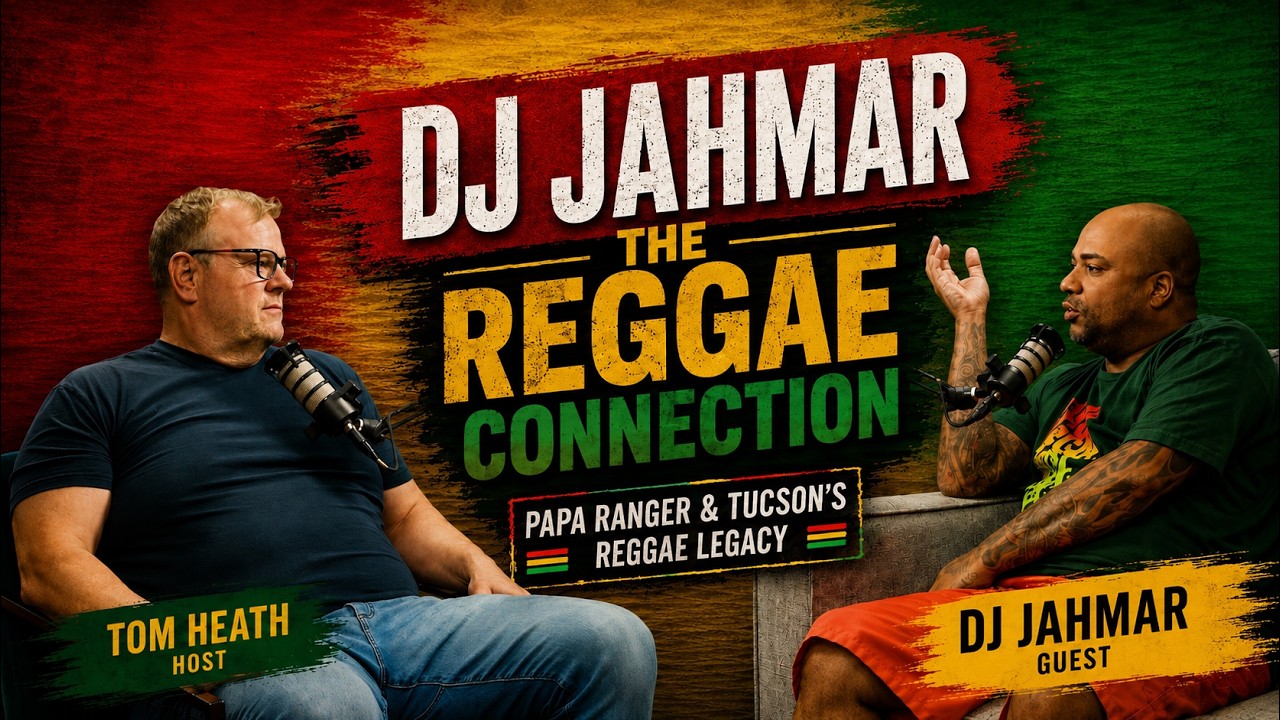
DJ Jahmar | The Reggae Connection, Papa Ranger & Tucson’s Reggae Legacy
Episode Highlights
- 🎶 Tucson’s Reggae Roots: DJ Jahmar shares how his father, Dennis Francis, better known as Papa Ranger, helped build a reggae community in Tucson.
- 🏪 The 12 Tribes Reggae Shop: Discover how the family’s shop became a gathering place for records, performances, food, culture, and visiting reggae artists.
- 🎤 Papa Ranger’s Lasting Influence: Jahmar reflects on his father’s work as a DJ, promoter, mentor, and father figure to generations of Tucson reggae fans.
- 🎨 A Legacy Honored in Public Art: Hear the emotional story behind the Papa Ranger mural at Corbett’s on Fifth Avenue and its connection to the family’s former home.
- 🎧 Finding His Own Path as a DJ: Jahmar explains how filling in for his father as a teenager led him from dreams of becoming a rapper to a thriving DJ career.
- 🔊 Reggae, Hip Hop, and Sound System Culture: Explore the musical and cultural connections between Jamaican toasting, sound systems, emceeing, and the development of hip hop.
- 📻 The Return of The Reggae Connection: Learn why Jahmar revived the radio program he once hosted with his father and how he is introducing a new audience to reggae’s many branches.
- 🌵 Keeping Arizona’s Reggae Culture Alive: Jahmar discusses supporting local artists, sharing the music he grew up with, and carrying Tucson’s reggae legacy into the future.
Episode Description
Reggae in Tucson is more than a familiar rhythm from a radio, club, or neighborhood gathering. For DJ Jahmar, it is family history, cultural inheritance, and a living connection to the people who helped the music take root in the desert.
In this episode of Life Along the Streetcar, Tom Heath sits down with Jahmar to trace that story from his father’s arrival in Arizona to the return of The Reggae Connection on Downtown Radio Tucson. At the center is Dennis Francis, better known as Papa Ranger, a Kingston-born DJ, promoter, shop owner, and community figure whose influence reached across Tucson’s music scene.
Jahmar shares how he grew up inside that world, found his own path behind the turntables, and came to see carrying the music forward as both a personal responsibility and a source of pride.
Papa Ranger, 12 Tribes, and the Roots of Tucson’s Reggae Community
Jahmar describes his father as Arizona’s first reggae DJ. Born in Kingston, Jamaica, in Trench Town, Papa Ranger came to Tucson by way of Detroit in the 1980s and recognized that reggae had an audience here. Jahmar remembers his father being moved by the connection Native American listeners felt with the music and its messages of struggle, resistance, unity, and hope.
That connection helped inspire Papa Ranger to open a reggae shop. The family’s first location was on Stone Avenue, followed by a move to 1133 East Sixth Street near the University of Arizona. The 12 Tribes Reggae Shop sold records, shirts, posters, stickers, and other pieces of reggae culture. It was part of a multicultural plaza that included Pizza City, Salam Market, a print shop, and other local businesses.
More than a store, 12 Tribes became a gathering place. Papa Ranger operated his sound system, brought major performers such as Jimmy Cliff and Burning Spear to Tucson, and welcomed touring artists into the shop. The space could become an informal venue for music, food, and conversation.
His nickname evolved from Ranger to Papa Ranger because he became a father figure to young people from many backgrounds who found a home in reggae culture. That connection is now honored through the Papa Ranger mural at Corbett’s on Fifth Avenue, where the family once lived and worked.
The mural carries special meaning for Jahmar. Before his death, Papa Ranger asked, “Do you think that they’re going to remember me?” The image at Corbett’s, the stories people still share, and Jahmar’s work today all offer an answer.
From Sound System Culture to DJ Jahmar’s Own Tucson Following
Although music was always part of Jahmar’s life, becoming a DJ was not his original plan. He wanted to be a rapper and recording artist. His direction changed when Papa Ranger developed cancer and could no longer handle every performance himself.
As a teenager, Jahmar stepped in to cover his father’s engagements. Because he was only about sixteen or seventeen, one Tucson bar arranged for him to work with a chaperone and remain in the DJ area. What began as a way to help his father soon revealed a different future. Jahmar discovered that he was building a larger audience as a DJ than he had as an artist.
He first developed a following on the east side through a Monday hip hop night at The Hideout near Skate Country. When he later began working downtown, he brought that audience with him.
That journey opens one of the episode’s most interesting conversations, the relationship between reggae and hip hop. Jahmar came up through Jamaican sound system culture, where the DJ, sound system, and artists work together. Instrumental tracks create space for emceeing, chanting, freestyling, and toasting. He hears those traditions in hip hop and describes the genre as reggae’s younger sibling.
The same connection informs his work as founder of the Tucson Hip Hop Awards. Across reggae, hip hop, R&B, Afrobeats, and reggaeton, Jahmar begins with an understanding of where the music came from and what it means to the community.
Reviving The Reggae Connection on Downtown Radio Tucson
The Reggae Connection is the return of a show Jahmar once shared with Papa Ranger.
Jahmar remembers joining his father on a Tucson station called The Echo, where they hosted a Sunday morning reggae program for years. The show continued through station and format changes before ending as Papa Ranger’s health declined. Even after stepping away, his father continued to talk about returning to radio.
When Downtown Radio Tucson offered Jahmar a program of his own, he knew what he wanted to create. Papa Ranger had left him the business names and creative legacy connected to his DJ career, including The Reggae Connection. Reviving the show allowed Jahmar to continue a family tradition while developing his own voice.
On the air, he introduces listeners to the many branches of what he calls the reggae tree, from foundational recordings to dancehall and newer offshoots. He also makes room for Arizona artists and Tucson’s reggae history, drawing much of the program from the music he heard growing up.
Jahmar describes the show as a way of telling listeners who he is and what shaped him, using music more than words. It is not only a playlist, but a guided connection to reggae’s culture, history, and continuing relevance.
Keeping Tucson’s Reggae Legacy on the Air
This conversation is ultimately about an inheritance that remains active. DJ Jahmar is carrying Papa Ranger’s work into a new generation through radio, live performances, community events, and support for Tucson’s wider music culture.
Listen to the full episode for Jahmar’s memories of the 12 Tribes Reggae Shop, the story behind the Papa Ranger mural, his journey from aspiring rapper to working DJ, and the personal meaning of bringing back The Reggae Connection.
Subscribe to Life Along the Streetcar, share the episode with someone who cares about Tucson music history, and tune in to Downtown Radio Tucson to hear DJ Jahmar tell his story the way he knows best, through the music.
Transcript & Show Notes
DJ Jahmar | The Reggae Connection, Papa Ranger & Tucson’s Reggae Legacy
This transcript has been lightly edited for clarity and readability. Repeated words, filler phrases, and false starts have been reduced, while the substance, personality, and natural flow of the conversation have been preserved. Obvious transcription errors and proper names have been corrected where the intended wording was clear.
Chapter Guide
00:00 Introducing DJ Jahmar and The Reggae Connection
01:24 Papa Ranger’s journey from Jamaica to Tucson
02:46 The 12 Tribes Reggae Shop and Tucson’s reggae community
05:23 The Papa Ranger mural and a family legacy
08:34 How Jahmar became a DJ
10:35 The Tucson Hip Hop Awards and reggae’s connection to hip-hop
13:09 Bringing The Reggae Connection back to the radio
14:49 Tucson’s reggae scene and the many branches of the music
16:38 Where to hear DJ Jahmar around Tucson
18:39 Arizona’s Reggae Ambassador and keeping the culture alive
Introducing DJ Jahmar and The Reggae Connection
Tom Heath: Welcome back to another episode of Life Along the Streetcar, where we cover the social, cultural, and economic impacts within Tucson’s urban core.
We define that as the area from A Mountain to the University of Arizona, and our shows typically follow topics that are accessible from a streetcar ride.
My name is Tom Heath. I’m your host, and each week I have the honor of sitting down with amazing people who are doing great things here in Tucson.
We encourage you to like, subscribe, share, comment, and do whatever you’re supposed to do to help make this more popular, because there are a lot of people doing great things, and we need to get the word out.
Today, we’re going back into Tucson’s music scene with who I think might be Downtown Radio’s newest DJ, DJ Jahmar. Are you the newest?
DJ Jahmar: Yeah, I’m the newest. I might be the youngest, too.
Tom: I think he just called me old. Welcome to the show.
Jahmar: Thank you for having me. I appreciate you.
Tom: Your show is called The Reggae Connection.
Jahmar: Yes, sir.
Tom: I’m going to need a little Reggae 101 later on. There’s so much about this genre of music that I don’t understand. There are pieces of it that amaze me, and I’d love to know more.
But first, I want to talk about you and how you grew up, because you come from a very interesting lineage of reggae here in Tucson. I think it started with your dad, right?
Jahmar: Yeah.
Tom: Do you mind telling us a little bit about him?
Papa Ranger’s Journey from Jamaica to Tucson
Jahmar: My dad was Arizona’s first reggae DJ.
He came here in the 1980s from Detroit, Michigan. When he came out here, he fell in love with Arizona. I don’t know whether he was trying to get away from the cold or what, but he fell in love with Arizona.
He especially connected with Native American people. They showed a real love for reggae music, so he said, “I’m going to open a reggae shop.”
At the time, he and my mom had split up. There was me, my brother Gerald, and my sister Janice. My dad said, “I’m going to take my boys with me to the West Coast. My daughter can stay here with you because I believe my daughter should be raised with her mom.”
That was his mentality. He packed me and my brother into a van and brought us out here.
Tom: How old were you at that point?
Jahmar: Maybe five or six.
Tom: Your dad wasn’t born in Detroit, though, right?
Jahmar: No, he was born in Kingston, Jamaica.
Tom: That’s what I thought.
Jahmar: My dad was born in Kingston, in Trench Town, right in the heart of reggae music.
Growing up, my dad was always playing at bars. He also had the store, where he sold T-shirts, vinyl records, posters, stickers, and other reggae merchandise.
The 12 Tribes Reggae Shop and Tucson’s Reggae Community
Tom: Let’s talk about the store. Wasn’t it just off Fourth Avenue?
Jahmar: Our first store was actually off Stone Avenue.
Tom: I didn’t know that.
Jahmar: We were there for two years. Then my dad moved the store to 1133 East Sixth Street, across from where Reds Tacos and More is now.
The University eventually bought the building and turned it into a parking lot, but it used to be a large plaza. There was a T-shirt printing place that I think was called Iguana Works. There was Pizza City, which was owned by a guy named Tom. There was Salam Market, and then there was the reggae store.
It was a plaza full of culture.
Tom: A multicultural plaza. And the shop was called 12 Tribes?
Jahmar: The 12 Tribes Reggae Shop.
A man named Mr. Hamilton owned the whole property. Ironically, he also owned Hamilton Aviation. He owned a lot of rental businesses and properties.
Tom: How did your dad get the name Papa Ranger?
Jahmar: It started as Ranger. Then a lot of people would call him “Papa,” and it became Papa Ranger.
My dad became like a father to every young person who loved reggae music. Whether you were a college kid who was into reggae or someone from the Native American community, people saw him as a father figure.
A lot of people come up to me and say, “That’s your dad, but he was my dad, too. That was my papa.”
Tom: He was a DJ, but was he also a performer?
Jahmar: He was a DJ, but my dad took DJing and reggae music to another level.
He brought major concerts to Tucson. He brought artists like Jimmy Cliff, Burning Spear, Culture, and other major reggae performers here. You could also say he opened for them.
The reggae shop became a hub. When reggae artists were touring, they would find out there was a reggae store in Arizona and come hang out.
My dad also had friendships with people from Jamaica. They might call and say, “Ranger, we have a show in Phoenix.”
My dad had a small dancehall and performance space at 1133 East Sixth Street. He would tell them, “I’ll give you a show. Don’t worry about paying me. Just cook some food, and I’ll invite everybody.”
Tom: Fantastic. I love those stories.
Your father’s name was Dennis Francis, better known as Papa Ranger. He has passed away, but people can still get a sense of him through the mural at Corbett’s.
I first learned about your father because of Ignacio’s mural there. I was looking at it and asked about the person in the image. At the time, I had no idea about the reggae shop or any of this history. That mural was my introduction to your dad.
The Papa Ranger Mural and a Family Legacy
Jahmar: That’s at 345 North Fifth Avenue.
When I was growing up, we lived at these shops. I grew up there.
After my dad moved out, the building stayed empty for more than ten years. At one point, I heard the University of Arizona had bought it. Then I heard a developer had bought it. It turned out to be Corbett’s.
One day, I received a message on Instagram. They said, “We’re Corbett’s. We’re going to open here, and we would love to do a mural recognizing your dad.”
I thought, “What?”
I went down and met with them. It was crazy to me because I saw Corbett’s before they even opened. They kept some of the original materials from my dad’s building.
Inside, you can still see some green sheet metal and other pieces from the original building. My dad had spray-painted the Jamaican flag on some of it, and they incorporated those things into the new space.
It brought tears to my eyes. It was like, “Wow.”
Tom: I didn’t know that.
Jahmar: There are a lot of things around Corbett’s that came from the original building.
Then they introduced me to Ignacio and asked whether I had a photograph of my dad that I liked.
I had a friend named Melanie who had taken a picture of him during a photo shoot. Whenever I looked at that picture, I thought, “That’s my dad right there.”
He was wearing his Bob Marley T-shirt, being goofy, and holding his hand out.
Tom: It looks like he’s beckoning people. It’s like he’s pulling you in.
Jahmar: Corbett’s, the management team, and Ignacio were all very hands-on with me. They sent me videos while the mural was being created, from the beginning through the finished piece.
It meant a lot because one of the last things I remember my dad asking me was, “Jahmar, do you think they’re going to remember me?”
I said, “Of course, Dad. From now on, they’re always going to remember you.”
My dad was a huge part of my life. Even today, there are times when I’m DJing and I break down in tears because I still miss him.
Tom: Of course.
Jahmar: My dad and I became very close, and we DJed together a lot.
When he passed away, I didn’t really want to do music anymore. But after speaking with my wife and other people in my life, they told me, “Your dad wouldn’t want you to stop.”
Tom: Absolutely. He would want you to keep it going.
Was there ever a time when this wasn’t part of your life? Was there a period when you weren’t interested in it?
How Jahmar Became a DJ
Jahmar: Being a DJ wasn’t my original plan. I wanted to be a rapper. I wanted to make music and be an artist.
But sometimes life has a different calling for you.
Music was how my dad paid our bills. We had the store, and he had his work as a DJ.
Then my dad got cancer. When he became sick, he couldn’t DJ the way he had before. I was around sixteen or seventeen, and I already knew how to DJ, so I started telling him, “I’ll go do your gigs for you, Dad.”
They worked something out with Chicago Bar. Wally was the owner back then. They allowed me to DJ even though I was underage.
I couldn’t drink or anything like that, and I had a chaperone who made sure I wasn’t wandering around. I had to stay right there in the DJ corner.
Tom: You were basically a placeholder for your dad at first.
Jahmar: Right, but then I started building more of a fan base as a DJ than I had as an artist.
I had a fan base as an artist, too. I don’t want to act like I didn’t. But as a DJ, I was gaining a following, and I was getting paid.
As an artist, it was like, “Come on, bro, you’re not getting paid.”
I thought, “You know what? Let me focus more on this DJ thing.”
I started DJing a Monday hip-hop night at a bar on the east side called The Hideout. It wasn’t the original Hideout on Mission. This was the other Hideout near Skate Country.
I started building a strong fan base on the east side.
My story is different from a lot of DJs in Tucson because many of them started downtown. I didn’t start downtown. I started on the east side. When I eventually came downtown, I brought my east-side fan base with me.
The Tucson Hip Hop Awards and Reggae’s Connection to Hip-Hop
Tom: You talk a lot about hip-hop. We’re airing this at the end of August, and coming up on September 6 is the Tucson Hip Hop Awards.
Jahmar: Yeah, the fifth annual Tucson Hip Hop Awards.
Tom: In what capacity are you involved?
Jahmar: I’m the founder.
Tom: That’s what I thought.
Jahmar: I’m the founder, the financial person, the dreamer, and the guy who believes in it.
Tom: Talk to me about hip-hop and reggae. Are these the same communities, or are they different communities?
Jahmar: When I compare reggae and hip-hop, I would say hip-hop is like reggae music’s little sister.
There are a lot of elements in hip-hop that come from traditional reggae music, especially the emceeing and chanting.
The rapping side of it has connections to Jamaican artists chanting over instrumentals and to sound-system culture.
Kool Herc, one of the founding figures of hip-hop, is Jamaican. When people talk about hip-hop’s birthplace, they often connect it to one of Kool Herc’s parties. That’s why he is called one of the fathers of hip-hop.
Tom: There are definitely vocal connections that I can hear. As communities, they seem connected but also different.
Jahmar: My story is different from a lot of hip-hop DJs here in town.
Many DJs came up through DJ culture. I came up through sound-system culture, which is different.
My dad had a sound system called 12 Tribes Sound. Every sound system had its artists. When sound systems went out and battled, they had artists rapping, emceeing, chanting, and toasting over the music.
I was one of the artists for our sound system. My dad would put on instrumentals, and I would freestyle over them.
Bringing The Reggae Connection Back to the Radio
Tom: I have to talk about your show, The Reggae Connection. I was doing some research, and your brother said that the show was back.
Is this a show you’ve done before?
Jahmar: Yes. My dad and I used to be on a radio station called The Echo.
We did Sunday mornings for years. When the station changed ownership and changed its format to alternative music, they kept my dad on for another two years.
After that, my dad went to KXCI, and we did a couple of years there.
Eventually, with his cancer and everything else he was going through, he stopped doing the show. But he always talked about wanting to go back to radio one day.
When I met with Ben at Downtown Radio, he said, “I want to offer you your own show.”
I told him, “I’ll do it, but this is what I want to do. I want to bring The Reggae Connection back.”
When my dad passed away, he signed over everything connected to his DJ career to me, including his likeness, his business names, and his DJ identity. I own everything associated with that work, and The Reggae Connection was one of those things.
To me, it was like, “You know what? Let’s bring it back.”
Tom: Nice.
Jahmar: Let’s bring back what Dad would have wanted to do.
Tom: It’s a great show. It’s on Mondays at nine, right?
Jahmar: Correct.
Tom: The show is reggae, but reggae itself is an umbrella term. There are many different forms of it.
Jahmar: There are a lot of different offshoots of reggae music.
You have dancehall. You have trap dancehall now. There are many different types and versions of reggae.
I compare it more to a tree. You have roots, and then all these different branches grow from them.
Tom: Forget the umbrella. It’s a tree.
Jahmar: It’s a tree.
Tom: Got it.
Tucson’s Reggae Scene and the Many Branches of the Music
Tom: You cover all those branches on the show. What about music made locally? Is there a good amount of reggae music being created in Tucson?
Jahmar: You have A1 Reggae Band. You have Neon Prophet. You have Jay Lava, who makes reggae music. You have reggae bands throughout Arizona, and you also have local groups here in Tucson.
Tucson has its own reggae background.
Tom: Where do you think that connection comes from?
Jahmar: A lot of Native American people have told me that they relate to the struggle expressed in reggae music.
When Bob Marley sings about slavery, racism, people coming together, and rising up, they can relate to that.
A lot of college students connect with the laid-back and marijuana-related side of the culture. They like to sit, relax, and listen to reggae music.
With reggae, it’s different for each person. It’s about what you feel.
Sometimes I hear songs Bob Marley made in the 1970s, and then I look at life today and realize the same things are still happening.
I think, “That’s crazy. Bob Marley was going through this in the 1970s, and we’re in 2026.”
Tom: The more things change, the more they stay the same.
Jahmar: For real.
Where to Hear DJ Jahmar Around Tucson
Tom: The time is flying by, so I have a couple of quick things.
The Tucson Hip Hop Awards are September 6. How do people get information about that? How do they follow you, and where can they hear you DJ?
Jahmar: For the Hip Hop Awards, you can follow Tucson Hip Hop Awards on Instagram.
You can also follow me under DJ Jahmar International on Instagram, or Jahmar International spelled all the way out on Facebook.
I play all over the place. I DJ six days a week.
On Monday nights from 9:00 to 11:00 p.m., I’m on Downtown Radio with The Reggae Connection.
On Wednesdays, we do R&B Wednesday at Mr. Heads. It’s a cool concept with 100 percent R&B, and it’s free to get in.
On Thursday nights, I’m at Ovi Lounge on the north side for Therapy Thursdays. The idea behind that night is that music is therapy, so we’re giving people their free therapy.
On Friday nights, we recently launched MTV Fridays at Mr. Heads. That night is all about 1990s hip-hop, rock, and pop music from the MTV music-video era.
You might hear House of Pain’s “Jump Around” mixed with Britney Spears’ “Baby One More Time.”
Saturday night is our premier night at Mr. Heads. It’s more of a wild club night where we play the latest club music and have fun.
On Sundays, we’re at Reds Tacos and More for Culture Sundays. That’s reggae, Afrobeats, and reggaeton. It’s an island-inspired, feel-good night.
I also DJ at the Rialto Theatre, festivals, the Pima County Fair, and concerts. I’m always doing something.
The easiest way to find out what I’m doing is to follow me under DJ Jahmar International.
Tom: I’m excited that you’re on Downtown Radio.
One of the reasons I love Downtown Radio is the quality of DJs it attracts. These are people who genuinely love the music and can share the culture behind it.
I saw the title “Arizona’s Reggae Ambassador,” and I think that fits you pretty well.
Arizona’s Reggae Ambassador and Keeping the Culture Alive
Jahmar: Shout out to the Pima County Board of Supervisors and the governor. They’ve both given me that recognition and the title of Arizona’s Reggae Ambassador.
It’s something I carry proudly because reggae is my culture.
I really care about how reggae is represented. I believe strongly in that responsibility, so it’s an honor when people say, “This is the reggae guy for the state.”
Shout out to everybody doing their part to keep reggae music alive and thriving.
A lot of us are getting older. One thing that makes my show different on Downtown Radio is that I play a lot of older reggae music.
I play new music, too, but I also play the music I grew up with. Unfortunately, many of those reggae artists have passed away.
In a sense, I’m telling the story of who Jahmar is and what Jahmar grew up with, but I’m using the music more than words.
Tom: Fantastic.
You can hear DJ Jahmar on Downtown Radio on Mondays at 9:00 p.m. It also sounds as though you can catch him somewhere in the community almost every day of the week.
We’ll make sure people have your social media information so they can follow you.
The Tucson Hip Hop Awards are at 191 Toole, right?
Jahmar: Yeah. The Hip Hop Awards are at 191 Toole on September 6.
You can go to the Rialto Theatre website, scroll to that date on the calendar, and find the ticket link there.
Tom: Perfect.
I appreciate your time today. As we wrap up another episode of Life Along the Streetcar, we’ve had another fantastic opportunity to learn about Tucson’s history and culture, and about the people who are making things happen.
Our music is brought to you each week by Ryanhood. Our executive producer is James Portis.
My name is Tom Heath, your host, and I’m excited and privileged to be able to do this.
I hope you tune in every Sunday for more Life Along the Streetcar. Please do all those things on social media that help us spread the word about the amazing efforts underway here.
Until next time, stay curious, Tucson.