

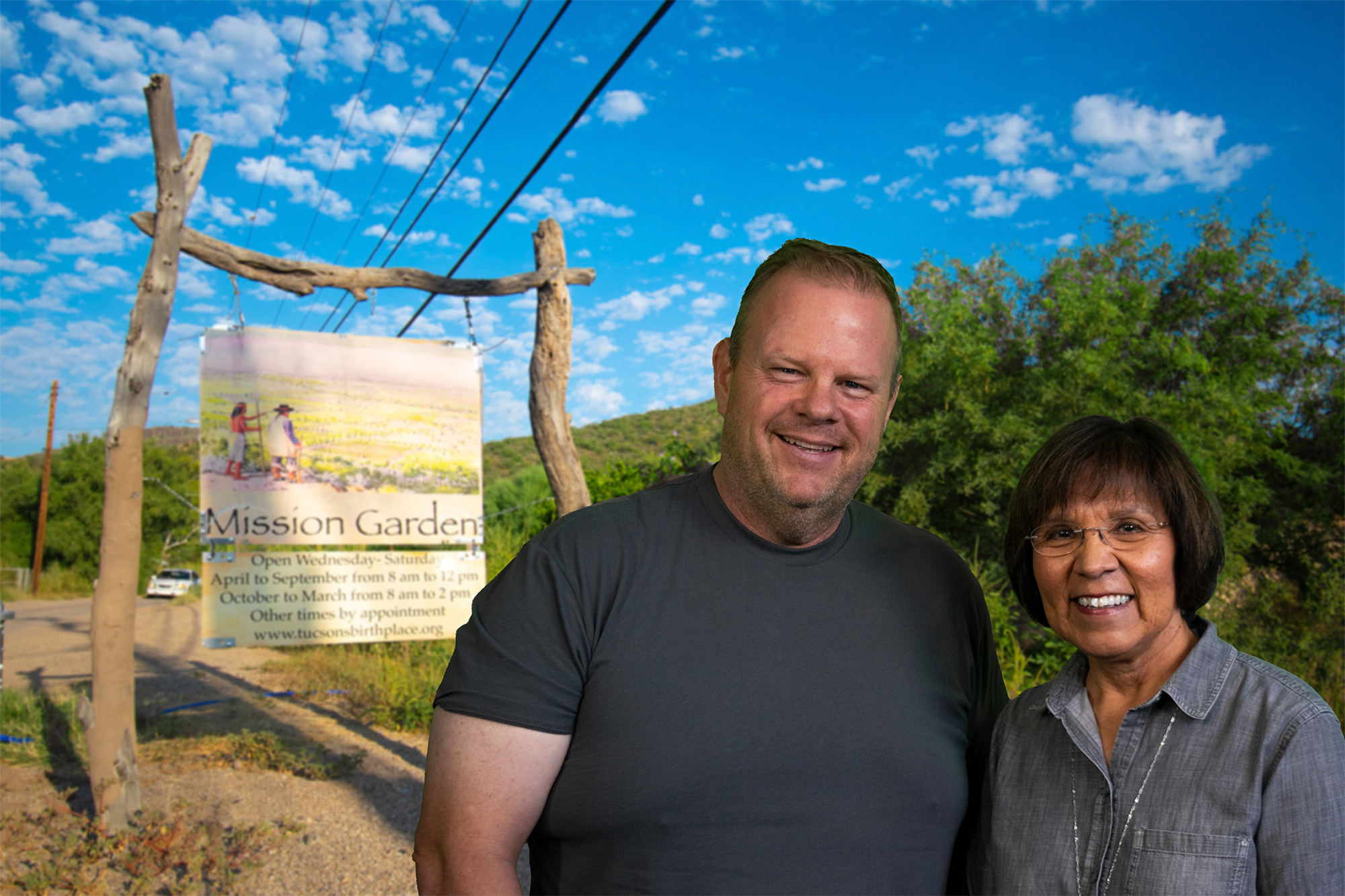
Mission Possible: Alyce Sadongei’s Cultural Leadership from Smithsonian to Sentinel Peak
Episode Highlights
🎉 350th Episode Milestone
Life Along the Streetcar celebrates a full-circle moment by returning to Mission Garden—the subject of our very first episode—this time with fresh insight from new leadership.
🛤️ From Smithsonian to Sentinel Peak
Guest Alyce Sadongei shares how her national work with the Smithsonian supporting tribal museums and Indigenous language preservation led her to Tucson—and why she saw Mission Garden as a place she could “help these people.”
🌽 A Living Timeline of Tucson’s History
Alyce walks us through Mission Garden’s culturally distinct plots—each representing a chapter of Tucson’s agricultural past, from ancient waffle gardens to Sonoran fruit trees and Chinese railroad-era crops.
🧑🌾 Not Just a Garden—A Cultural Landscape
Mission Garden isn’t just recreating the past—it’s reactivating it. Alyce and her team emphasize authentic planting methods, ancient irrigation canals, and stewardship of endangered species—all rooted in traditional knowledge.
🌱 Food as Culture and Connection
Learn how Mission Garden distributes fresh produce to local food banks, elder care facilities, and community restaurants—while also using it to educate, celebrate, and connect through tastings and seasonal programming.
🎨 Events that Grow Community
From third-Thursday Summer Sunsets to the November Native American Arts Fair, Alyce outlines how Mission Garden blends education and culture to offer a meaningful, multigenerational experience in the heart of Tucson.
Episode Description
In episode 350 of Life Along the Streetcar, we return to where it all began, Mission Garden, but this time, we explore it through the lens of one of the most influential cultural advocates in the country: Alyce Sadongei.
From her national work with the Smithsonian Institution to her current role as director of Tucson’s “living agricultural museum,” Alyce brings unmatched expertise, deep cultural insight, and a vision rooted in both heritage and innovation. In this episode, we dive into how Alyce is helping shape a new chapter for Mission Garden, and how that work ties into broader themes of Indigenous preservation, community resilience, and the land we call Tucson.
Whether you’re a Tucson native, a visitor curious about our roots, or someone passionate about food, culture, and sustainability, this episode connects past and future in ways that are both inspiring and actionable.
🏛️ From National Institutions to Neighborhood Roots: Alyce Sadongei’s Cultural Impact
Before she ever stepped into Mission Garden, Alyce Sadongei had already left a profound mark on the national stage. She worked for nearly a decade with the Smithsonian Institution, specifically within the National Museum of the American Indian, where she helped support tribal communities across the United States in establishing museums, preserving their languages, and reclaiming their stories.
Through that work, she was cultivating a pipeline of future leaders. Alyce personally mentored interns who have gone on to become museum directors, educators, and advocates in their own right. Her influence created ripple effects across Indian Country, encouraging Indigenous people to see cultural work not just as preservation, but as a profession and a mission.
Now, her focus is grounded (literally and figuratively) in Tucson’s soil. With a deep understanding of Indigenous systems, Alyce brings her cultural fluency, administrative acumen, and reverence for storytelling to the heart of the Sonoran Desert, helping Mission Garden evolve into a space that does more than educate, it helps you reconnect.
🌾 Honoring Tucson’s Agricultural Heritage Through a Living Timeline
Mission Garden sits on land that has been cultivated for thousands of years, at the base of Sentinel Peak—or “A Mountain”—known in the Tohono O’odham language as Chuk-son, the namesake of Tucson itself. It’s a cultural timeline, told through food, farming, and the earth itself.
Under Alyce’s leadership, Mission Garden continues to showcase distinct plots that each represent a different era and community:
-
Ancient Indigenous waffle gardens, which captured rainwater long before modern irrigation.
-
Tohono O’odham post-contact rows, reflecting Spanish influences on planting patterns.
-
Mexican heritage plots, reminiscent of a Nana’s backyard.
-
Chinese gardens, honoring the early immigrant communities that brought both seeds and commerce to the region.
-
African American and African diaspora gardens, growing cowpeas and other staple crops tied to cultural resilience.
These plots are more than reenactments. They are cultivated with historical accuracy, supported by research, oral traditions, and the hands of volunteers committed to authentic storytelling through agriculture. Even the acequia (canal) system has been revived to echo ancient irrigation methods, now supporting endangered fish, native plants, and even a recently arrived mud turtle.
As Alyce notes, the Mission Garden is about grounding us in the continuity of Tucson’s story, told through plants, water, and the people who have always called this land home.
🌱 Cultivating Community, Sharing Food, and Sustaining the Future
While Mission Garden honors the past, its impact is deeply felt in the present. Under Alyce’s direction, the garden has become a hub for community nourishment, both literally and metaphorically.
The fruits and vegetables grown across the garden’s many cultural plots are harvested and shared:
-
Donated to local food banks and refugee support networks
-
Delivered to elder homes on the Pascua Yaqui and Tohono O’odham reservations
-
Provided to restaurants and used in monthly tasting programs that celebrate seasonal harvests
But it’s not just food that’s being cultivated, but also connection. Through her background in cultural programming and Indigenous language preservation, Alyce is shaping Mission Garden into a space where people can learn, gather, and heal. From casual picnic nights to educational tastings and culturally immersive festivals, the garden is a living classroom and community gathering place.
Even for those who aren’t deeply connected to the agricultural side of the work, the garden provides a moment of pause, a place to walk through centuries, taste something new, and remember that sustainability includes culture, health, and belonging.
🌄 Get Involved: Events That Bring the Mission to Life
Want to experience this vibrant space firsthand? Mission Garden offers ongoing events that welcome the community to enjoy, learn, and participate:
-
🌅 Summer Sunsets at the Garden: Every third Thursday (5–7pm) through August. Bring a picnic or grab a bite from a local food truck, relax in the cool evening air, and maybe even spot the mud turtle.
-
🍴 Monthly Tasting Events: Held the second Friday and Saturday each month, these events let you taste what’s in season while learning about the crops’ cultural significance.
-
🎨 Native American Arts Fair – November 8: A celebration of song, dance, and handmade arts, featuring Indigenous artists and new cultural sharing components from tribes across Arizona.
Mission Garden is open to all, whether you’re bringing a date, your family, or a notebook full of questions. Come hungry for food, history, and connection.
🔗 Explore more and plan your visit
Visit: https://missiongarden.org
Follow: facebook.com/LifeAlongTheStreetcar
Listen to the episode on: SoundCloud
👉 Have a story we should tell?
Reach out via our contact page or tag us on social media. We love hearing from our Tucson community!
Transcript (Unedited)
Tom Heath
Good morning. It’s a beautiful Sunday in the Old Pueblo. And you’re listening to Katy. Tucson. Thank you for spending part of your brunch hour with us on your downtown Tucson. The community sponsored all volunteer powered rock’n’roll radio station. This week, we speak with Alyssa Donaghy, the director of Mission Garden. We’re going to explore how her background in cultural preservation and community engagement is shaping the future of this living agricultural museum and what’s next for the garden as it continues to grow its roots in Tucson’s history.
Tom Heath
Today is August 3rd, 2025. My name is Tom Heath and you’re listening to Wife Along the Street car. Each and every Sunday we shine a light on social, cultural and economic forces shaping Tucson’s urban core from a mountain to the University of Arizona and all stops in between. You get the inside track right here on 99.1 FM, streaming on downtown radio.org, or through downtown radios.
Tom Heath
Very own app on your phone. And if you want to connect with us directly here on the show, follow life along the Streetcar on Facebook and Instagram, or head over to life along the streetcar.org. Most episodes are posted there with audio and video. Plus, you’ll find past shows, info on our book, and an easy way to reach out.
Tom Heath
Episode 350 is upon us. That’s a milestone. You know, not as many as maybe DJ Bank or Paleo Day, but we’re getting up there and we wanted to honor this by going back to the beginning. And we, very first episode we ever aired was on Mission Garden. It’s been quite a while. So we reached out. They’ve got a director newer into the role, and we had not yet chatted with her, so we asked Alyssa Donaghy to come into the studio and recorded an interview with her just a few weeks ago.
Tom Heath
And here we are in episode 350 with Alice suddenly of Mission Garden. Well, I am welcoming in Alice Donaghy from a mission and garden. We were just saying before that, before the show, that mission garden is one of those stories that that we knew was important to tell from. And that was a very first the anchor story of our show.
Tom Heath
But it’s been like eight years. So anything happened over at the Mission Gardens?
Alyce Sadongei
Oh yes. A lot’s happened since eight years and I don’t know, the last time you ever have been there to walk around, but so it’s actually I think we’re in terms of the organization, I think we’re in like 12 or 13 years. Okay. You know, the site itself. Okay. That’s important to the site itself is a historical site.
Alyce Sadongei
It’s full of, archeology. It’s full of history. And we’re located at the base of Sentinel Peak, or junction, which is the autumn name. Donna Autumn name for the Sentinel Peak. And that is a place where ancient indigenous farmers, grew their food and their crops and cultivated seeds and used the Santa Cruz River, which was flowing way back when, to feed their families and settle.
Alyce Sadongei
That is the beginning of this story thousands of years ago. And then fast forward to 13 years. What is it, 13 years and years ago? Yeah. So the, the Rio Nuevo project, that was, funded or approved by the voters of Tucson to take care of the history, in that area. It was passed.
Alyce Sadongei
Things were moving and then recession and things just dried up. And there was a core group of volunteers and people who were very committed to the vision of that original plan, and they incorporated and called themselves friends of Tucson’s birthplace. And, one of their projects is was Mission Garden, which is situated on that historic site, as I mentioned, and it’s named Mission Garden because it’s supposed to be and it is sort of, a recreate a recreation of the Spanish Garden that the priests at Saint Augustine, which no longer exists.
Alyce Sadongei
It was a convento. So it’s not quite the church, but like the business of the church and the area at that time, we’re talking Spanish colonial period.
Tom Heath
Late 1700s. There you.
Alyce Sadongei
Go. I’m not good with dates, but I’m glad you are.
Tom Heath
Oh, I’m making this up. Right. So what would be great is that as long as you trust me with dates, we’re going to be just. Okay.
Alyce Sadongei
That’s good. So Spanish colonial period. They had a garden and they saw the ancient indigenous farmers there, and, hey, let’s do that. So they had a garden there. The ancient indigenous farmers are most likely displaced and, you know, moved on, moved out, forced out, whatever. But that land is that’s that’s the history of that place. So the project, Friends of Tucson’s birthplace was to create that recreate that garden, because that was part of the original plan.
Alyce Sadongei
That was, the Rio Nuevo plan. And so that’s what they did. And so we are actually on the footprint of the walls. The mission right that they put up. So that’s kind of exciting to know that we’re within that footprint. And underneath is the the existence of those, those walls that were put up there recently.
Tom Heath
We did a story on, the the big celebration of Tucson with their 250th, birthday. But it’s very important that that we recognize it as the 250 plus birthday, because, yes, the 250 is that that date, that arbitrary date that we’ve established as a city. But that plus represents thousands and thousands of years of history.
Tom Heath
And, and that was, something that I learned very early on, I think in the very first interview was that Mission Garden is named because of its spot where the Spanish had the mission. But it’s certainly I mean, your, your, your recreations go well beyond that.
Alyce Sadongei
Right. And that’s what the garden, grew from. I mean that was the vision of the founders, that started this mission garden was to recreate that space with the agriculture and so we have garden plots we have there in, situate in timelines. And so since the focus was the, mission, we have some Spanish garden up in the front, with some orchards, some heritage fruit trees.
Alyce Sadongei
And then we move on. Or maybe we should start actually at the, what they call the pre-contact, garden, which is the archeological kind of what, what the ancient, indigenous people were farming there. What it look like. And it is based on an archeological site, I think, somewhere north of Tucson, when they were trying to recreate it.
Alyce Sadongei
So it features, Waffle Gardens, which is a type of, they’re not in rows, but they’re like, if you can envision a waffle. And so they’re little squares. So those squares gather, water when it rains. So it’s like a little tiny basin.
Tom Heath
I don’t know, it’s I called them off. We’ll go to.
Alyce Sadongei
The Waffle Gardens. And so we have a sample of that there. And then some of the, the plants growing in there are reflective of that time. Don’t ask me all the names of those because I don’t know them. But we have we have maps and we have information galore on our website, which is I think every plant is on our website.
Alyce Sadongei
We’ve just put up a nice, I think we call it either encyclopedia or Atlas, but it’s really Cerro.
Tom Heath
What’s the level of commitment of your volunteers is just so amazing because they, they spend so much time to make sure they’re as close as they possibly can. Obviously, we’ve got different circumstances. You can’t actually 100% recreate it. We’re doing such a fabulous job to be so authentic with every piece of that garden. It’s just really tremendous.
Alyce Sadongei
And our staff to I must point out our staff. Yes. Yeah. So, working on that. Obviously they’re good hand in hand. We need them. We need them both. But so so we have that art that the ancient garden. We have the, Donna Autumn garden, which reflects, traditional art. I’m gardening from. Again, I’m not good with dates, but contact is what they call it post contact.
Alyce Sadongei
So in this in, in this garden you will see then.
Tom Heath
And by contact you’re referring to like it.
Alyce Sadongei
Said there, like people contact you, and in this, garden. So they’re in rows. So they were being influenced by settlers to plant in row. So you don’t see the Waffle Gardens there? But you do see a lot of traditional, foods that people still enjoy today and like, today. And then the other, moving on from that timeline and we have a what we call the Mexican garden, which is supposed to be, you know, featuring a recreation of a type of garden that would be in Sonora or actually is reflective of some of the early, gardens here in town in Tucson.
Alyce Sadongei
As somebody once said in some material, it’s like, you know, what we’d find in our grandma’s garden or Nana’s garden, you know? So then we have the Chinese garden that reflects the people and seeds and plants that they brought with them to work on the, the railroads that came in. But I think what’s fascinating to me about that garden is that there was a group of folks from China, a certain region, I want to say the southern region could be wrong, but check our website to make sure.
Alyce Sadongei
But they you know, that group came and settled in Tucson. And you know, how you go, you settle and you bring in your family and friends. And so to me, that’s interesting because there’s a certain language they spoke or a dialect. And so we have that here and the history is here, Chinese Cultural center, you know, we have a relationship with them where you can go and learn more about that.
Alyce Sadongei
But I don’t know if people realize that the Chinese community here was actually the first, people that sold the produce to the settlers here. You just think of them in terms of a lot of people think of just as a railroad. But it was more than that. They were actually selling to the people that lived here with their little wagons, carting it around and selling that produce.
Alyce Sadongei
And then of course, they had their own gardens. And they have, of course, all the seeds they brought with them were cultivated for this area. So they grow well.
Tom Heath
We are listening to Alice today. She is the director over at Mission Garden. We’re celebrating our 350th episode by going back to, the very first story we ever shared on life along the streetcar. We’ll be back to the second half of that interview in just a moment. But first, I want to remind you that you are listening to Lifelong the Streetcar on Downtown Radio 99.1 FM, streaming on Downtown radio.org.
James Portis
This podcast is sponsored by Tom Heath and the team. Another home loans. If you’ve enjoyed this podcast, continue listening or head over to lifelong the Street Khou.com for current events and information on what to do while visiting Tucson. Tom Heath and MLS number 182420 Nova and MLS number 3087 became number 0902429. Equal Housing Opportunity.
Tom Heath
Welcome back. If you’re just joining us, we are in the midst of episode 350 here on Life Streetcar. And as part of that, lineage, we went all the way back to episode one. We had Roger Phifer on in 2017 talking about Mission Garden, and today we have Allison on. The, director was fairly recently installed over there.
Tom Heath
I’ve been talking to kind of about the background and, and such, and we’re going to get into a few more things about her and how the garden celebrates their wonderful crops.
Alyce Sadongei
Just today we had a sampling of Kelpies, which are in another garden called the African Americas Garden, which was related to the Kelpies. But the long, beans are in the Chinese garden that we have jujube trees in the garden, which I didn’t know until I started working there. And it’s history that bears a little fruit about this big.
Alyce Sadongei
And someone explained it to me. The size.
Tom Heath
Of the quarter is that.
Alyce Sadongei
It’s little kind of round, like kind of a big. Oh, you maybe sort of like olives. Maybe the size of an olive, maybe. Okay. And it’s a cross between, like a little apple. And, now I’m just lost my little apple and a date.
Tom Heath
Oh, interesting. It’s a jujube. I’ve heard the name, but I. I think there’s, like, a candy or something named that. And,
Alyce Sadongei
Maybe it’s it’s. I don’t know.
Tom Heath
But it’s definitely not, apples and dates. Yeah, yeah.
Alyce Sadongei
So it’s, it’s a, it’s a cute little, fruit. And it is. Got that distinct taste and it’s small and it’s really nice. It’s different.
Tom Heath
But, the, there’s so much to talk about here, and we’re not going to nearly have time today, but so much of, of the, the praise that we get here as a community for our being, our city of gastronomy and the awards that we receive for that and the recognition a lot of people don’t. I mean, they they attribute it to our great chefs, and we do have fantastic chefs, but many people don’t know that that award was in large part based upon the work that your team is doing to recreate this, this millennia of of agricultural history and connecting us with things that we wouldn’t have in our presence if it wasn’t
Tom Heath
for your group.
Alyce Sadongei
Yeah, it was, documentation of the the rich, the deep history of growing food. And that, that really is I’m happy we were able to contribute to that designation. And so we continue to do that. I think before we started I was chatting about the how beautiful the garden looks now. It’s lush, it’s green, it’s full.
Alyce Sadongei
The the trees are heavy with fruit. The figs are coming out. Oh my gosh. The greens are coming out in the African-American garden. And so that’s a lot of work to harvest and distribute. But we do distribute to some restaurants. But also to the food bank and to, like elders homes on the reservation. Pascal Yaki and Donna Autumn.
Alyce Sadongei
Okay. And each casita refugee network. Okay. We distribute to them as well. And then we also try to use some of it for our own, tasting programs, which I just mentioned today. We’re, featuring Kelpies, and it’s a program that happens, I think it’s the second Friday and Saturday of the month, and we try to just feature what’s growing in the garden.
Alyce Sadongei
Come taste what’s in the garden.
Tom Heath
Fantastic.
Alyce Sadongei
So, yeah. And it was a nice taste today. I’d never really had count these before. And they’re not peas. They look like they’re beans. It’s kind of misleading. Yeah. Like little beans there.
Tom Heath
We we call them what we call them. But yeah, the, the other thing that’s really interesting to me about the, about the, the garden is, is you because you have this extremely deep background, of promoting and serving and, our, our, the different indigenous communities around the United States. I mean, you’ve, you’ve well traveled. I believe I even saw something about, working at the, the Sonia.
Alyce Sadongei
Yeah. I did, I worked at the Smithsonian Institution for about 7 or 8 years. And what I did there was, worked with tribal communities who were interested in starting their own museums and cultural said, wow. Yeah. Okay. So, and then from there, I actually that was the work of the National Museum of the American Indian, but they were not staffed to do that.
Alyce Sadongei
So I was indirectly creating a pool of talent as well that the, museum could use to hire. And I’m really proud to say the first class of interns I had, the director was one of them, Cynthia Chavez, who is later went on to earn her PhD, the fantastic. But she was like one of the first. So, yes, I’m glad because for at that time, a lot of, I think museum careers weren’t, seen as readily as education, law, health, you know, for indigenous people to go to go into.
Alyce Sadongei
And so I’m really I’m really glad of that. So I think it worked, all that work.
Tom Heath
And there are a lot of a lot of legacies, based upon some of the work that you’ve done, how did you then end up back in Tucson? Are you from Tucson and came back or.
Alyce Sadongei
I’m from Phoenix, Arizona. My mother was from Tucson. Okay. And I came back because my husband was going to finish his graduate, work at the UVA. Okay. And I just made a, query to work at the Arizona State Museum. And so I was hired there. Okay. Yeah. So I was there for a while and then stayed at the UVA working, also after the museum at the American Indian Language Development Institute to, promote the use of native languages by indigenous people.
Alyce Sadongei
And then from there, I went to Mission Garden.
Tom Heath
What was the Paul. Did you did you seek them out? Did they seek you? How did you know?
Alyce Sadongei
Somebody gave me the job description, and I thought I’d pass it on, like I always do. And I read the description, and I thought I.
Tom Heath
Didn’t.
Alyce Sadongei
Know. I thought, you know what? I think I could help these people.
Tom Heath
But when did you start then?
Alyce Sadongei
Two years ago. Yesterday.
Tom Heath
Oh.
Alyce Sadongei
Happy anniversary.
Tom Heath
Happy anniversary. Thank you. It’s, it’s it’s a remarkable institution that has so many intricate connections within our community. And, the things we do a lot of tours. And one of the things we love to share is, is this canal that you’ve built. So, you know, and, and sort of the unintended consequences of being a, a wildlife refuge.
Alyce Sadongei
Now, sort of. Yeah. It’s, an Sakya which is recreate it again, the canals that the ancient indigenous people used to, get the water from the river for their crops. And, yes, the game, the state game and fish department, is approach the garden. Years ago I guess, but is we have taught minnow in there that are then, gathered up by the staff, the fish and game folks and then they are repopulated in, in rivers and streams.
Alyce Sadongei
We have also, a type of plant, an aquatic plant in there that also is endangered that at some point was so thick along the Santa Cruz. So that’s another thing to recreate. And just recently we are the habitat for a mud turtle.
Tom Heath
Oh I do not know about the motor. Yeah.
Alyce Sadongei
That was put in. He he’s in there. She’s in there a couple weeks now okay. And apparently they will spend a lot of time in the mud and in the ground.
Tom Heath
In their appropriately named unlike the cow beans know cowpea.
Alyce Sadongei
Yeah. Mean. Yeah. So that’s the other thing. And then plus because of that water, because of our location, because of the, the the trees, we’re a really a bird haven, too. We have a birding thing every first Saturday of the month, and all kinds of birds have been sighted there. And I think that’s also on our website.
Tom Heath
And there’s a fantastic, rendering, a drawing that I know it’s at the Presidio, and I think I’ve seen it at Mission Garden that just show, it from a mountain, the view to the east, as it would have been in the 1700s, with how lush and green and the Santa Cruz River and and it’s hard to imagine as you drive through there and see such, you know, empty space.
Tom Heath
But then when you get inside the walls of the garden and if you can all of a sudden transport yourself back and see, oh my gosh, this entire area was like this.
Alyce Sadongei
Right? Yeah. That’s that. We’re on a historic site. I mean, it extends all to that neighborhood. And and I tell people that that land there is inherently good. It took a little just as soil supplements and work, but that’s inherently good soil all through there because it was on the floodplain.
Tom Heath
Yeah. So much, so much history there. The, where do people find out information? You’ve got some things, you got third Thursday in August. You go to sunsets.
Alyce Sadongei
And yeah, we have summer sunsets. Thanks for reminding you. Every third Thursday. So we’ve got one next Thursday and one in August. The third Thursday. And we’re open from 5 to 7. And it’s cool. We’re not surrounded by buildings, so there’s not that heat trapping. It cools down when the sun goes down. It’s a nice place to bring your dinner.
Alyce Sadongei
Bring your picnic dinner. We have a food truck outside. We may have some music. But it’s just a nice place to hang out, and people come and hang out. Just see.
Tom Heath
The lecture.
Alyce Sadongei
Yes, they hide in the mud turtle. And as one of our, newer staff people said, hey, bring your date here. It’s free. Doesn’t cost. It’s a good date. Date night place.
Tom Heath
Oh, there you go. Oh, no. Perfect. So, yeah. Yeah, we like to share dating advice now.
Alyce Sadongei
Yeah.
Tom Heath
So exactly where do we get all this information?
Alyce Sadongei
It’s on our website at Mission garden.org Adobe dot mission garden network. Okay. Well yeah. And it’s really there’s so much information there on the plants, the history, the site, the events, the people, the animals, the birds. So, yeah.
Tom Heath
And the celebrations because coming fall and, you know, memory. Oh, fast and, and pomegranate all these things that the garden celebrates the harvesting of this.
Alyce Sadongei
Right. And we haven’t done we are not doing those festivals as much as we used to because, our capacity is staff and volunteers, but we do have the tasting every month, and that’s what that does. Yeah, we will feature what’s it, what’s growing like? We will have in the fall all the things that are going for that little like a festival, where we have samples and information about how to grow it, what it tastes like, how to cook it.
Alyce Sadongei
We have recipes and you can taste it. And sometimes we have other people, other vendors, other organizations that also work with that particular fruit. So but yes, in the early days, that’s what I think we were known for, for the festivals.
Tom Heath
And what you’re talking about are the key components of those festivals is it’s understanding the, the, the fruit, the vegetable, not just as a, as a, as a food source, but also as a textile or as an ink. Yeah. The amazing ways that, that these creative cultures for, for centuries have figured out how to take this element and use it in so many different ways.
Alyce Sadongei
Right. We will have the Native American Arts Fair in November, November 8th, and that’s, a nice thing to come to as well. We’ve just recently incorporated a cultural sharing component. So we have, tribes from different parts of the state coming to do share their song and dance that.
Tom Heath
A newer.
Alyce Sadongei
It’s always we. This part is new. We’ve extended the time and the cultural sharing. Okay.
Tom Heath
Okay. If you want to know more about that too, I know you did a great interview with Frank powers. Oh yeah, I, he’s a friend of mine, and I was doing research, and I saw, you know, it is like, oh, Frank got to your first book, but that’s okay. His show, it’s a lifestyle show that he does.
Tom Heath
And I think there’s a great, another great segue into Mission Gardens. So you don’t get all the information here. You can check that out. And we’ll obviously stay in touch to and post as things come up. And great. James and I have made the decision, we are not going to wait another eight years. Yeah. To bring mission going back, we’ll, maybe do something every year or so just to make sure we’re staying on top of the amazing work that your staff and your volunteers are doing.
Alyce Sadongei
Great. Sounds good. Thank you.
Tom Heath
Thank you. Alice, a donkey by way of the Smithsonian here to Tucson. And she just really is, I think, so well-suited for what she’s doing. And we’re lucky to have her here in Tucson. My name is Tom Heath. You are listening to life along the streetcar in downtown radio 99.1 FM, streaming on downtown radio.org.
James Portis
Support for downtown radio is provided by the Tucson Gallery, located in downtown Tucson. Instead of the proper shops at Barrett East, Congress Street, the Tucson Gallery offers original work, reproductions, and merchandise from Tucson artists like Joe Padgett, Jessica Gonzalez, Ignacio Garcia, and many more. For information about other artists, including when they will be live at the Gallery, head to the Tucson gallery.com or find them on Instagram and Facebook as Tucson Gallery.
Tom Heath
Well, don’t go anywhere. We’re going to stay tuned for Words and Work as Ted key interviews writers and others from the labor movement and coming up on Life on Streetcar. Next week, we’re going to have Jim Owens, who, after spending decades in downtown Fourth Avenue’s music scene, bar scene, restaurant scene, took the leap with his partner, Michael.
Tom Heath
They purchased the, Thunder Canyon Brewery operation. It’s now called Brick Box has been open just over a year, and we’ll talk with Jim next week about how things are going and really how they’ve they’ve created a community space and how all of his, different fields of interest have come together to put, an interesting spot on Broadway there, on the east end of downtown.
Tom Heath
And if there’s something you want us to cover, if you’re involved with out there, if you’re passionate about something since you’re listening to the show, it’s pretty hyperlocal. We, we cover about three miles and 350 episodes. Three miles. So we go pretty deep into, our history, our culture, the, social, economic developments that are happening.
Tom Heath
So if you, are out there and thinking, hey, I’ve got someone you should be talking to, hit us up on Instagram or Facebook. If, you have a fantastic social media presence, tag us so we can tag you and, build on that. That’s, you know, collaboration. That’s how we how we build this audience and create a meaningful dialog in our community.
Tom Heath
And you can always reach us directly through the, the old fashioned way of that email contact at life along the streetcar.org. And, you can also head over to the website there or lifelong street car.org. There’s a can contact us button on there. Lots of things coming up in August. As I mentioned earlier, we got Jim Owens of, a brick box, and we’re going to have, Brittany battle back.
Tom Heath
I’ve been kind of teasing out a U of A star, and I want to get the name out there too soon. I gotta tease it, but we’ll we’ll, have a big name joining us here in a couple of weeks as well. I also want to remind you, about Tucson Gallery. They are a sponsor and underwriter here of Downtown Radio, a business that I’m involved with.
Tom Heath
The the location has moved, so you’ll hear some, 300 East Congress coming through the promotional material that’s being updated. But as you know, with the volunteer run stations, we have some copy that is attached to, older shows that we will rebroadcast. So if you hear that address, don’t pay attention. But come October, will be at 245 East Congress and invite you to come down and check that out.
Tom Heath
That first weekend of October will be a grand opening. If you want information on the gallery head over to the Tucson gallery.com website. We actually have a newsletter we send out one a month. If you sign up there, you’ll get all the details on upcoming events, including the grand opening and with our new space, be more room for events presentations, artist to interact with their adoring fans here in the community to sign gallery.com for that.
Tom Heath
Well, James Ford, this is our executive producer. Amanda Maltose is our associate producer. And I’m Tom Heath, your host. Our opening music is from Ryan Hood. And we’ll close today with the, Frank Jack’s Field Orchestra. It’s from a 2011 album called Afternoon Delight. It’s their version of Garden Party in honor of Mission Garden. Have a great week and join us next Sunday for more life along the streetcar.