

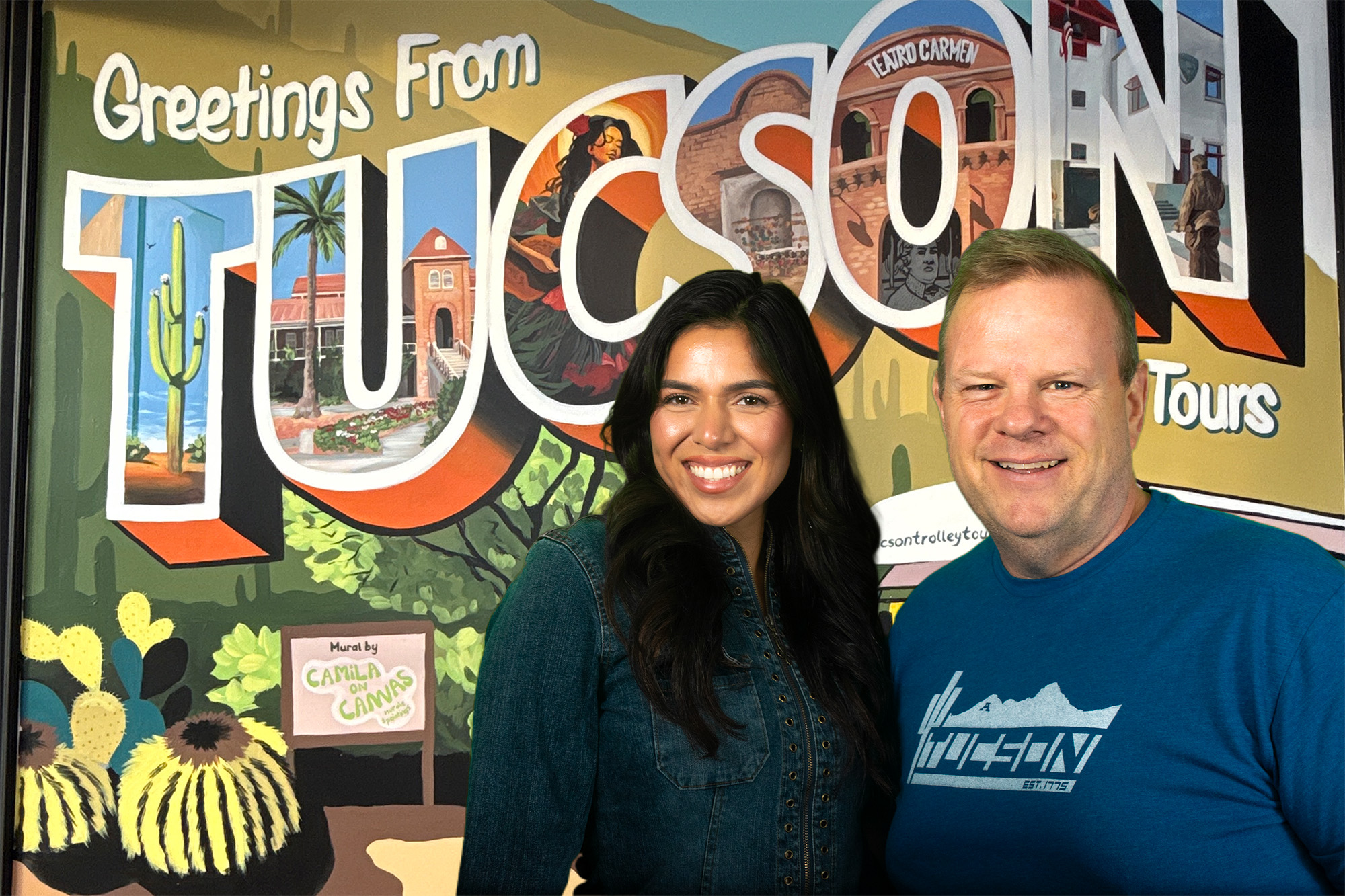
From Engineering to Murals: The Story of Camila Ibarra
Episode Highlights
-
Coming Home to Tucson
Camila shares why, after seven years in Phoenix, she felt called back to Tucson—drawn by her boyfriend, the possibility of homeownership, and a deep love for the city’s culture and people that “just feels more homey here.” -
From Civil Engineer to Full-Time Muralist
Hear how Camila went from a “typical 9-to-5 in a cube” as a civil engineer to becoming a full-time artist in January 2025, a move she describes as “very overdue” after years of painting murals on the side. -
Art, Math, and the Engineer’s Brain
Camila talks about how her comfort with math, scaling, and precision helps her tackle massive walls, and why she thinks so many engineers turn out to be incredible artists too. -
Designing Tucson’s 250+ Mural
Go behind the scenes of her city-commissioned mural that tells 10,000 years of Tucson history—from a Hohokam basket weaver to Father Kino and Mission San Xavier, all the way to a modern train pulling today’s Tucson together. -
Research, Timelines, and a Wall of History
Before painting, Camila immersed herself in documentaries, museums, and local historians, building a huge handwritten timeline to decide what moments had to make it onto the wall. -
Cactus Empire League at Michael Perry Park
She describes her playful new mural for a Little League field on Tucson’s east side: cacti playing baseball on the diamond while cactus fans cheer, snack, and throw popcorn from the stands. -
Thoughtful Details in the Tucson Gallery Trolley Mural
Camila explains how taking a Tucson Trolley Tour inspired the mural she created for the Tucson Gallery kiosk, weaving in specific tour moments and details so every element on the wall has meaning. -
The Long Road from Idea to Mockup
Get a real look at her process—from feeling overwhelmed at the start, to slowly sketching, revising, adding, and subtracting ideas until a final design emerges, long before the first stroke of paint ever hits the wall. -
Impact, Recognition, and Community Connection
Camila reflects on what it’s like to see her name “explode” around Tucson, be recommended by artists she’s long admired, and have people stop her on the street asking for photos and saying they’re starstruck. -
Where to Find Her Work (and Follow Her)
Listeners learn how to see her Tucson 250+ mural downtown, visit her piece inside the Tucson Gallery, and follow her online under her art name “Camila on canvas” across social platforms.
Episode Description
Tucson’s streets are a little brighter these days, and if you’ve walked past certain walls downtown, you’ve probably felt it. Those bursts of color, history, and personality are pieces of Camila Ibarra’s journey home. In this episode of Life Along The Streetcar, we sit down with Camila, a Tucson-born civil engineer turned full-time muralist, whose work is reshaping how we see our city, our past, and ourselves.
From a “typical 9-to-5 in a cube” to making a living telling stories in public spaces, Camila’s path is both wildly inspiring and surprisingly practical. She didn’t leap blindly; she built, layer by layer, just like her murals. This is a story about coming home, trusting your skills, and discovering that the walls around you can become your canvas.
Below, we dive deeper into three parts of her story: coming back to Tucson and leaving engineering, the way her technical brain fuels her art, and the deep storytelling and connection behind each mural.
From Phoenix Freeways to Tucson Walls: Coming Home and Changing Careers
Camila’s story starts where so many Tucson stories do: she left, and then she came back. Born and raised in Tucson, she moved to Phoenix for college, spending about seven years there before feeling the pull of home again. What brought her back wasn’t just one reason; it was a mix of love, logistics, and longing. Her boyfriend already lived in Tucson, buying a house felt more realistic here, and the culture and people made the city feel “more homey” than anywhere else.
While Tucson was calling her home, Camila was living a double life, by day, a civil engineer in a conventional 9-to-5, and by night and weekend, a working artist. She had studied civil engineering, spent about three and a half years in that career, and did everything “right” on paper: STEM degree, stable job, clear path. But art never let go. Even in college, she carved out a tiny studio corner in her dorm and picked up paid portrait work for classmates, slowly moving from paper to walls, from small commissions to full-blown murals.
By the time she officially left engineering, she wasn’t taking a blind leap, she was stepping onto a bridge she’d been quietly building for years. She describes the switch to full-time art in January 2025 as “very overdue,” not reckless. She already had murals under her belt (her first one in high school at Saguaro High’s cafeteria), a client base, and a deep sense that this was no longer a side project, it was the main story. That mix of safety, planning, and courage is part of what makes her path so relatable for anyone thinking of changing careers.
Engineering the Canvas: How a Technical Mind Shapes Bold Public Art
Camila may have left the office, but she didn’t leave her engineering brain behind. In fact, it’s one of her secret superpowers. She talks about always having been good at math and systems, which is a huge asset when your “office” is a multi-story wall and you’re responsible for getting proportions, perspective, and layout right at scale.
She never went to art school, but the kind of technical skills they’d teach (scaling, grid systems, proportion) came naturally to her. She sees a strong overlap between the precision of engineering and the technical side of art, and she’s noticed the same pattern in others: plenty of engineers she knows are incredible artists. Maybe it’s the perfectionism, maybe it’s the love of structure, but that crossover becomes part of her creative fingerprint.
That technical mindset really shows up in her process. Camila is honest about how intimidating it can be to start a new mural project. Before a single brush hits the wall, there’s a whole invisible phase of thinking, sketching, scratching things out, and trying again. She describes needing to “build up the courage” just to put pen to paper, then iterating, adding, removing, reimagining, until a mockup finally feels right. It’s equal parts creativity and problem-solving.
Time is another engineering-style factor. For her Tucson 250+ mural, the painting itself took about a month, with help during the first two weeks, but that doesn’t include the heavy lift of planning, design, and research that came before. When you see her work in person, you’re not just looking at color and form, you’re looking at a carefully engineered experience, built to function beautifully on the surface and in the story underneath.
Painting Tucson’s Story: Murals as History, Impact, and Human Connection
At the heart of Camila’s work is storytelling. One of her standout projects is the city-commissioned mural for Tucson’s 250+ anniversary celebration, where she was asked to represent pre-Spanish history, the Spanish period, and modern Tucson—all on a single wall. To prepare, she dove headfirst into research: documentaries, museums, conversations with local historians, and a giant handwritten timeline filled her workspace before she ever chose her final images.
The finished mural reads like a visual timeline of Tucson. On the left, she honors the Hohokam era with a woman weaving a basket. In the center, she depicts the Spanish period, featuring Father Kino on horseback with Mission San Xavier in the background. On the right, a modern scene where the train symbolizes connection and the city we know today. The whole wall becomes a path from “then” to “now,” tying together 10,000 years of history in one continuous narrative.
Her storytelling is playful, intimate, and rooted in community. At Michael Perry Park on Tucson’s east side, she’s painting “Cactus Empire League,” a mural where cacti are playing baseball on the field and cheering from the stands, popcorn flying and all. It’s whimsical, but still very Tucson, and it speaks directly to the kids and families who use that space.
Impact is what drives her toward larger walls and public work. She explains that while creating a piece for a single person is powerful, murals that speak to an entire neighborhood or city feel transformative. Downtown, people constantly walk by as she paints, stopping to watch, ask questions, or share how the work makes them feel. Those interactions are as much a part of the art as the paint itself.
You can see this deep thoughtfulness in her mural for Tucson Trolley Tours inside the Tucson Gallery kiosk, where she wove in elements inspired by actually taking the tour herself. Every piece of that mural, and of the 250+ wall, and even her cactus baseball league, is placed with intention. Each scene is a way of saying: this is Tucson, and this is us.
Meet the Artist Behind the Walls of Tucson
Camila Ibarra’s journey from civil engineer to full-time Tucson muralist is the kind of story that makes our city feel alive. It’s a blend of practicality and passion, timelines and timelines-on-walls. She came home for love, affordability, and culture, and in the process, she’s been giving Tucson new stories to look at every day.
In the episode, she shares that you can find her across social media under her art name “Camila on canvas,” so if you want to follow her latest projects, that’s the handle to look for. And if you really want to feel the impact of her work, make a point to visit the Tucson Gallery downtown, where you can see her Tucson Trolley mural up close and experience how she translates tours, history, and place into color and line.
To dive deeper into Camila’s story, listen to the full episode of Life Along The Streetcar on our website at lifealongthestreetcar.org, where you can also catch the video version and explore past episodes. Then keep the conversation going by connecting with us on Facebook at Life Along The Streetcar and streaming the show on SoundCloud at Life Along The Streetcar, perfect for sharing with fellow Tucson art lovers.
Tune in, then head downtown. See the murals, ride the trolley, stop into Tucson Gallery, and let Camila’s work change the way you see the streets we call home.
Transcript (Unedited)
Tom Heath
Welcome to Life on the Street Car podcast, where each week we sit down with people who are making things happen in our urban core, and we’d like to shine light on the social, cultural, economic forces shaping Tucson’s urban core from about to the University of Arizona and all stops in between. You get the inside track right here on life along the street car.
Tom Heath
Today our guest is Camila Ibarra, Tucson born muralist whose vibrant public art is transforming the cityscape and celebrating her cultural roots. We’re going to talk about her role, the Tucson’s 250 plus anniversary celebration, as well as community driven projects across Tucson. This Camila is bringing history, identity and bold color to the streets we call home. Show originally aired on Downtown Radio on November 16th as part of our show Life Long Streetcar, as we have that every Sunday at 11 a.m. on May 9.1 FM, and it’s available for rebroadcast right here on Life Along the Street car.org.
Tom Heath
This is the audio version. Check out the website for the video version. Every Sunday we’re back with a new story, a new feature, and we invite you to check us out on Downtown radio. And then if you miss it or if you want more, head over to the podcast every Monday. Here is our interview with the fabulous Camila Ibarra recorded in our show Source Studios.
Tom Heath
So it’s always, always a pleasure to welcome artists into this space because I’m so enthralled with this creative spirit we have in Tucson. But Camila, welcome to to the show.
Camilla Ibarra
Thanks. I’m honored to be here.
Tom Heath
Just a couple questions that I because I do horrible research. Are you a Tucson native?
Camilla Ibarra
I am, okay, yeah. Born and raised. And then I moved to Phoenix for college.
Camilla Ibarra
I got seven years out of Phoenix, and then I wanted to come back.
Tom Heath
Okay. What brought you back?
Camilla Ibarra
Well, my boyfriend lived here, so. Okay.
Tom Heath
That’s a that’s.
Camilla Ibarra
A good sentence. And I wanted to buy a house, which seemed a little more realistic for me here at the time.
Tom Heath
So loving economics. It wasn’t art. It wasn’t some. It was.
Camilla Ibarra
It was also the culture and the, The people. Yeah. I just it feels more homey here.
Tom Heath
But you know what? What did you study in your your years away from us?
Camilla Ibarra
I studied civil engineering. Really? Yes.
Tom Heath
Civil. So you are. You’re an engineer who has, moved from that world into the art world?
Camilla Ibarra
Yes. Yeah, I studied engineering for four years, and then I was an engineer for about three and a half years. Like, typical 9 to 5. Wow. Position in a cube and that.
Tom Heath
That is not what I was expecting you to say. Yeah. Okay. I thought it would be something in the creative world. So now I need to know all about this. You. You are an engineer. Are you doing art at the time of you? When did you start.
Camilla Ibarra
Doing the art? I’ve been doing art my entire life. Okay. Even in college, I like my little dorm room. There was a little art section that I had separate from. Like, just right off of my bed area. Okay. And I would I would draw portraits for people like my clients were other students that were in the program.
Camilla Ibarra
I would do portraits. I did pet portraits. And so that was over, though. That was about like ten years ago that I started doing that. Okay. And then slowly, like, my project started to get a little bit bigger. I asked people to paint on their walls. And so I would do that on the weekends. And.
Tom Heath
Then like, in their dorms or.
Camilla Ibarra
More like I was a part of a boxing gym. So I asked them if I could paint their wall, and I gave them, like, the craziest deal ever. And so I just slowly started to, like, grow, I guess, in terms of skill with my art projects. And I would design after, work, I would design mockups, and then I would paint the murals on the weekends.
Camilla Ibarra
And so it was it’s like having two full jobs at once towards like, the end of my,
Tom Heath
Career,
Camilla Ibarra
Engineering.
Tom Heath
When did the the artistic bug sort of get you, like, as a child? Were you drawn to, or were you drawn to drawing or. Yes.
Camilla Ibarra
I think I was drawn to, like, the arts in general. Everything about art, like even musical theater and instruments and drawing and painting and just creating things with my hands. I remember being in preschool and they gave us some construction paper and I, like, made a scooter out of it. And everyone was so impressed.
Tom Heath
Yeah. I mean, I’m still like in the paint at that point, right?
Camilla Ibarra
Yeah. And then like the third grade, I think it was where they made us all paint the same painting. And my painting sold before at during parent night, before my mom even went to go see it. So it’s just always been a part of me.
Tom Heath
And then the civil engineering is that. I mean, that’s there’s a lot of, of art. There’s there’s a sort of an artistic element to civil engineering cause you’re designing things. You’re creating things. Is that work? Like like that just seems an interesting change for it to go from, making scooters out of craft paper to designing cities and.
Tom Heath
Yeah, and such.
Camilla Ibarra
I wouldn’t say that it was the most artistic job I ever had. It was I think I also have like that technical brain, and I was always really good at math and, systems, I guess. And so that’s just that just made the most sense to me to go into engineering. And that’s what they tell you to do also.
Camilla Ibarra
Okay. And so I just I was like, okay, that’s what I’m going to do. I’ll give it a go. And and that’s what I did.
Tom Heath
So you improve the Stem ratings, you get to get some someone into I a young woman getting into Stem. That’s always an exciting things for people. And then you did that. You’re like, okay, now I check that box. Now I’m going to go do art. Yeah, but when you came down to Tucson, were you a full time artist at that point, or were you still working in as an engineer?
Camilla Ibarra
I was still an engineer, for about another year, and then I finally went full time. Art as of January 2025. So just this.
Tom Heath
Oh, this is.
Camilla Ibarra
Very breaking.
Tom Heath
News here. I know we’re, Yeah. Very excited. I always love to break news. I know, coming up, breaking news is the, the idea of murals, though, you kept getting bigger. You know, you start with pet portraits and people that are in the program. Why get bigger? Like, what is it about the size of it that excites you?
Camilla Ibarra
I don’t know if it’s like the size. I think it’s the impact. I think it’s the impact that it has on the community. And just like what what murals mean to people and when like when I’m painting a mural, especially downtown, there’s constantly people around me just walking by and it’s just amazing, like how touching it can be to some people.
Camilla Ibarra
And so when you go from like creating one thing for one person, that’s also very impactful and very touching, but I think just being able to create a mural that really speaks to like a whole community is very, it’s amazing. I love to do that.
Tom Heath
But and then speaking of that, one of your more recent projects, as part of the celebration of Tucson’s 250th birthday and, you know, we’ve talked about this on the show. They commissioned for murals to do a 250 plus. So not only are you representing, you know, a city, you’re representing 10,000 years worth of history. And you have to do that in, well, a fairly sizable wall, but you start to do that in a fairly contained space.
Tom Heath
First of all, what what went through your mind when you got that call?
Camilla Ibarra
Well, I got an email and.
Tom Heath
I didn’t even get a call. I just got an email, I got an.
Camilla Ibarra
Email and it was, it was like this person, this person, this person recommended you for this project. And it was like the names of artists that I’ve been looking up to for years, like Joe Ignacio, Jessica Ellis, like what? And I showed my boyfriend. I was like, am I like, am I like dreaming? So it was very, like very much an honor.
Tom Heath
And I do interaction with them or do they just they know your artwork? Yeah.
Camilla Ibarra
I had interacted with them. They know, like we knew of each other. Okay. And I’m very much like, they have more experience, I guess, more years under their belt. And so it just felt really nice for them to.
Tom Heath
Absolutely.
Camilla Ibarra
Recommend me. That was amazing.
Tom Heath
Yeah. To get to get that and say they’re the top people in your field, think you should be doing this project.
Camilla Ibarra
Exactly. So that was I was like, what? And so I made sure it was real. I called the lady. She’s like, come on, you’re interested, Danny. And I was like, hello? Is this like, are you real? So it was awesome.
Tom Heath
For my understanding, they didn’t give you a lot of parameters. They wanted you to kind of, represent the history prior to the Spanish, the Spanish, the a version of modern Tucson. And your your vision. Can you kind of walk us through what that looks like and how you came up with that?
Camilla Ibarra
Yeah, I mean, I so I wasn’t the best with history. I was always like the math.
Tom Heath
Well, I hopefully there’s going to be one thing because it’s science arts, music theater. Right. Leave something for the rest of the lesson so.
Camilla Ibarra
You guys can have that too. But, so I went so when I got the job, I, I was like, you’re going to have to give me a few weeks. So I like, watch documentaries. I went to museums, I talked to local historians. I did pretty much everything that I could do, and I had so many notes on my desk.
Camilla Ibarra
I had like a huge timeline. So anytime I found something new out, I would just like slip it into the timeline. It was like 1912. This happened. So, after doing so much research, I kind of just like, compiled like the general things that I thought should be represented, with Tucson’s history. So the Hohokam era, I represented that all the way to the left with the lady weaving a basket, and then, the central area is more of, like the Spanish era.
Camilla Ibarra
So I had Father Kino and a horse and, the son of your mission in the background. And then all the way to the right is kind of more modern. So I had the. The train is, like, bringing us all together. So it’s kind of like a path. The mural shows a path from beginning to where we are now.
Tom Heath
And if you understanding the little bit of history that I do because of the tours that I’m leading, that’s exactly how we tell the story to is this this period of, of, tremendous vibrancy up through the time and then the Spanish come in and things certainly change. And then we always talk about when we go to the train depot, I was talking about that being the the modern version of Tucson.
Tom Heath
You got the the birthplace of Tucson. Tucson as a city and then the modernization. So I looked at your murals like, oh my gosh, like this. This made perfect sense to me.
Camilla Ibarra
Okay.
Tom Heath
So I appreciated how how you, you did that and I didn’t realize it was Father Kino that was on the horse until I was doing some research for the, for the the tour that we did of the mural.
Camilla Ibarra
So very appropriate was kind of it was kind of tough to paint him, especially at that scale, because there’s no good picture of Father Kino. So there is now. Oh. Thank you. But I use the statue that is at the Kino and the Kino area. Yes, I use that as a reference. And the photos like that, he.
Camilla Ibarra
His face wasn’t very, It wasn’t really. There was like, it’s kind of like, hidden in the shadows.
Tom Heath
So I was taken to a couple hundred years ago, so there’s not.
Camilla Ibarra
Yeah, but they’re all different. So I was like, why does Father Kane actually look like. I’ll just base it off of the statue?
Tom Heath
Yeah, well, the good news is, no one can refute that. That looks like Father Kino, so we can just say it’s a spot on image, so.
Camilla Ibarra
No. Thank you.
Tom Heath
Yeah, it was that was a was that one of your larger works?
Camilla Ibarra
That’s my largest blank one wall piece. I’ve had other projects where it’s like multiple walls, but that was the largest one wall and the most.
Tom Heath
And if you want to see it, it’s on the, the, the, the Riley Pizza building so I can get to it. As it’s not Scott. What is that? Is that.
Camilla Ibarra
Scott? I think it’s Scott and Pennington. Yeah. Right. Yeah.
Tom Heath
There’s, it’s just beautiful. It you know, again, I know I’ve talked to other muralists on this, but the, the challenge of working with a building because you’ve got windows and protrusions and intentions and trying to make this beautiful piece of what you could do easily on a canvas. But now you have to deal with all of the, the elements of the building.
Tom Heath
And you kind of work those into your. Yes. Your theme.
Camilla Ibarra
Yes. Yeah. I liked the character of the windows and the, and the doors that I, so Penn and I were kind of deciding between two walls and I was like, I want this wall. She’s like good because I want that wall. And I really was drawn to that. The wall on Riley’s just because of the character of the windows, and I think that’s naturally what I’m drawn to is that kind of style.
Camilla Ibarra
So. Yeah.
Tom Heath
So, yeah, I got to find out about this transition to becoming a full time artist that that has to be exciting, exhilarating and scary all at the same time. Is that is that accurate?
Camilla Ibarra
It’s it was very, overdue. Okay. It was very exciting. I think people would ask me if I was scared or, like you say, I’m brave for leaving such a secure job. But I had been painting murals for a long time. My first mural I painted in high school, and I think I just, I already had so much built up, and I think that maybe I should have quit, like a little bit earlier, and focused on art earlier.
Camilla Ibarra
So I think it was less brave. I’m very a safe. I’m very much a safe place. Okay. So I did it when I knew that it would be the good decision.
Tom Heath
So, ter, this first mural you did in high school, is it still up?
Camilla Ibarra
I don’t think so. I think, well, I think it it was made with such cheap paint. So the last time I saw it was like five years ago, and I was already peeling off the wall. But it’s just the mascot at Saguaro High School, so I had a huge mascot, and, like, some letters in the cafeteria.
Tom Heath
All right, well, then if you see that you’ve got an original. Yeah. The original. Original?
Camilla Ibarra
That’s the first mural ever.
Tom Heath
On the murals. What projects are you working on right now? Are you able to to disclose those or.
Camilla Ibarra
Actually today. And so two days ago, I started a mural at, Michael Perry Park for the Little League team.
Tom Heath
Where’s Michael Perry?
Camilla Ibarra
It’s on the east side. Okay. It’s like Pantanal Parkway and golf links.
Tom Heath
Okay. Yeah.
Camilla Ibarra
It’s a cute little park. So I was, So I’m painting a mural for the Little League, and it’s. It’s really cute. It’s called cactus Empire League. And so I have a bunch of cacti playing ball. Oh, nice. In the mural. And then in the stands are some other cactus fans with, like, throwing popcorn and doing whatever.
Camilla Ibarra
So it’s really cute.
Tom Heath
Where do these these ideas come from you or how do you get there?
Camilla Ibarra
I usually do generate my own ideas, but this one came from my boyfriend. He’s like, you should do that. And he drew a little mock up in Snapchat and he like, this is what it could look like. And I was like, okay, that’s a good starting point. Like, take it up a little bit.
Tom Heath
Is he an artist?
Camilla Ibarra
No, no, he’s an engineer. He’s like a full blown engineer. His parents are engineers, his family, everyone’s engineers. Okay, but he’s very creative.
Tom Heath
And it seems, you know, I think when I was growing up, there was seemed to be a differentiation between arts and sciences. Like you took different paths, but it does seem like that there’s a crossover in the brain power and how they operate. And I’m just wondering, like if that that precision sort of enters into how you design a mural and, you know, are you looking at it more from a an engineer’s perspective and grading it out, or how do you how are you coming up with these?
Camilla Ibarra
I think they teach you all that stuff in art school anyway, not that I ever took art school, but I think that because I am an engineer, the math, like the scaling and the proportions, does come a little bit. I mean, it came easy to me, but I think had I just gone the art route, I would have learned that anyway.
Camilla Ibarra
But I should look into the science behind that more, because I do know a lot of engineers that are incredible artists, and maybe it’s just because of the technical skill. I mean, once you do, learn a lot of art, it really comes down to like technicality as well. So maybe that’s what it is. I think engineers might be more perfectionists or something.
Tom Heath
I’ve seen more more, engineers or scientific math type, brains that really love music. And, and that’s, you know, once I and I don’t, I have, I don’t do math. I don’t do anything. The only thing I can actually do is sit in a chair and talk to people. So that’s the only thing I can do.
Tom Heath
But I’m always amazed that the precision of music and the precision of math, they tend to sort of mirror each other. I was just kind of curious that if that sort of filtered into your work, I’m sure it does in some way. But, you know.
Camilla Ibarra
I’ve never even heard people talk about it either. But if there’s.
Tom Heath
Some, there you go. I like to make stuff up on it. So there’s a direct correlation.
Camilla Ibarra
Yeah. I mean, people ask and I just never I’m like, I don’t know how I happen to be this way. And but there’s also other engineers that are incredible artists as well.
Tom Heath
So. Well, I was excited because you did, a mural for us in the Tucson gallery, and it’s, it’s part of the Tucson Trolley Tours. It’s in our kiosk there where we launch and and all of our tours. And, when I saw the mural, I was so, like, touched because you had taken a tour and you were able to incorporate elements of that into the mural.
Tom Heath
So it just the thoughtfulness. It’s not just a beautiful mural. There’s every piece of of your 250 plus every piece of of the Tucson trolley mural. I’m sure every cactus has its as its position on the field appropriate. And I’m like, oh, what is that timeline in your mind? Like from okay, I need to do a mural for this Cactus League.
Tom Heath
And I have a general concept before you start putting pen to to paper or ink to the walls, how much time goes by in your mind?
Camilla Ibarra
Oh, it’s such a process. It is. It. Honestly, when I start a project, it can be pretty overwhelming just because I’m like, where do I even start to begin what I’m going to do? And so I’ll, I will I have to like, build up the courage to start with putting my pen on or. Yeah, pen on paper.
Camilla Ibarra
So, but then I just start and then I’ll start with an idea and then I’m like, oh, scratch that, or take this out, put this in. And it’s a long process to get a mockup to be complete. But it’s just like slowly you’re just adding, taking away and thinking of a new idea randomly. And yeah, it’s a it’s a long process.
Tom Heath
So the painting is the easy part.
Camilla Ibarra
Oh wait.
Tom Heath
How long did it take? Like the 250 plus mural? How long did that take you to to paint that?
Camilla Ibarra
It took me about a month, and I had help for the first two weeks.
Tom Heath
And then they’re like, this is hard. They quit. So what happened? Are you are you just too mean of a boss?
Camilla Ibarra
Oh, my. My cousin, my nephew. He flew out from LA. He’s. He’s going into art school at New York.
Tom Heath
Oh.
Camilla Ibarra
Fantastic work. And so he flew out to help me. And he was amazing. Yeah. I was like, whoa. I hadn’t seen him in years. And so he painted the the basket. He painted the basket. Okay. The mural, and he killed it. I was like.
Tom Heath
It’s crazy and is absolutely fabulous, man. I hope people get a chance to see it. Yeah, I hope they get to to stop in the Tucson gallery. See what you’ve done there. If you’re in, I don’t think we can wander on to the saw campus to see if your mural still there, so.
Camilla Ibarra
Oh, yeah.
Tom Heath
Well, I have to ask you that one, but there’s plenty of stuff out there. And, you know, I, I would imagine in a few years when they’re reaching out to artists for another project and, they are told that, Camille Ibarra said that that you would be a good fit. I mean, like, wow, I look up to her, I love her, I love her work is you really?
Tom Heath
I know you’ve been doing this for a while, but it does seem like in the last several years, there’s been this explosion of your name around Tucson. And now that that that mural you did with the city of Tucson has done just seems like everybody knows who you are now they’re talking about you.
Camilla Ibarra
Oh. Thank you. Yeah. I mean, I definitely feel like I’ve taken off a little bit. I think I still, like, look at, you know, the other artists that have been doing it a long time, and I’m like, I’m always aspiring to be like them. But I do get people that come up to me and they’re like, do you mind if I take a picture and, like saying they’re starstruck and stuff?
Camilla Ibarra
I’m like, whoa, okay.
Tom Heath
Yeah. I don’t know if any of the artists fully understand how impactful when people see you that that really is meaningful, that they get to interact with the person who created this vision. How do people follow you or are you on Instagram or are you on the social media, the websites. Yeah.
Camilla Ibarra
Pretty much anything. Yep. Camila on canvas okay. That’s my art name.
Tom Heath
And it’s a CRM. CRM I.
Camilla Ibarra
La la. On canvas.
Tom Heath
On canvas.
Camilla Ibarra
I came up with that in high school and I’m like I kind of good idea.
Tom Heath
There you go. Miller on canvas and Camila on walls and. Yeah okay. You all over Tucson. I appreciate you taking some time to come in here today and excited to see where these next projects take us.
Camilla Ibarra
Thanks. Yeah, thank you so much.
Tom Heath
That was the fabulous Camila Ibarra making Tucson beautiful. One paint stroke at a time. We’re always privileged to have these fabulous guests come into our studio and chat with us on Life Along the Streetcar originally airs on Downtown Radio 99.1 FM as a radio show, and then we make a few adjustments to bring it to you as a podcast.
Tom Heath
And if you go to our website, Life Along the Street car.org, you can, check out the video version of this, as well as connect with us and, find out information about our past episodes and, details on our book and again, there’s a contact button on there if you want to reach out, if there stories you want us to be covering, hit us up on the social media.
Tom Heath
It’s probably the best way to do that. We are all over Instagram and Facebook. You can find us on Spotify, die Art radio, SoundCloud, all those places. Pretty much. If you just put in life along the street car, that’s going to be our handle, everywhere. That is, that you could find us. Well, our producer, executive producers, James Portis on the show, Amanda Burns is our associate producer.
Tom Heath
And my name is Tom Heath. I am your host. Each week, Ryan Hood provides our music and we play deal in three days to open and close the podcast and, thank them for being a part of our show for the last eight years since episode number one. I hope you have a great week. Tune in for more life along the street car.
Tom Heath
And until next time, stay curious. Tucson.