

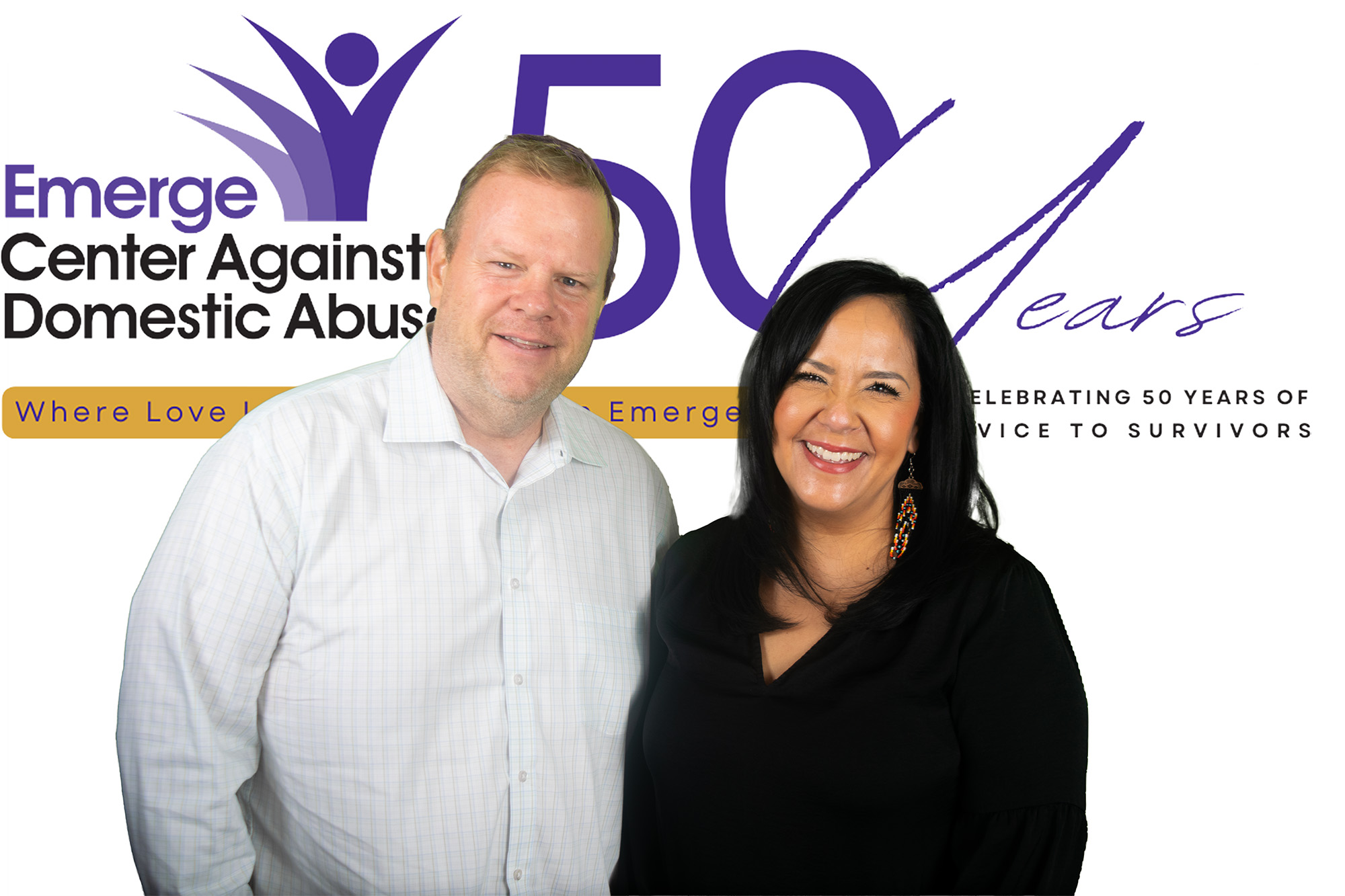
From $9 an Hour to CEO: How Anna Harper Redefines Safety and Healing at Emerge Tucson
Episode Highlights
💼 From $9 an Hour to CEO
Anna Harper reflects on her 26-year rise from advocate to CEO, revealing the passion, resilience, and heart that have fueled her journey at Emerge.
🎉 Celebrating 50 Years of Emerge
Learn how Emerge Center Against Domestic Abuse evolved from a home-based hotline to a full-spectrum support network — and get the details on their upcoming community celebration.
🧩 Domestic Abuse is a Community Issue
Domestic violence goes far beyond crisis moments. Anna breaks down how Emerge addresses the full continuum of care: shelter, legal aid, family services, and housing stabilization.
⚖️ Equity as a Safety Strategy
Emerge is reshaping the model — designing survivor services that reflect the realities of Black, Indigenous, and Latino communities, where traditional systems may not offer true safety.
👥 Men as Part of the Solution
Surprised? So were we. Discover how Emerge works with men through support groups, youth engagement, and a one-of-a-kind helpline to prevent violence before it starts.
🌆 Rooted in Tucson, Powered by Love
Anna’s story is more than leadership — it’s a reflection of Tucson’s soul. Her lived experience and decades of community commitment are changing the way we define healing and safety.
Episode Description
Celebrating 50 Years of Community, Courage, and Compassion
On this episode of Life Along the Streetcar, we meet Anna Harper, the newly appointed CEO of the Emerge Center Against Domestic Abuse. Her journey is a testament to what happens when passion, equity, and unwavering commitment meet community need.
Over the past 26 years, Anna has gone from earning $9 an hour as a frontline advocate to stepping into one of Tucson’s most vital leadership roles. In this conversation, she opens up about the emotional weight of the work, the evolving landscape of domestic violence prevention, and what it means to lead an organization that’s marking 50 years of impact in Tucson.
This episode is a powerful exploration of healing, leadership, and innovation. It’s also a story of how we, as a community, must evolve to create real safety for survivors.
🔥 Anna Harper: A Lifelong Commitment to Justice in Tucson
Anna’s story starts well before her CEO title. In the 1990s, she began her work with one of Emerge’s predecessor organizations, the Brewster Center, fresh out of college and earning $9 an hour. At the time, she had no idea this would become her life’s work. But through mentoring, community, and firsthand experience with survivors, Anna discovered not just a career, but a calling.
Now, as CEO of the Emerge Center Against Domestic Abuse, Anna is navigating one of the most complex moments in the organization’s history. Facing increased funding challenges and an alarming rise in domestic violence cases, including several recent deaths, she’s leading with both urgency and heart.
But Anna is quick to point out: she didn’t become CEO for the title. She stepped up because this moment required someone who already understood the depth of the mission. And that’s exactly what makes her leadership not only timely, but transformational.
🧩 Domestic Abuse is Complex — and So Are the Solutions
For many, the words “domestic violence” immediately conjure images of emergency shelter and crisis intervention. And while those are vital parts of the equation, Anna helps us understand that true safety and healing require a comprehensive, long-term approach.
Emerge Tucson provides:
-
Confidential emergency shelter for high-risk survivors
-
A 24-hour hotline, integrated with law enforcement risk assessments
-
Legal advocacy and lay legal services
-
Housing stabilization support to help survivors rebuild their lives
-
Services for children and families affected by abuse
But what sets Emerge apart is its equity-driven strategy. Anna shares how the organization is moving away from “one-size-fits-all” approaches and instead designing services that reflect the unique needs of Black, Indigenous, Latino, and other marginalized communities in Tucson. Many survivors don’t feel safe calling the police or turning to the court system. Emerge is listening to those voices and building alternatives that prioritize trust, dignity, and true safety.
👥 When Men Are Part of the Solution
Perhaps the most surprising and groundbreaking part of this episode is the discussion of Emerge’s Men’s Education and Prevention Program.
Yes, Emerge works directly with men who have used or are at risk of using violence in their relationships. Without the shame or punishment, Emerge Tucson programs are grounded in accountability with compassion. Anna explains how the program supports men in identifying harmful behaviors, making different choices, and learning healthier models of communication and conflict resolution.
The program includes:
-
Intensive support groups for men who’ve used abuse
-
Youth re-engagement initiatives in partnership with Goodwill of Southern Arizona
-
A healing space for Black men
-
Community dialogues on accountability and masculinity
-
A first-of-its-kind helpline for men in moments of potential aggression, designed to intervene before violence occurs
This kind of work is rare, even controversial in some circles, but it’s deeply rooted in the belief that if we want to end domestic violence, we must address its causes, not just its consequences. And we must do so with empathy, education, and a commitment to real change.
🎉 Celebrate 50 Years of Impact with Emerge Tucson
This September, the community has a chance to honor Emerge Tucson’s 50-year journey and be part of shaping its future.
📅 50th Anniversary Community Celebration
-
Date: Sunday, September 28, 2025
-
Time: 3:00 PM – 5:00 PM (Program 3–4 PM, Reception 4–5 PM)
-
Location: Armory Senior Center (ASB Center), Tucson, AZ
-
Tickets: $50 (with pay-what-you-can option available)
-
🎶 Featuring live music by Sue Claussen, storytelling from the founders, community awards, and tributes to survivors and loved ones
Register today at emergecenter.org — space is limited, and this is one celebration you won’t want to miss.
🔊 Listen, Share, and Get Involved
This conversation with Anna Harper is one of our most moving and important yet. It’s a window into the heart of community leadership and a reminder that healing is collective.
🎧 Listen now on SoundCloud: Life Along The Streetcar on SoundCloud
💬 Share this episode with someone who believes in justice and equity
📲 Follow us on Facebook and Instagram
🌐 Explore more stories from Tucson’s urban core at lifealongthestreetcar.org
Until next time, stay curious, Tucson. 🖤
Transcript (Unedited)
Tom Heath
Good morning. It’s a bit of sun in the old pueblo. And you’re listening to Katy. Tucson. Thank you for spending a part of your brunch hour with us on your downtown Tucson community. Sponsored, all volunteer powered rock and roll radio station. This week, we’re joined by on a Harper from the Emerge Center Against Domestic Abuse, a merger celebrating 50 years of service in Tucson.
Tom Heath
And next week they’re going to mark the milestone with a special community celebration. Today is September 21st, 2025. My name is Tom Heath and this is life along the streetcar. Every Sunday we shine a light on social, cultural and economic forces shaping Tucson’s urban core from a mountain to the University of Arizona and all stops in between. You get the inside track right here on a 9.1 FM streaming on downtown radio.org, or through Downtown Radio Tucson app on your very own phone or.
Tom Heath
If you want to connect with us directly on the show, we suggest to do that through our social media and follow along. Life along the streetcar, Facebook and Instagram. You can also head over to our website life Along the streetcar.org. Most episodes are posted there with audio and video, plus find past episodes, info on the book, and an easy way to reach out.
Tom Heath
Well, I am back. Sorry I missed kind of unexpectedly last week. And thank you to Mister Ben Barta for, jumping right in D.J. Bank putting out some, sweet tunes for me. Apparently he put together a playlist very quickly with all the names Heath in them, so that you felt a little connected with me. While I was absent.
Tom Heath
But I’m glad to be back. And I’m glad to introduce our segment here with, on a Harper with the Emerge Center Against Domestic Abuse. It was a fascinating interview. I learned so much, so much in just a short time. We spent together and excited to share this with you. But I could give it a more than that.
Tom Heath
I’m going to jump right into it. An interview with, on a Harper for just just a couple of days ago, recorded at the show Source Studios. Today we’re joined by Anna Harper, the new CEO of Emerge Center Against Domestic Abuse. For 50 years, emerge has been Tucson’s frontline support for survivors, offering shelter, crisis service and advocacy, and has been with the organization since 2009, helping shape its strategy and equity work.
Tom Heath
And now she’s leading it into the next chapter. So, Ana, welcome to life along the streetcar.
Anna Harper
Thank you for having me here. I’m happy to be here.
Tom Heath
But we’re going to talk about emerge and your success over 50 years. But I need to know about you because this you’ve you’ve been with the organization for a while, but you just stepped into a new role.
Anna Harper
Yes. Excited? Yes. Yes, that’s one word for it. That is one word for it. It’s been, the last nine months. We are going into my nine month here at EO have been quite the adventure. You know, I just hit my 16th year with the organization last week, I believe. And.
Tom Heath
Actually.
Anna Harper
Thank you, thank you. And my 26th year in the work. Okay. So it’s, you know, as I’ve been reflecting leading up to our, our big event, I’ve been, you know, just trying to think about what do I say about this, this really awesome experience and what it means to be here now in this role. And it’s sometimes there are no words.
Tom Heath
I can only imagine that the the things that you see on a on a daily and regular basis that your organization is going through. But really quickly, what, what brought you to emerge 16 years ago.
Anna Harper
Sure. So so it actually starts, you know, a lot, a lot earlier than that. So emerge is actually the merger between two longstanding organizations in this community, Tucson Centers for Women and Children. And the Brewster Center had been in this community for some 30 years. And in 2008 they merged to become emerge. And in the 90s, I worked at the Brewster Center right out of college, making a whopping $9 an hour as an advocate.
Anna Harper
And that’s that’s where I began. And, you know, prior to that, I had volunteered at our local rape crisis center. And so this work has been my life’s work. It is, my heart’s work. And and I didn’t know at the time, but when I got to the Brewster Center, I found a community of people who really, you know, poured into me and helped me to see what was possible.
Anna Harper
And, and as I as I learned more and, of course, listen to the stories of the people that were coming to us for help, I began to really understand not just the complexity of individual people’s stories, but the much bigger picture around what was happening in our community. And that just lit a fire in me that has grown, and most people that know me would say, you know, that passion and that fire is, what I, what I think I am most known for, and it has served me and carried me all of these years.
Anna Harper
You know, the work is not easy, but but I really believe in the work. And I didn’t set out 26 years ago to be a CEO. I’ve been saying that, and that sounds kind of, maybe counterintuitive. You know, I didn’t I didn’t I never wanted to be the CEO of a marriage. I wanted to do the work.
Anna Harper
I believe in the work. Sure. I care about survivors. I care about families who have been impacted by abuse. And that love and that passion is what has carried me here. And so in December, it was actually October when Ed Stockwell announced that he was ready to transition out of his role, and he had been he had been in the organization for some 15 years and had been the CEO for 12.
Anna Harper
And he was ready. He was ready to transition out. I wasn’t really prepared for that. And, and it was a real scary thought because I hadn’t thought of myself as the CEO of a marriage. And and I don’t think it had quite registered for me what was coming for the organization. In terms of funding challenges. Right.
Anna Harper
And certainly all that has unfolded in our community since there’s been a lot of really, difficult cases, a lot of deaths as of late. And, and it has been, quite challenging. It’s been the hardest thing I’ve ever done. And initially, you know, I’ll be I’ll be real honest. I kept thinking, why? Why me? Why is this happening right now in this way?
Anna Harper
I’m new, you know, I’m I’m working real hard to learn everything that I need to learn so that I can be the best leader that I can be for this community, for this organization. And, and I know this isn’t the normal transition that a CEO has, but it’s real clear to me now about why it’s me. You know, it it this moment really requires someone who believes deeply in the work, because the way forward isn’t clear.
Anna Harper
And we are going to climb the steepest hill we have ever climbed in terms of, maintaining services, making sure we have the funding we need to continue making sure that we are caring for survivors and their families. And we need that fire.
Tom Heath
And I can imagine a CEO coming in that’s going to take months, the first nine months, just to learn the organization and the impact.
Anna Harper
Right.
Tom Heath
When you’re facing a challenge or challenges like you’re facing, having that experience and knowing right off it, right out of the gate, you have to learn how to be a CEO, but you understand what the organization needs, right? And someone who comes in that knows how to be a CEO and has to learn with the organization needs, that’s going to take a little bit longer, and you don’t really have the time for that right now.
Anna Harper
Right?
Tom Heath
Right. So I think when you when you well, I’m just going to say it from my perspective, when I think about an organization like emerge, I immediately think about crisis management. But you are I mean, that’s a piece of what you do. But I mean, kind of what what the organization in general, what are some of the aspects you kind of touched upon or some of the aspects that as an organization, you’re dealing with in our community?
Anna Harper
Sure. Yeah. So I think emerge is most known for our shelter. When people think about emerge, most often they think about our shelter. And we do we operate, confidential emergency shelter. And it’s different from homeless shelters in that the people who come into our shelter are people who are most at risk of serious, serious harm or at risk of being killed.
Anna Harper
We also operate a 24 hour hotline for the community. It’s also the hub of our county’s risk assessment protocol. So that’s a protocol that law enforcement uses when they go out to the scene of A911 call, they administer a risk assessment tool that tells them it gives them some information about the potential risk in a person’s situation.
Anna Harper
And then that activates a protocol that includes calling our hotline and trying to give that person access to immediate services. But we also have two offices in the community. And, and between our shelter and those offices in the community, we have a full range of support services. So that’s everything from individual support sessions that can include safety planning, further risk assessment, case management, lay legal services or court support kinds of services.
Anna Harper
We also have family services for children who have been impacted by abuse and violence. We have housing stabilization services. And that’s intended to help folks stabilize beyond the immediate crisis. We know that it takes many years for people to stabilize after they have lost everything following abuse. And so we need to make sure that we have the ability to help them with that.
Tom Heath
We’re in the middle of our interview with Anna Harper. She’s the new CEO about six months, I think, she said into the job maybe a little bit longer than that. With the Emerge Center Against Domestic Abuse celebrating 50 years and amazing things right after the break, we’re going to learn about, some, some work. They do with, their men’s program, which I just found absolutely fascinating.
Tom Heath
You’re listening to lifelong the streetcar in downtown radio 99.1 FM and streaming on downtown radio.org.
James Portis
This podcast is sponsored by Tom Heath and the team at Nova Home Loans. If you’ve enjoyed this podcast, continue listening or head over to left on the Street Khou.com for current events and information on what to do while visiting Tucson. Tom Heath and MLS number 182420 Nova and MLS number 3087, UK number 0902429. Equal Housing Opportunity.
Tom Heath
Hey, if you’re just joining us, welcome to the show. We have a guest today is Anna Harper. She is the CEO of the Emerge Center Against Domestic Abuse and they’re celebrating a 50 year milestone this year of service within the Tucson community. They’re having a big celebration, which we’ll talk a little bit about here. In just a few minutes.
Tom Heath
We’ve been going through her background, the, the impact of emerge, and we’re going to talk about some new programs, not new programs, but some some programs that were new to me to find out about it, such as the, the men’s program and the support group that they have there. So let’s jump back into the interview with Anna Harper.
Anna Harper
We also have a men’s engagement program that also has a full continuum of services. So we have groups for male identified folks who are struggling with using abuse and violence in their relationships. And those are really, intensive groups where we’re helping men with learning different models of addressing their feelings. And concerns that don’t include harming their partner or controlling their partner.
Tom Heath
No idea that you’re doing that.
Anna Harper
Yeah. And then outside of that, we have a range of, sort of like community engagement opportunities for men across the community that aren’t those intensive group sessions, but they’re, dialogs. We offer groups in partnership with Goodwill of Southern Arizona. They have youth re-engagement centers across town, and we facilitate programing there so that we’re reaching a younger demographic.
Anna Harper
Many of those young people are coming from homes where violence was happening. So we’re trying to intervene in that cycle. Earlier. And their staff have been trained in our model and we co facilitate that programing. We also have a healing space for black men. We have a call to action space where men are coming and learning about abuse and violence, and then taking action in their community to address it.
Anna Harper
We have a clinic. We’ve launched the first helpline in the community for men to call when they’re in a moment with their partner, where they believe they might make an aggressive choice.
Tom Heath
Wow. And so this, this, this preemption of it or the help with identifying within ourselves the anger and the rage, I, I didn’t realize that someone might be open to that. I was I just assumed that the perpetrator was someone that just they weren’t interested in in getting better. But you’re you’re finding that they are. Some are.
Anna Harper
Right. Yeah. And I think, you know, this idea that change is not possible, right, is a myth. And certainly there are people who are not ready for that, but that when we started our men’s education program, we what we found was that the men who were attending our groups began to call, we have a cell phone in the program.
Anna Harper
And the men began to call that cell phone outside of. And it was after hours, weekends outside of the time they were in group and they were seeking support from the facilitators. They were trying to navigate moments with their partners because they knew they shouldn’t do the thing that they wanted to do right, but they couldn’t quite get there on their own.
Anna Harper
And so and this model of having helplines was starting to pick up nationally. And there were a couple, there’s a couple internationally, one in the UK and one in Colombia. And so we decided that we were going to launch one here locally, as an in a, in an effort to provide safety to survivors. We believe that that’s a service to survivors.
Anna Harper
And if you provide the right conditions, if you provide accountability with support and compassion, right, without shame, without punitive kinds of responses, people will lean in, and they will try and, it is worth the effort to accompany people through that process, because we know that not everyone who is harming their partner ends up in the criminal justice system, and we also know research has shown us that arrest is not a deterrent for abuse and violence.
Anna Harper
It may be a helpful respite to a survivor so that they can make decisions about what might be next, or what kinds of safety measures they need, especially in very high risk situations. But in terms of long term change and safety, the criminal justice system really isn’t the answer. The solution really does have to come from community based work.
Anna Harper
And so that’s why, you know, in the last 50 years, I work has evolved from what started as a very basic hotline out of someone’s home into this full continuum of services and many different options across the community, through different partnerships where people can access support services and many different forms. We know that people who are experiencing abuse aren’t just coming to emerge, but they’re accessing help all over our community.
Anna Harper
So why not build a strategy where the work is embedded across our community and many different places?
Tom Heath
But in Tucson and I’m sure every city has their their diverse population. But Tucson has several different types of communities, you know, indigenous communities, black communities, Hispanic communities, the the, the white communities, they all experience this, but sometimes differently. And, and I think that’s been what I read about you is that, equity was a big part of your push at emerged since you’ve been there.
Anna Harper
Yes. Thank you for bringing that up. I, you know, a one size fits all model as has never served anyone. Right. And we also know that people have varying experiences in the world. And when we talk about equity, when we talk about identity, we know that people’s experiences with violence, people’s experiences with, accessing health and utilizing more formal systems like law enforcement and courts, all of those things are correlated.
Anna Harper
So if we’re really going to design strategies that meet their needs and really address safety, then we have to consider those things. If we know that certain communities of people are less likely to trust in accessing court systems, we shouldn’t push that as the primary source of safety. That doesn’t make sense. Right. That’s the real logical, right.
Tom Heath
The one size fits all is not right. It’s not going to work.
Anna Harper
And so it and really what it comes back to is, you know, really listening to what survivors need, what they say works, what they say is safest for them. And then designing our service lines and our approach to the work based on that. And certainly it’s not perfect work. And we we are always evolving and trying to do better.
Anna Harper
But I think that approach has helped us, to really meet people’s needs in a different way. And I think, when we talk about safety, you know, and we know that hey make oh you’re fine. Okay. And we know that what’s at stake in a lot of situations are people’s lives.
Tom Heath
Yeah.
Anna Harper
So why wouldn’t we design strategies that address the real safety concerns and the real risk in their life? When we talk about things like gun violence, for example, which is one of the highest risk situations that someone can be in where there is where there is a gun or a firearm involved and abuse is happening, someone is seven times more likely to lose their life.
Tom Heath
Anna Harper
We must consider all of the research and information that we have about what is the safest way to help someone access safety like that. That is just a no brainer for us. And if what the research tells us is certain communities, certain populations of folks are not likely to call the police, then let’s design strategies that will engage them and resources that they will access, things that they will take part in.
Anna Harper
That ultimately is what the work is about. So when we talk about prevention, when we talk about intervention, those solutions have to be based on what people say they need.
Tom Heath
I, they just think about, someone’s phone in their home 50 years ago and the, the thought, the effort, the energy, as you said, the fire that is involved in this organization, in our community. I feel like we we should be talking so much more about what you’re doing, and but we’re running low on time, and I need to talk about this huge event that’s coming up because we’re celebrating, we’re solving.
Tom Heath
So this show is going to be airing on the 21st and on downtown radio, and then on the 28th.
Anna Harper
Yes, the 28th of September.
Tom Heath
You’ve got a huge 50 year celebration talking about that evolution. Yes.
Anna Harper
On Sunday, September 28th, from 3 to 5, we invite the entire community to come and celebrate with us at the ASB Burger Center. And we have, just a I am so proud and I don’t want to give away all the details, but.
Tom Heath
We sang it. I thought I was going to get some a.
Anna Harper
Lot of storytelling.
Tom Heath
Inside scoop.
Anna Harper
And what I’m most thrilled about is that many of the people who were a part of starting this work 50 years ago, in 1975, have come back to help us plan. And for this event, their voices will be a part of the storytelling, that the community will hear. Sue Claussen, who is the director at the Invisible Theater for many years.
Anna Harper
So Sue Susan Malls is how they were known at the time, provided the entertainment at the opening of the center in 1975, and they are back and going to be providing the entertainment at our 50th year celebration. And I am just thrilled about that. We also have, as I said, some storytelling from folks who over the years witnessed and were a part of the evolution of our work.
Anna Harper
We’ll also be, honoring, some of our volunteers, community partners, and also and always uplifting and honoring survivors in our communities and families who have lost their loved ones will be having a small reception after. So the program itself runs from 3 to 4, and then we’ll have a reception from 4 to 5. Tickets are $50 each, of course, for the 50th.
Anna Harper
And when when people go to register, you’ll see on the registration page that there’s an option to register without paying. And we certainly appreciate if folks can contribute to the cost of a ticket. But we don’t want that cost to be prohibitive. And so there’s an option to register without paying. We invite everyone to come and be a part of this celebration.
Anna Harper
It’s meant for the community. And so we hope that everyone will join us.
Tom Heath
Well, how do we find out more? Where do we get information?
Anna Harper
Go to our website at Dot Emerge Center talk.
Tom Heath
All right. And are you on social media as well?
Anna Harper
Yes. Emerge center.org is our handle on request of there.
Tom Heath
And we briefly talk before we got on the air. You’re doing your own audio podcast. Yes. Where do people get that. Because that’s intriguing to me because it’s like the the day to day of what you’re working through.
Anna Harper
Yeah, it’s kind of liberation through love. It’s a, our own little out of our conference room. Podcast. We usually post the episodes. They’re available through our website. Okay. We’ve done a few, a few episodes. We just, posted one or I think it’s going to be going out if it’s not already posted. Forgive me, I don’t I’m not sure if it’s been posted, but we just, recorded one that included some information about our 50th, but also our large, footsteps for Healing Walk that’s coming up October 18th, and it included a bunch of our community programs so folks can find that on our website.
Anna Harper
Please do listen to it. It’s, that is also a labor of love for us and just our way of sharing our work with the community.
Tom Heath
I can imagine there’s a lot of labor and a lot of love that goes into this. Yeah, well, honor, welcome to the role of CEO.
Anna Harper
Thank you.
Tom Heath
Thank you for the, the since the work you’ve been doing for 26 years in our community and, I look forward to hearing about the, the celebration on the 75th anniversary, what we’re going to do for that.
Anna Harper
So thank you so much. We get back to our ship and sharing our work.
Tom Heath
That was on a Harper CEO of the Emerge Center Against Domestic Abuse. Hey, don’t go anywhere. We’ve got Ted Purcell coming up in just a few minutes with his show words and work as he talks to writers and others from the labor movement. And at the top of the hour is Ty Logan. We’re running a little low on here on time, so, again, I just want to thank D.J. Bank for stepping in last week and let you know that if you want to get Ahold of us, you can do so on Instagram, Facebook, and on our website.
Tom Heath
Life along the Street car.org. We’re always looking for stories and connections. Ana was one that came to us from a listener. So powerful stuff out there. James Portis is our show’s executive producer and Amanda Mulattos is our associate producer. I’m Tom Heath, your host. Opening music each week is by Ryan Hood. They, let us use their song and Dillinger Days to celebrate the opening of Every Life along the Street car.
Tom Heath
And today to close out the show, we’re going to take you all the way back to 1967 with Aretha Franklin’s timeless anthem, respect. More than five decades later, its message is still as powerful and relevant today. Have a great week! Tune in every Sunday for more life along the streetcar. And until next time, stay curious. Tucson.