
Episode Highlights
- 🎙️ Khris Dodge connects his work in music education, performance and festival programming to helping Tucson artists find their voices and opportunities.
- 🎙️ Tom and Khris explore why the interaction and uncertainty of live jazz can reach listeners even when they are unfamiliar with the genre.
- 📝 The 2027 preview includes Trombone Shorty and Orleans Avenue, Rick Braun celebrating Chuck Mangione’s music, and collaborations with Tucson performers.
- 📍 Dodge describes plans to pair visiting guitarist Diego Figueredo with local musicians and Ballet Tucson, making collaboration part of the festival experience.
- 📍 The free Downtown Jazz Fiesta is described as an all-day Martin Luther King Jr. Day gathering with two stages inside and outside Corbett’s.
- 🚋 The new January 15 Downtown Jazz Hop links ticketed performances, restaurant specials and additional live music in a walkable downtown evening.
Episode Description
A jazz festival can tell you something about its city between the concerts. There are the restaurants where listeners linger, the local musicians sharing a stage with visiting artists, and the music that carries into nearby neighborhoods. For Khris Dodge, those experiences belong at the center of the Tucson Jazz Festival.
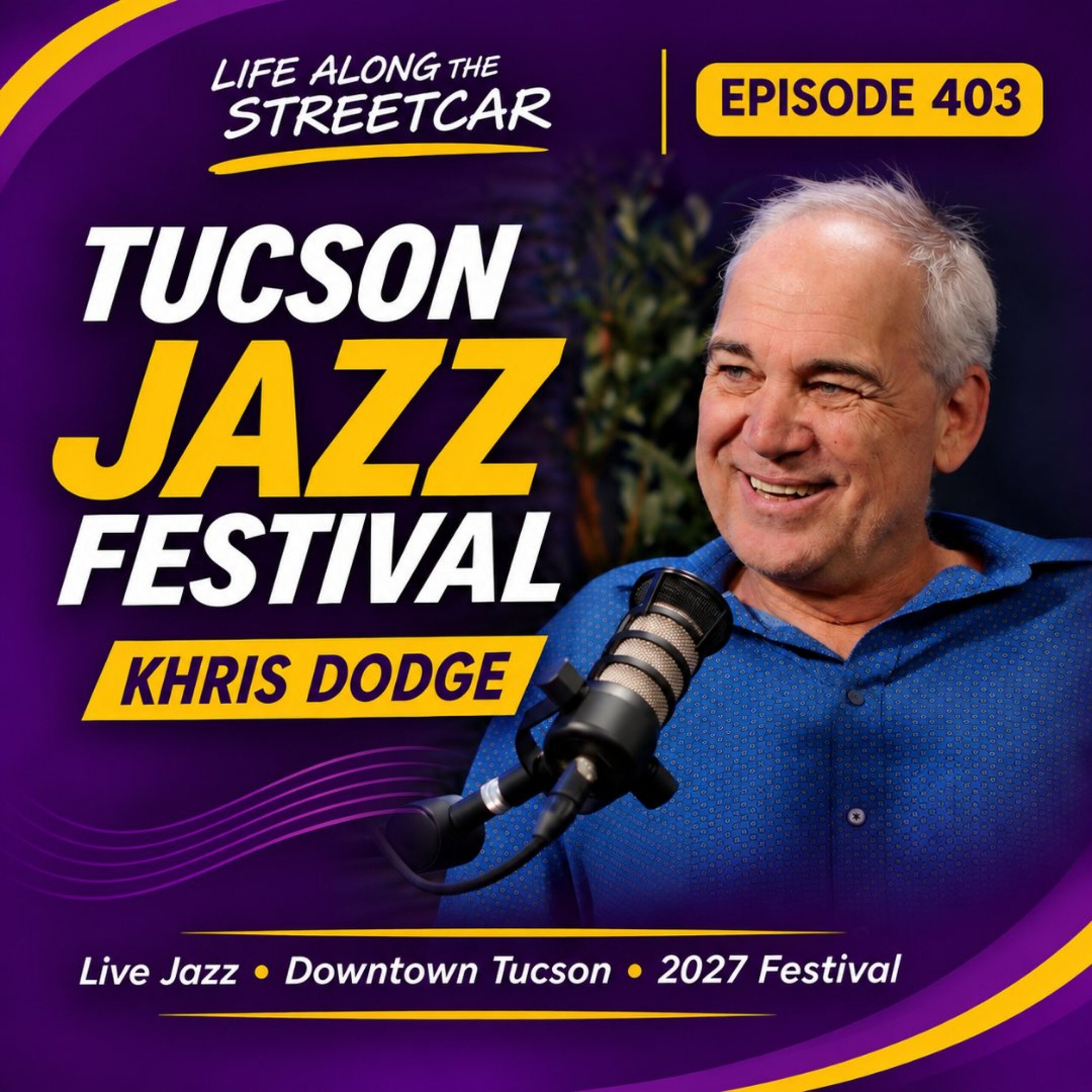
In Episode 403 of Life Along the Streetcar, Tom Heath talks with the festival’s Executive & Artistic Director about plans for 2027 and the community behind them. Their conversation makes room for newcomers wondering where to begin, longtime listeners looking for a different musical encounter, and Tucsonans who want to experience their downtown through live music.
Tucson Musicians and the Connections Behind the Festival
Dodge’s approach grows out of a career spent performing, teaching and creating opportunities for others. He describes more than 20 years in public school music education, his work as a percussionist and orchestra manager with Arizona Opera, and his role conducting the Tucson Pops Orchestra. He also recalls a composition commissioned by Arizona Women’s Chorus, with lyrics by Katherine Burns, that premiered at Carnegie Hall. Across those different settings, he keeps returning to the people making music here.
What stands out to Dodge is the willingness of Tucson artists to help one another. Heath brings up Britney Battle as an example of someone who sought Dodge’s help moving into performance. Dodge connects that work to teaching: encouraging people to find abilities already within them and helping them take the next steps. Sometimes the goal is professional performance; sometimes it is simply finding a voice. That distinction helps explain why his festival plans include opportunities for both established musicians and listeners still discovering the music.
The planned collaborations put that outlook onstage. Dodge describes pairing visiting Brazilian guitarist Diego Figueredo with local performers, including Bryce Winston, and bringing Ballet Tucson into the program for dance accompanied by guitar. He also discusses Gunhild Carling performing with local musicians. These encounters give Tucson’s own artistic community a visible role in the festival and offer returning visitors something different to hear.
Live Jazz for First-Time Listeners and Longtime Fans
For Dodge, the appeal of live jazz begins with being in the room. The instruments produce sound you can feel, while the musicians listen and respond to choices unfolding in real time. He describes the sense that a performance might come apart, even as the players bring it somewhere unexpectedly moving. Heath recognizes that feeling from a novice listener’s perspective: you may not know the musical mechanics, but you can still sense the tension and the moment everything comes together.
That accessibility shapes the programming. Dodge wants the same artist to offer something meaningful to a newcomer and to someone who has listened to jazz for years. He describes a mix of Latin jazz, straight-ahead jazz, New Orleans sounds, vocalists, instrumentalists and larger ensembles. Heath points to the artist playlists on the festival website as a practical way to explore unfamiliar names. Listening ahead can help someone choose a show without needing an extensive knowledge of the genre.
Among the visiting artists discussed are Trombone Shorty and Orleans Avenue, whom Dodge identifies as the closing headliner, and Rick Braun, whose planned concert celebrates the music of Chuck Mangione. Dodge recalls taking his sister to a Trombone Shorty show when she did not know the songs and watching her leave delighted by the experience. The interview also includes a snapshot of strong ticket demand at the time of recording in November. Those availability comments belong to that moment; the conversation’s lasting advice is to explore the lineup early.
Downtown Jazz Fiesta, Jazz Hop and a Festival That Feels Like Tucson
“I want to have a festival that feels like it’s in Tucson, that is Tucson,” Dodge says. He connects that goal to venues, collaborations and the experiences people have around the performances. Alongside the downtown venues discussed, La Rosa features in the opening-weekend plans. Dodge describes visitors who arrive for the music and leave talking about Tucson itself. The festival website and app support that broader visit with restaurant information and ideas for time between concerts.
The free Downtown Jazz Fiesta brings that community focus to Martin Luther King Jr. Day, with two stages inside and outside Corbett’s. Dodge discusses a lineup including Katherine Burns, Autumn Dominguez, Zona Libre and New Breed Brass Band, along with a local group playing Monk’s music. Heath remembers hearing a previous Fiesta while near the Fourth Avenue co-op. He was not attending at that moment, but the sound carrying through the neighborhood still made him feel part of it.
The new Downtown Jazz Hop is planned for opening night, January 15. Dodge outlines four ticketed shows with multiple sets, restaurant specials and additional live music at participating businesses. His example moves from an early performance to dinner, another concert and a late-night stop, all within a walkable downtown evening. A possible street closure remains conditional in his description. The central invitation is already clear: spend time with the music and with the local places around it.
Conclusion
Listen to the full conversation with Khris Dodge for the thinking behind the 2027 Tucson Jazz Festival, the collaborations taking shape and the small moments that make live music personal. Whether you know the artists or are choosing your first jazz show, this episode offers a way into the music—and into Tucson.
Transcript & Show Notes
Editorial note: This conversation has been lightly edited for clarity while preserving its substantive content and original sequence.
Welcome and the Tucson Jazz Festival’s Community
Tom Heath: Welcome back to another episode of Life Along the Streetcar, where I have the opportunity to sit down and talk to all those fabulous people making things happen within Tucson’s urban core. We define that as the route pretty much that the streetcar follows, from A-Mountain to the University of Arizona. All of this will happen on Downtown Radio every Sunday at 11 a.m. Then we have this podcast, with usually a slightly extended version of the interview available on our website, LifeAlongTheStreetcar.org. My name is Tom Heath. I’ll be your host today, and I’m always excited when I get to sit down with people making the magic happen here in Tucson. This is a returning guest, because it seems like every time we talk about music in Tucson, Khris Dodge’s name comes up. So you’ve either been on the show or talked about on this show a lot more than you probably realize.
Khris Dodge Tucson Jazz: Hopefully people are talking positively.
Tom Heath: Well, somewhere. Khris, welcome in. We’re going to talk about some jazz today.
Khris Dodge Tucson Jazz: Wonderful.
Tom Heath: But your name came up. I was talking to Mr. Bing.
Khris Dodge Tucson Jazz: Oh, yeah.
Tom Heath: I’ve been talking to Britney Battle. It just seems like you are very connected to music here in Tucson, specifically when it comes to this art form known as jazz.
Khris Dodge Tucson Jazz: Yeah, I run the Tucson Jazz Festival. We’re hitting on our 14th year this coming January. It’s a passion project, but it’s also something I’m really proud is part of the Tucson ecosphere and musical ecosphere—that we support it in our town, and people come from all over the country to see Tucson.
Tom Heath: All over the world.
Khris Dodge Tucson Jazz: All over the world, yeah.
Tom Heath: With the gallery downtown, we have people that will come in and tell us wherever they’re from, and they’re like, “We’re here for the jazz festival.” It’s internationally known.
Khris Dodge Tucson Jazz: Yeah, and I love that. Something that was just an idea in a few people’s heads 15 years ago, and they said, “Let’s make something of this.” It’s really expanded and built to a big thing here in Tucson. It’s wonderful to see the community that it brings together, for sure.
Tom Heath: We’ve talked about this on previous episodes. I don’t want to get too far into it, but briefly, you didn’t just pop up and be a jazz festival runner. You’ve been involved with music and jazz and teaching for decades.
Khris Dodge Tucson Jazz: Yeah, I taught in the public school system. I’m very proud of that career I had and the students I was able to affect positively with music. I did that for over 20 years.
A Career in Music and Creating Opportunities
Editorial note: The promotional break is retained as part of the supplied recording.
Khris Dodge Tucson Jazz: I was a member of the Arizona Opera orchestra, and I was the orchestra manager for over 20 years.
Tom Heath: I didn’t know that.
Khris Dodge Tucson Jazz: Yeah, I was the principal percussionist with Arizona Opera for 20 years. I’m a pianist and a percussionist by trade. I’ve done everything from directing musicals, played on dozens of Broadway tours. I conduct the Tucson Pops Orchestra and have a production company that plays probably a couple hundred shows. I don’t play in all of them, but we have 30, 40 shows that we produce that get played all over Arizona and the Southwest. And I run the jazz festival. All those things are little different things I do. I write a lot of music. I just had a composition premiere at Carnegie Hall this last year, which was huge. It was surreal to have something like that happen. Arizona Women’s Chorus commissioned me to do that, and it was just an honor to be thought of and to write the music.
Khris Dodge Tucson Jazz: I wrote it with Katherine Burns. She wrote the lyrics—another local phenomenal musician here in town. I say all this, and I mean it wholeheartedly: the musicians that we have here in Tucson and the people that are part of the arts atmosphere, they are better than anywhere else I’ve seen all over the country in what I do. We have something special here. As artists and musicians, we tend to lift each other up instead of seeing each person as competition. I love being in the position that I’ve been in to find all these wonderful people ways to find work and to create opportunity.
Tom Heath: Stay with us. There’s more of our conversation with Khris Dodge just ahead. Right now, I’m switching from podcast host to mortgage lender for just a moment with a word from the Heath Team at Nova Home Loans. Jazz is built on preparation, but the magic happens when you know how to improvise. Home financing can work the same way. I’m Tom Heath with Nova Home Loans. For close to 30 years, I’ve helped home buyers navigate changing markets, unexpected challenges and opportunities that don’t always follow the sheet music.
Tom Heath: My team prepares carefully, communicates clearly, and when something changes, we know how to adjust without losing the beat. When you’re ready to make your move, visit theheathteam.com.
Tom Heath: That was going to be one of the things that I didn’t know if you were going to hit on, but you’re also really good at helping people find their voice, literally, and get out into the public. Britney Battle, for example, she’s a direct reflection of working with you and seeking you out to help get her into performance.
Khris Dodge Tucson Jazz: Yeah, she’s one of many. They’re looking for something, and it’s kind of like teaching for years, too, right? People have inherent things in them, and you just help encourage folks to move into the space that is already there. You help create a little bit of the right steps along the way to do that. It’s not always for people that are out professionally performing. Sometimes it’s just finding ways for people to find their voices. The arts do that because it’s a universal language.
Tom Heath: Yeah, and I liked what you said earlier about the level of talent in Tucson, because we’ve recently done shows with the Tucson ballet. We’ve done things with the Arizona Theater Company.
Tucson’s Music Scene and the Feeling of Live Performance
Editorial note: The unspecified national survey and festival-year counts are retained as spoken claims.
Tom Heath: I’ve talked to musicians that perform in LA and Texas and other places, and they all seem to resonate that Tucson, surprisingly, is very strong in those areas. We’re getting more people coming to Tucson to perform because that word is getting out.
Khris Dodge Tucson Jazz: Yeah, it is. I think in some national surveys, Tucson is ranked as fifth or sixth highest as a music city in the country. You have your usual suspects: New York City, Chicago, San Francisco, Austin, Tucson.
Tom Heath: Tucson. People: “What? There’s a typo.”
Khris Dodge Tucson Jazz: Yeah, they meant Phoenix.
Tom Heath: Phoenix doesn’t even make the list.
Khris Dodge Tucson Jazz: I know, that’s what everything says. Sorry, Phoenix.
Tom Heath: They’ve got enough up there. We can have our arts.
Khris Dodge Tucson Jazz: Yeah, I love Arizona, don’t get me wrong. But we all have our different niches and things that make us special. Certainly, the arts and the music scene here in Tucson is something that’s special.
Tom Heath: The 14 years for the Tucson Jazz Festival—I moved downtown in 2015.
Tom Heath: So it was in its infancy at that point. I remember the MLK free concert that was done on the sand lot there. I was living in the building, so I was able to oversee it, listen to it, and think how cool it is that we’re embracing jazz, because we don’t see a lot of that. Now I fast-forward 14 years later, and jazz is a component. Tucson is a jazz destination city now. I’m sure it had a lot of factors involved, but the jazz festival started something, and it ignited something in people that really has driven things like the Century Club, the work that Mr. Bing is doing, that is really elevating a different style than we’ve seen in Tucson.
Khris Dodge Tucson Jazz: Yeah, we as humans thrive on personal interaction. We’re social beings, and we also want to experience things that are real. Music is real. Live music, and feeling those sound waves hit you that are being produced by the instruments right there in front of you—there’s nothing that compares to that experience. Jazz music at its core is about the purest form of that realness, because not only is the music being produced in front of you, but just in the nature of how jazz is performed…
Khris Dodge Tucson Jazz: There’s improv, obviously, but there’s way more interaction and choices being made than any other types of music. Every type of music, there’s always thousands of choices being made. But in this particular idiom, you have every musician onstage like, “Hey, I want to say this. Are you listening? Hey, I’m speaking this. Oh, okay. You just jumped off that cliff. You want us to jump off that cliff with you?” Human sociology and psychology—we love danger, right? Instinctively, we love to see that what’s going onstage could blow up and disintegrate in any one moment. That’s why there’s rubberneckers out on the freeway. They’re like, “Oh, look at that. I’m glad that’s not me.” But we love that danger. Schadenfreude. We love that, and it happens on a stage. In jazz, it’s like, “Oh my gosh, this thing sounds like it could just fall apart at any moment,” but all at the same time, “Oh my gosh, this is moving me in a way that I had no idea or expected,” because of the authenticity of what’s happening onstage.
Tom Heath: I think sometimes, from a novice standpoint, you can experience that without realizing you’re experiencing it. You feel that. There might be some disconnection or some dysfunction in there, and then it all comes together. As a professional, you’re like, “Where are you going?”
Finding Your Way Into the Festival
Editorial note: Ticket availability refers to the November conversation, not a current inventory.
Tom Heath: “Where are you going? I see where you’re going.” But even as a novice, you can feel that, especially when you’re live, because there is something about that sound hitting you versus just hearing it. You’re feeling that, and you’re seeing it in a way that’s different.
Khris Dodge Tucson Jazz: Yeah, that’s a beautiful way to encapsulate what I was saying, too. The accessibility to everybody at every level of how you listen to music, it’s there. We’re all going to experience it a little bit differently, but it’s the universal language that’s hitting us. I might just listen to something and see colors of the sunset, and that’s how it gets interpreted for me. Somebody else hears it and, “Wow, that reminds me of my father who passed.” Somebody else sees it and, “That’s my dog.” Other people are like, “That makes me hungry. I’m gonna go eat a burrito.”
Tom Heath: Music seems to do that to me a lot. I’m excited for this interview because we’ve talked about the jazz festival before, but normally by the time we air it, it’s like, “Hey, you should do the jazz festival. It started last week.” We’re actually getting ahead of this thing, and we have time to promote some of these things that are coming in here. I went to your website, and some of your stuff’s already sold out, and we’re in November. The jazz festival starts January 15, and some of your performances are already sold out.
Khris Dodge Tucson Jazz: That is correct.
Tom Heath: So we have time now.
Tom Heath: There’s still tickets.
Khris Dodge Tucson Jazz: Yeah, there’s still tickets. But if you’re hearing this and you’re like, “I’ll check things out the week before,” you may be like, “Whoa, I guess I missed out on the opportunity to see that artist.” There’s always going to be something there, for sure. But I love the fact that there’s momentum, and people are seeking out what’s happening.
Tom Heath: Your website is fabulous because, for me, who is again a very novice jazz appreciator, you have their Spotify playlist on there. You can get a sense of, “I don’t know this name.” You can play, hear a couple of their songs: “Okay, I want to go see,” or maybe it’s not for me. But the fact that it’s there on your website makes it so much easier for me to select where I want to spend my time.
Khris Dodge Tucson Jazz: Right, and we want to do that on purpose, obviously. Even within jazz fans, there’s always names that may not have name recognizability. But what I can say about the festival for sure is that the festival is curated very carefully, and you can trust the brand when you see the Tucson Jazz Festival.
Khris Dodge Tucson Jazz: It’s of the highest quality of music. I try, when programming the festival, to make sure that for a novice listener, pretty much anybody who’s coming, you’re going to find something beautiful out of it. Then for someone who’s a longtime jazz fan, that same artist is going to deliver something to them. It’s trying to speak to the big funnel and the smaller funnel all at the same time.
Tom Heath: That’s challenging.
Khris Dodge Tucson Jazz: It is challenging, but it’s also exciting, finding artists that I know speak at different levels and having a diversity of artists, too. From your Latin jazz artist to straight-ahead jazz, to the bigger band, to New Orleans jazz, to saxophone players, vocalists, trumpet players, big band, local musicians—the whole mix of everything. If you came two nights in a row to jazz festival things, you’re going to see three, four, with your choice of how many concerts you want to see, and they’re all going to be drastically different. That diversity and that beauty of what the art form brings is kind of fun. It’s the journey that you can take.
Tom Heath: Some specifics. Again, it’s a two-week event, so saying who is the headliner—you’ve got multiple headliners. What are some of the bigger names that are coming in?
Trombone Shorty and Rick Braun
Editorial note: Ticket estimates and relative biographical timing are retained as spoken. The caption’s uncertain song-title wording is preserved.
Khris Dodge Tucson Jazz: The biggest headliner, who closes the festival, is Trombone Shorty and Orleans Avenue. This guy’s huge. As we’re speaking right now in November, there might be 150 tickets left at the Fox Theater for his show.
Tom Heath: And how many does the Fox hold?
Khris Dodge Tucson Jazz: It holds 1,100, 1,200 people.
Tom Heath: Okay, so like 90 percent of the tickets are sold out.
Khris Dodge Tucson Jazz: I can say this unequivocally: it is one of the best live shows you will ever see in your life. I took my sister to see the show outside of town. She goes, “Khris, I don’t know who this is.” I’m like, “Don’t worry about it. You will love the show.” “I don’t know any of his songs.” “Don’t worry about it. You’ll love the show. You’ll be on your feet, and you’ll be singing along to the songs before the end of the night.” She’s very sheepish and shy. Shout-out to Julie. She’s a beautiful and wonderful human being. She walked away like, “Oh my gosh, Khris. That show was so good. I’m gonna be thinking about it.” So that’s the headliner. The night before…
Khris Dodge Tucson Jazz: Rick Braun, he’s usually known more in the smooth jazz world. He’s a fantastic trumpet player, and he started originally in straight-ahead jazz, just like Chuck Mangione did. A lot of people know Chuck Mangione, especially, I would say, our age bracket.
Tom Heath: Or if you watched King of the Hill.
Khris Dodge Tucson Jazz: Yeah, I know he’s on that. But literally, one of the first trumpet players I ever heard was “Feeling So Good” in the early ’70s, hearing Chuck Mangione playing that music. Like, man, this is great. He plays flugelhorn; it’s not trumpet. So he’s doing a whole concert of that, and that’s a not-to-be-missed kind of…
Tom Heath: He used to headline—still does—he headlines a New Year’s Eve.
Khris Dodge Tucson Jazz: Yeah, he used to do that.
Tom Heath: That was a major event. He brought in his own collection of artists with that.
Khris Dodge Tucson Jazz: Right. He hasn’t been back to Tucson for many years, so to come back to Tucson and do music that’s celebrating the music of Chuck Mangione, who sadly left this earth a year and a half or so ago…
Venues and Collaborations That Feel Like Tucson
Editorial note: Names appearing only in the captions retain their supplied spellings.
Khris Dodge Tucson Jazz: It’ll be a wonderful night of music. But opening weekend, we have a full slot of shows at La Rosa, too. We’re activating that beautiful space.
Tom Heath: Let’s talk about that for a second, because the usual suspects are there. You’ve got the Fox Theater, the Rialto, the Century Room. But you’re also using, I think it was the Grand, La Rosa. This is becoming not just a downtown thing. This is Tucson.
Khris Dodge Tucson Jazz: Yeah, for sure the central area is downtown, but we’re expanding out. What I like about Tucson, and I always want to try to program this way, is you can have jazz festivals all over the country, but I want to have a festival that feels like it’s in Tucson, that is Tucson. That things are happening at this festival, and spaces that you’re activating and experiences that you’re having, are things that only could happen in Tucson.
Khris Dodge Tucson Jazz: We hear that from the people that come from Canada to Germany to Chicago, Minneapolis, Denver. I’m just thinking of lots of people I’ve met in the last few years that come here specifically. The takeaway is, “We love the music,” but the second takeaway is, “We really love how cool Tucson is and what you bring.” To your point, La Rosa is another one of these cool, unique spaces, and they’ve really done it up right over there to have a wonderful patron experience, from the moment you walk into the space to what’s happening on the stage. We have Diego Figueredo, who’s a Brazilian guitarist. He’s been here before. What could we do that’s different? Let’s pair him with a bunch of local musicians that play at the highest level, and he’s going to do duets throughout the whole entire day. Bryce Winston, arguably the best saxophonist here in town—he’ll do duets with Bryce Winston, Arthur Vent on drums. We have Ballet Tucson coming in, and they’re going to do a pas de deux or two with Diego playing guitar with them. Just finding ways to collaborate with local artists and organizations to do something absolutely lovely. Look Keisha Benjamin—she’s ferocious on saxophone. She’s going to be at La Rosa on Sunday the 17th, doing an afternoon concert not to be missed. Then that evening we have Gunhild Carling coming here. She’s been in Tucson before, too.
The Free Downtown Jazz Fiesta
Editorial note: The second promotional break is retained in sequence.
Khris Dodge Tucson Jazz: She plays 10, 12 different instruments, and she can play three trumpets at one time. But her whole act’s not a circus act. It’s really steeped in traditional jazz, trad jazz kind of thing. It’s amazing, the show that she puts on. She’s going to be paired with local musicians playing with her and a great band.
Tom Heath: We’ll be right back to finish up our interview with Khris Dodge and the Tucson Jazz Festival. But first, let me introduce you to a different kind of ensemble: my team at Nova Home Loans. A great jazz performance isn’t about one musician. It’s about everyone listening and communicating, knowing when it’s their turn to step in. Buying a home takes that same kind of teamwork. I’m Tom Heath with Nova Home Loans. My team coordinates with you, your real estate agent, title, insurance, underwriting—everyone involved in getting you to the closing table. For close to 30 years, I’ve learned that good communication keeps the whole process in rhythm. The Heath Team at Nova Home Loans. For more information, visit heathteam.com.
Tom Heath: You still have the free event? There’s typically the free…
Khris Dodge Tucson Jazz: Oh, yeah. It’s called Downtown Jazz Fiesta, and that’s on Martin Luther King Jr. Day. It’s free, and all-day concerts out in front of Corbett’s and inside Corbett’s. We have two stages, nonstop music going on all day long.
Khris Dodge Tucson Jazz: Katherine Burns is going to be there with a new project. Autumn Dominguez—she used to live here in Tucson; she lives in New Orleans. She’s coming back to do a project with us there on that day. We have a local group doing some Monk music. We have Zona Libre playing, best Latin band here in town. We also have a brass band from New Orleans, New Breed Brass Band. They’re amazing, and they put on a great show. They’re going to be headlining on that day as well. It’s just a wonderful day of hanging out, having some great food at Corbett’s, maybe picking up some merchandise from the festival, and just being part of community for a day.
Tom Heath: I like the community aspect, because it’s a long day, but sometimes you’re not there or able to be there for the whole day. I remember last year I was on Fourth Avenue getting something at the co-op, but you could hear it just wafting throughout the neighborhoods. You could just hear the music. It was fantastic. I wasn’t attending that particular moment, but I was still a part of it just by being in its presence. It was fun.
Khris Dodge Tucson Jazz: Mission accomplished on our end, right? I saw a little smile come to your face when you were recounting that story.
Planning a Visit and the New Downtown Jazz Hop
Editorial note: The evening’s example times illustrate a possible visit. The street closure is conditional.
Tom Heath: A couple quick things here. One, you got one of them website things? People get tickets?
Khris Dodge Tucson Jazz: Oh, yeah. You go to tucsonjazzfestival.org. It’ll tell you everything you need to know. We also have an app. If you get on your phone and go to the app store and just type in Tucson Jazz Festival, you can get on the app. You can design your own experience. You can see the restaurants that we partner with here in town.
Tom Heath: I did like that on the website, too. You had the itinerary. If you’re listening and you’re from Chicago or Canada and you’re coming in for three or four days, there’s kind of an itinerary of, “Here’s some places to fill the gap between the jazz shows. You can stay at these places. You can eat at these places. You can do these things.” I think that’s a great way to build out.
Khris Dodge Tucson Jazz: Right, because whether you’re from out of town or you’re a local tourist, we want you to experience Tucson. Come to a show, go to one of our local restaurants, and really take in what Tucson has to offer. It’s really cool. There’s one more thing I want to talk about.
Tom Heath: Fine.
Khris Dodge Tucson Jazz: What’s that?
Tom Heath: Fine, go ahead.
Khris Dodge Tucson Jazz: This is really cool. New this year, opening night, January 15, we’re doing the Downtown Jazz Hop. What is the Downtown Jazz Hop?
Khris Dodge Tucson Jazz: We have four different shows going on that are ticketed shows, and each of those shows has multiple sets, two to three sets each. On top of that, we’re partnering with probably most every restaurant in downtown Tucson for them to offer specials for that evening, whether it’s a drink special or a food special that’s inspired by jazz. Many of those restaurants and establishments will also be having live musicians play. Imagine an experience where you come to downtown Tucson and go see an early 4:30 show. Then you go out to dinner at one of our places, where you hear a local musician playing. Then you go to an 8:30 show at another venue. Afterwards, you do a late night, and you’re sitting in one of our great late-night bars, soaking up another musician. The whole idea is everything’s walkable. It’s all around downtown. If we’re able to, we’ll shut down the street and just activate all of downtown Tucson, have people walk in the streets enjoying music, going to all of our local businesses and taking in shows.
Tom Heath: Man, that sounds so fun.
Khris Dodge Tucson Jazz: Yeah.
Tom Heath: It sounds so fun. Before I wrap up, I would be remiss if I didn’t say you have your own podcast.
Khris Dodge Tucson Jazz: I do.
Tom Heath: Where do we find that? Tell us briefly what this is.
Khris Dodge Tucson Jazz: Thank you for that. It’s called TJF Talks.
TJF Talks and Closing Credits
Khris Dodge Tucson Jazz: You can find that anywhere you find podcasts. You also can find episodes on YouTube, and we have it linked on our website as well.
Tom Heath: It’s coming out at least two episodes a month, and you’re talking about musicians, local…
Khris Dodge Tucson Jazz: Yeah, some not local.
Tom Heath: Great stuff. If you’re into jazz or music, you need to check it out.
Khris Dodge Tucson Jazz: It’s just great conversations much like this, talking about things that inspire us and music and jazz and all that.
Tom Heath: Khris Dodge, the Executive and Artistic Director of the Tucson Jazz Festival. We are lucky to have the festival here in Tucson and you at the helm right now. It’s remarkable what this festival is doing for Tucson, and I’m excited to see where it goes in year 15. So 14, that’s coming up here, but you’re already probably thinking about 15.
Khris Dodge Tucson Jazz: Oh, yeah. Thinking down the line.
Tom Heath: Thank you again for your time listening to Life Along the Streetcar as we focus on all these fabulous things happening here in the urban core. I always want to give a shout-out to Ryan Hood, the duo that lets us use their song “Dillinger Days” to open and close our podcast each week. They’ve been allowing us to do that since day one, and we’re very appreciative of that. Our executive producer is James Portis. My name is Tom Heath.
Tom Heath: I am your host. We’re always looking for more ideas, more guests. If it’s happening within the urban core, hit us up on our social media. All of our handles are Life Along the Streetcar. Well, all of our handles—it’s Facebook and Instagram. That’s all we got, but you can find us on those two places. Our website, Life Along Streetcar dot org. I hope you tune in every Sunday for another episode of Life Along the Streetcar on Downtown Radio, 99.1 FM. Until next time, stay curious, Tucson.