
Episode Highlights
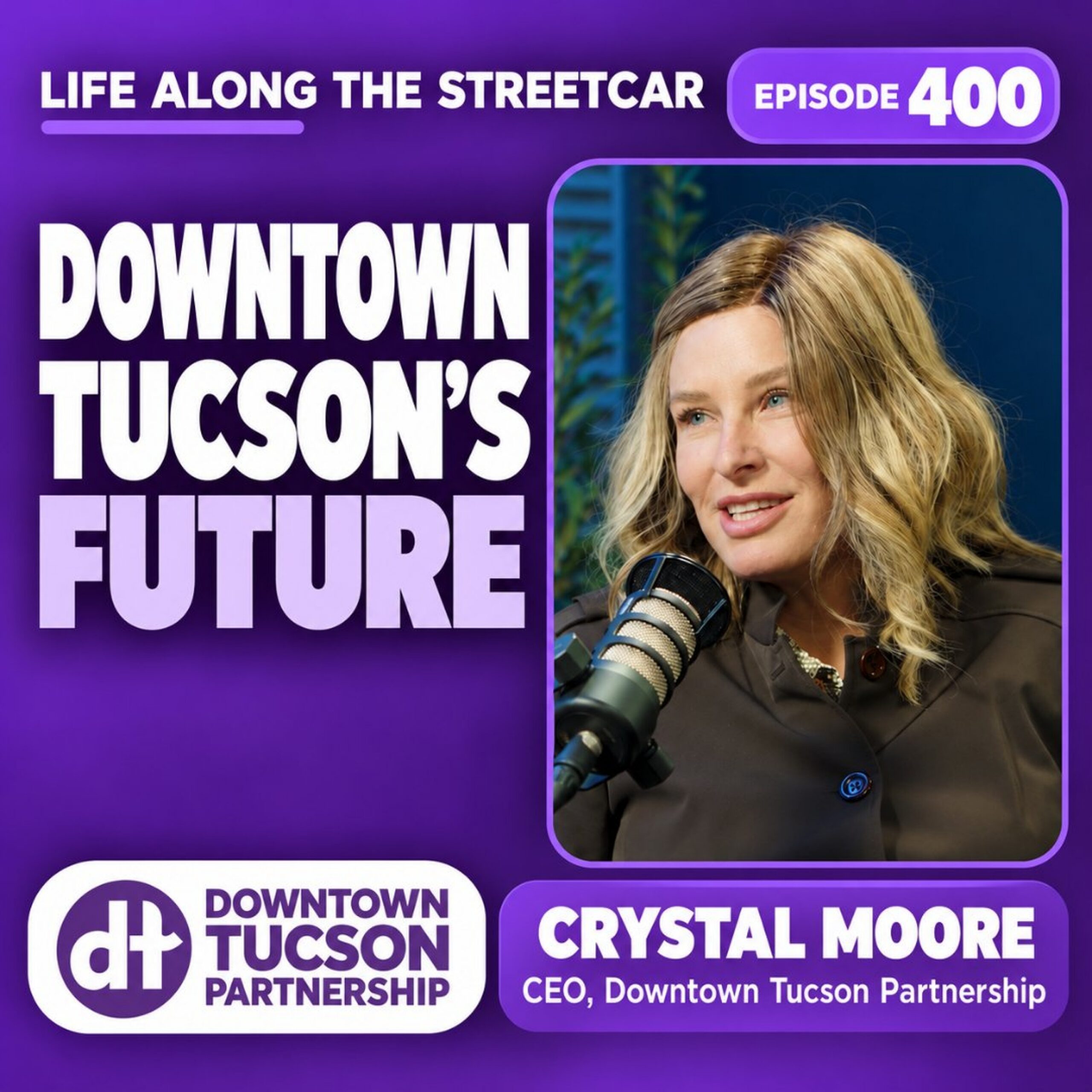
- 🎙️ Episode 400 welcomes back Crystal Moore, who traces her unexpected move from board leadership to CEO and explains how her downtown real estate experience informs support for merchants.
- 📍 The purple-shirted ambassadors handle daily cleaning, graffiti removal, visitor assistance and reporting concerns, with off-duty officers providing late-night coverage on Fridays and Saturdays.
- 📝 Moore explains how property assessments and voluntary contributions from Pima County, the city of Tucson and Rio Nuevo support services across the 54-block district.
- 📍 Parade of Lights plans include bringing downtown storefront businesses into the festival, helping visitors discover merchants they can return to after the celebration.
- 📝 The conversation covers restaurant expansion, proposed hotel projects and Hyatt construction, with Moore sharing the development expectations she held at the time of the interview.
- 🚋 A proposed October 31 Congress Street pedestrian pilot would retain streetcar service while testing crowd safety, access, wayfinding and possible future uses of the street.
Episode Description
Four hundred episodes into Life Along the Streetcar, the conversation still begins with the people making things happen in Tucson’s urban core. For this milestone, Tom Heath welcomes back Crystal Moore, CEO of the Downtown Tucson Partnership, to discuss the everyday work behind a welcoming downtown and the plans that could change how people experience it.
The episode, originally aired October 25, 2026, connects familiar sights with less visible decisions: purple-shirted ambassadors, merchants reaching new customers, public partners supporting services and a proposed Halloween pedestrian pilot on Congress Street. Across those topics, Moore returns to a practical question: how can a visit downtown become a reason to return?
Downtown Tucson Partnership’s work begins with people
Moore calls her route to leadership accidental. An invitation to serve as board chair led to an interim CEO assignment, followed about six weeks later by the permanent role. Her experience downtown reaches back to obtaining her real estate license in 2001, working with mentor Buzz Isaacson and later moving into property management and development. That background informs her attention to what merchants need to survive, prosper and attract customers.
The Partnership’s most recognizable presence is its purple-shirted ambassador team. Moore describes daily trash pickup, graffiti removal, directions for visitors and extra eyes and ears supporting the Tucson Police Department. Sometimes the help is as ordinary as changing a flat tire. Behind that street presence, she has also built an office team handling social media, website content, email communications and merchant programs. Different staff perspectives help the organization speak to longtime locals and people discovering downtown for the first time.
Those services depend on relationships as well as assessments. Moore describes a 54-block Business Improvement District with 364 parcels and explains that municipal properties are exempt from the special tax supporting DTP. Pima County, the city of Tucson and Rio Nuevo nevertheless contribute voluntarily, she says. The partners revisit needs during the year and adjust where resources go. For Moore, showing up consistently—on the street, in businesses and through communications—is part of earning confidence in that investment.
Holiday celebrations that introduce visitors to local merchants
The holiday discussion looks beyond the festival itself to what happens afterward. For the Parade of Lights, Moore describes plans to bring downtown’s brick-and-mortar merchants into the celebration so visitors can meet businesses they might otherwise pass by. A temporary booth can become an introduction to a permanent storefront. That connection gives a busy event a purpose beyond attendance: helping people discover something they want to come back for.
Moore says the parade organizers agreed to relocate the celebration from Armory Park to the plaza and the El Presidio neighborhood. She describes a mile-long route, the holiday tree, children’s activities, live music and appearances by Santa Claus, Mrs. Claus and the Grinch. DTP is learning from longtime organizer Brandi before taking over organization of the event for 2027. Plans also include collaboration with the city and county on full-day parking garage rates.
The wider seasonal calendar includes the Greek festival, dusk and el tour, along with a holiday tree lighting Moore identifies as November 20. She says Mayor Romero will do the honors, with mariachis and Mexican hot chocolate contributing to the celebration. These are plans discussed during the interview, and the conversation does not establish every event’s complete schedule. What it does make clear is DTP’s interest in bringing people together while keeping downtown merchants visible within those gatherings.
Congress Street’s pedestrian pilot and downtown development
The proposed October 31 Congress Street pilot brings that same attention to the visitor experience into the street itself. Moore describes temporarily opening a stretch of Congress to pedestrians while maintaining streetcar service, with a pilot car accompanying it through the closure. Public safety is the immediate motivation. She cites growing Halloween crowds and says the experiment could also help answer whether future pedestrian use might accommodate live music or other activities.
Access and communication are central to the proposal. Moore discusses directing through traffic to the bypass, keeping access to parking, routing buses into Ronstadt from the north and identifying rideshare locations. She also points out the need to tell pedestrians that traffic returns November 1. The interview presents this as a test with lessons to gather; it does not establish a permanent conversion of Congress Street.
Restaurant and hotel projects provide another view of downtown’s future. Moore discusses Pueblo Vita’s expansion and a pizza partnership with Scott Gerard of Anello, hotel proposals near the Tucson Gallery and at 75 East Broadway, and Hyatt construction she expects to finish in fall 2027. She also describes plans for lucky penny and bonanza in the former Miss Saigon space, including outdoor seating. Together, the updates show the range of work underway or being considered, with project expectations remaining those expressed in the interview.
Conclusion
Episode 400 brings downtown’s daily services, merchant relationships and future street plans into one conversation. Listen to Tom Heath and Crystal Moore for the details behind those efforts and the questions still being explored. Find the episode and more Tucson stories through Life Along the Streetcar, and learn more about the Downtown Tucson Partnership through its official channels.
Transcript & Show Notes
Editorial note: This conversation has been lightly edited for clarity while preserving its substantive content and original sequence.
Episode 400 and an unexpected path to downtown leadership
Tom Heath: Welcome back to a very special episode of Life Along the Streetcar. We cover the topics from A Mountain to the University of Arizona, following along that streetcar path, and today is episode 400. Good heavens. Please do like, share, do all those things on social media that make us very popular, because although I enjoy being the host, this is really about our guests and things they’re doing in the community. My name is Tom Heath, and for almost 10 years I’ve had the privilege of talking to people that make things happen in the urban core. Today is no different. In fact, this is intentional to be episode 400 because we have Crystal Moore, who’s leading the charge of the Downtown Tucson Partnership. Crystal, I appreciate you coming in. I know you’re busy.
Downtown Tucson’s Future: Thank you, Tom. But before we get too deep, I want to say everyone should thank Tom Heath and his team for highlighting and making downtown a spotlight that is so bright, partially because of his efforts in supporting all of the merchants. So, 400th episode. Hats off to you and your team.
Tom Heath: Hats off. I didn’t wear a hat, but I would take it off to the team for making this happen. But hats off to you, because we had you on just soon after we got this studio, and you had just stepped into the role.
Downtown Tucson’s Future: Yes.
Tom Heath: Well, tell us briefly. This was sort of the accidental CEO.
Downtown Tucson’s Future: The accidental CEO caused by Tom Heath, when Tom Heath asked me to be the board chair. That turned into an interim CEO role, which then rolled into a permanent CEO role about six weeks later. So November 1st will be the beginning of my third year, accidentally.
Tom Heath: Accidentally, but it was no accident that you were selected for this position, because I think the board saw what you were doing as the interim and realized that you were bringing a certain level of experience to this. You have been involved in downtown for 20 years?
Downtown Tucson’s Future: 25 years, since 2001 when I obtained my real estate license. I was mentored by Buzz Isaacson for eight or nine years, and then in the 2008 era kind of recreated myself as a property manager and got involved in the development of a few properties downtown. Really understanding what merchants and retailers need to survive, what can make their business prosper and obtain the general traffic from the consumer.
Purple shirts and the work of welcoming downtown visitors
Editorial note: The supplied transcript says Northwest; that wording is retained.
Tom Heath: Admittedly, when we interviewed you previously, you were a deer in the headlights kind of thing—drinking from a fire hose, I think is what it was—because so much was happening and you were grasping so much. I think a lot of what you were telling us then was, I got ideas, I got plans, but it took a while to get everything pulled together. You can go to LifeAlongTheStreetcar.org for the past episode if you want to know a lot about your history and the downtown partnership. But very briefly, every time we talk to the partnership, I’d like to explain what you are and what you do.
Downtown Tucson’s Future: Sure. The Business Improvement District was created in 1998. Primarily our responsibilities are clean and safe downtown, as we supplement services from Tucson Police Department. We’re the extra eyes and ears on the ground that report problematic behavior in the district. In addition to that, our clean ambassadors are in the district every single day, seven days a week, picking up trash, removing graffiti and acting like ambassadors, concierge to the guests and visitors of downtown, providing instructions. We have one ambassador who is really good at changing tires, and when people get to their cars and have a flat tire, we can change the tire. We’re really here to help make the experience downtown better.
Tom Heath: And they wear the purple shirts.
Downtown Tucson’s Future: They wear the purple shirts.
Tom Heath: They’re somewhat identifiable in downtown. Purple has become a synonymous color with help and support. They’ve been in the role for a while. What have you been doing?
Downtown Tucson’s Future: What haven’t I been doing? Aside from working 10 to 12 hours a day, I think we’ve gained some momentum with some really great ideas, working with the International Downtown Association, understanding what’s working through different urban cores throughout the world, bringing some of those ideas back, seeing if they’ll work here in the Northwest. But primarily building an infrastructure within DTP that can better support our merchants and stakeholders. I think that was the biggest lift, putting that team in place to amplify the efforts of our merchants and retailers. I think that was a big deal.
Tom Heath: And you’ve got quite a team.
Downtown Tucson’s Future: Lovely team.
Tom Heath: It’s awesome. Do you want to tell us about the team?
Building the merchant support team and a word from the Heath team
Editorial note: The advertising message continues in the next chapter.
Downtown Tucson’s Future: Sure. When I started at DTP, we had an office staff of two, and they were spread relatively thin. Now we have, in addition to me, four. We have a social media person, Taylor, who does a great job. Jen is in our website design and blog, weekly, biweekly email communications. By the way, those two things reach about 190,000 people, really extending our reach beyond just the downtown district. Then we have a district’s program coordinator who’s really focused on how we can bring merchants together to create experiences that people will leave their home space for, come downtown, have a great time and suggest to others to return and have a great time.
Tom Heath: There was some semblance of those roles, but that team was all put in place under your tenure, correct?
Downtown Tucson’s Future: Yes.
Tom Heath: And I think Taylor came from Tennessee or Memphis.
Downtown Tucson’s Future: Taylor came from Memphis, and she came from higher ed. She worked at the university there and has a completely different perspective on what a visitor would see and engage with. We have these different perspectives that we can tap into to attract, whether it’s a local person or someone traveling from abroad. We can curate that messaging to be very specific or very broad.
Tom Heath: A quick word from the Heath team at Nova Home Loans. I’ll buy when mortgage rates are perfect. Ever thought that?
Showing up for merchants in person and online
Editorial note: This chapter opens with the continuation of the advertising message.
Tom Heath: I understand the impulse, but there’s no calendar telling us when the perfect day will arrive, and rates are only a part of the decision. What’s your budget? How long might you stay? Would moving actually improve your life? Sometimes waiting makes sense. Sometimes it’s worth exploring now. I’m Tom Heath, and I’d rather help you understand the trade-offs than guess at tomorrow’s headlines. If you have questions, let’s talk. I’m at theheathteam.com.
Tom Heath: One thing I’ve noticed, especially in probably the last eight to ten months, is the visibility, not just from the ambassadors, the clean and safe, but your team. You’re out, you’re visible, and you’re bringing people. You were walking around with the mayor the other day, bringing her into downtown.
Downtown Tucson’s Future: Yes. I think Kaylee has produced a DTP crystal social media Instagram account, and that has really shown us that merchants and stakeholders appreciate our engagement. They want to see us. That platform is us building confidence between us and the merchants and stakeholders, and it’s proven to be a very effective way to communicate.
Tom Heath: I will say, from when we first talked with you, you were—I don’t want to say shy—but you were like, I’m not the outgoing person. I’m the behind-the-scenes person.
Downtown Tucson’s Future: Tom, I’m still that introvert.
Tom Heath: But it’s changed. Your role has changed, because you are now out and about talking to people, interviewing. The DTP crystal is fun. It’s annoying because you just started and you’re doing better than my site’s been out there forever.
Downtown Tucson’s Future: That’s not true.
Tom Heath: Whatever, that’s fine.
How assessments and public partnerships support downtown services
Tom Heath: Money is always an issue, so what’s going on? You’re funded through the funky formula based upon how much square footage or street frontage and height and all that stuff. The building owners are paying for the partnership, and then you get support from the city, the county and Rio Nuevo in lieu of that. But what else?
Downtown Tucson’s Future: Very briefly, the Business Improvement District is a 54-block area. We have 364 parcels. Municipally owned parcels are exempt from participating in the special tax that supports DTP’s efforts. Municipal parcels are a large portion of ownership in our district because we’re in the downtown area. Pima County and the city of Tucson own a big chunk of those parcels. Without municipal parcels, our revenue stream would be about $560,000 a year. We could not do a third of what we do on that budget. We have 26 full-time employees, so take that into consideration, and we’re downtown 24/7 except for Friday late nights and Saturday late nights.
Tom Heath: Why aren’t you downtown Friday and Saturday late nights?
Downtown Tucson’s Future: Because we put police officers here instead.
Tom Heath: Okay.
Downtown Tucson’s Future: They’re more effective from 10 p.m. to 6 a.m.
Tom Heath: So the off-duty police officers?
Downtown Tucson’s Future: Yes.
Tom Heath: Okay, so you stagger that. You’re not leaving downtown; you’re just changing the—
Downtown Tucson’s Future: Yes, it’s more effective.
Tom Heath: Got it, okay.
Downtown Tucson’s Future: Good question.
Tom Heath: I was like, wait a minute, what’s going on? It seemed like we needed people there, but that makes sense. There used to be a time that I wasn’t down after hours, but I’m downtown now.
Downtown Tucson’s Future: In order to do the work we do at a level that our entire region can be proud of, we need more money. Thankfully, Pima County and the city of Tucson recognize that work is needed and that we’ve built that trust and confidence that we’re good stewards of that investment. They have voluntarily chosen to pay their assessment amounts even though they are exempt, which is a lovely relationship, and we couldn’t do it without those. In addition to Pima County and city of Tucson is also Rio Nuevo. Through some of their properties that they support, they also have an exempt status possibility, but they voluntarily pay as well.
Tom Heath: I did want to clarify, because I think sometimes this gets lost in all of the context: when the city and the county are supporting, they’ve asked for detailed reports and studies, and they’re looking at what is offset in city and county costs. It’s not just, here’s some money to do something. It’s, when we pay you, we don’t have to do this.
Downtown Tucson’s Future: Correct.
Tom Heath: So it’s not necessarily just funding for you. It’s really a trade-off of services that you’re providing that they no longer have to provide in that space.
Downtown Tucson’s Future: That’s correct. We evaluate that a couple times a year. We can talk about where the hot spots are, where the spaces within the district are that we need to support Pima County more or the city of Tucson, and we can deploy resources to where those needs are. It is a very mutually beneficial relationship, and it’s not static. It’s not just, this is all we do. We take data and need and deploy that way.
Tom Heath: I remember there’s a study—I don’t want to get too far afield—I think the police department put together, with the amount of time they saved with the purple shirts being able to get out and intervene with de-escalation training and things they’re able to do prior to or in lieu of the police having to show up. There was a significant cost savings for them, which was very eye-opening to me when I saw that report. That was a few years ago, but I’m sure it’s still quite relevant.
Tom Heath: Fun stuff. What’s going on here? This is the holiday season. I’m seeing some trees are getting some lights on them. We’re here at the end of October. There’s going to be a Halloween thingy. You’ve got lights, you’ve got parades. What’s going on?
Downtown Tucson’s Future: This is the fun time. This is the special time of year. The fall festival season starts this weekend with Tucson meet yourself. By the time this airs, lots of people had been downtown last weekend.
Tom Heath: So if you’re listening now, you missed it.
Downtown Tucson’s Future: You missed it, but put it on your calendar for next time. Coming up would be the Greek festival, which is the first time the Greek festival has been in Hockamay Plaza for two days, Friday and Saturday. Please come and support them and their efforts. Last year they took over the mural lot and sold out in their single-day activation. It was so crowded. Because of that level of community engagement, they’ve extended over to Hockamay for two days. Let’s show them what our community is about and come out and support them.
Tom Heath: Sixth and seventh, right? November?
Downtown Tucson’s Future: I think so. Thank you. I could quickly look it up. Then of course we have dusk, which is an amazing music festival that’s coming and taking over a few days. Then we have el tour. Something that is going to be really special this year is our holiday tree lighting that is happening on November 20th. Mayor Romero is doing the honors, and we’ll have mariachis and Mexican hot chocolate and all the things to celebrate the holiday season here in the desert.
Tom Heath: Hockamay Plaza again?
Downtown Tucson’s Future: Yeah, we’re in the center there.
Tom Heath: Big tree.
Downtown Tucson’s Future: Big tree, like 32, 36 feet.
Tom Heath: Funny thing about a house: the address stays the same while life inside changes. The spare room becomes an office. Kids move out. Plans shift. Sometimes the mortgage you chose years ago still works beautifully, and sometimes it’s worth another look. Refinancing isn’t automatically a win. You have to think about closing costs, timing and what you’re actually going to gain in the process. My name is Tom Heath, and if you’re wondering if now is a time to revisit your mortgage, if you have questions, I’m here to answer and talk about trade-offs and benefits. You can reach me at theheathteam.com.
Downtown Tucson’s Future: Something that you may or may not be aware of is, years ago in the 2016 era, Downtown Tucson Partnership was part of the organizer team for the Parade of Lights.
Tom Heath: That was the first time I let you down. I had volunteered to be a marshal, and I think Brandi was running it. I was so excited, and then she sent me the thing and I realized I already have a work commitment that night. Before I’d done anything, I’d already disappointed DTP, right out of the gate.
Downtown Tucson’s Future: Excuses, excuses.
Tom Heath: I was looking forward to telling people where to line up their floats.
Downtown Tucson’s Future: I think that was the last year DTP was involved.
Tom Heath: My fault.
Downtown Tucson’s Future: It was. You dropped the ball and we just closed shop. This year we’re learning everything we can from Brandi, who’s been organizing the Parade of Lights for the last seven, eight, nine years. Officially, Downtown Tucson Partnership will take the Parade of Lights over in January, so we will be organizing that event for 2027. But because this year we’re involved, we convinced the parade organizer team to relocate from Armory Park to Hockamee Plaza and the El Presidio neighborhood. We’re so excited about this. Imagine the parade, a mile-long route circling around Hockamee Plaza, with the holiday tree, merchants, kids’ play area activation, Santa Claus, the Grinch—don’t forget Mrs.
Parade of Lights plans and connections to downtown storefronts
Editorial note: The transcript uses Hockamee here. A school name is unclear in the supplied text and remains rendered as a day school.
Downtown Tucson’s Future: Claus—all there for our community to rally, photograph and have a really lovely time, and lots of live music.
Tom Heath: Merchants: you’re having a community inside of the festival, or you’re talking about just supporting downtown?
Downtown Tucson’s Future: Good question. Traditionally, when people have these types of activations and they create these little markets, it’s individual craftsmen throughout southern Arizona that could have one of those tents. But we’re doing something kind of unorthodox, and we’re inviting the bricks-and-mortar merchants within the district to set up shop at Hockamee. Again, the intention is to give them the presence to these 20,000 people that are going to be downtown to enjoy the parade and the festival, letting those individuals know that there’s a reason to come back downtown. They’re not hiding down the street on Congress. That visual connection, I think, is really important, and I think the merchants appreciate the opportunity to get out of their storefronts and engage with the community at this level.
Tom Heath: A little sample. Here’s a little sample of what we have, and if you like it, we’re right there.
Downtown Tucson’s Future: Yeah.
Tom Heath: Fantastic.
Downtown Tucson’s Future: We have both a day school and City High volunteering to help with the festival, and I just think it’s going to be this really great community event. Last year there were 26,000 people at the Parade of Lights over in Armory Park. We’re partnering with the city of Tucson and Pima County on full-day rates for the parking garages around the area, so accessibility will be easy, parking will be minimal costs, and lots of food trucks and food vendors and merchants and lots of holiday cheer. Come and join us.
Tom Heath: With that, let’s talk about the future. A lot of these things, I’m not sure if you can talk about or not, but what’s happening? Are we getting new businesses? Are we getting new hotels? I saw Pueblo Vita’s changing, expanding. What are some of the cool things that we can see in the near future?
Downtown Tucson’s Future: Cool things that we can see are Pueblo Vita’s expansion, which is going to be lovely. They’re just moving next door. They’re expanding their footprint, and they’ll have a pizza partner in there that will be somebody that we love and already has a local following. That’s wonderful.
Tom Heath: It’s been announced.
Downtown Tucson’s Future: Oh, it has? Okay, why don’t you announce it?
Tom Heath: It’s Scott from Anello.
Downtown Tucson’s Future: Yeah, that was announced. I just didn’t know it.
Tom Heath: But they’re just moving?
Downtown Tucson’s Future: They’re not moving. They’re just expanding, and they’re creating their kitchen and moving things around within their envelope.
Tom Heath: Okay. But this, come to our taproom for the last time, that’s just before the renovation?
Downtown Tucson’s Future: Yeah.
Tom Heath: Okay, that’s what I wasn’t clear on. But Scott Gerard with Anello is going to partner with them.
Downtown Tucson’s Future: Taylor just did a reel with them, so that’ll be on our downtown Tucson Instagram page soon. Check it out.
Tom Heath: Hotels?
Downtown Tucson’s Future: Hotels. We have the moxie going through the process with the city of Tucson, which will be on the site just north of the Tucson Gallery at 5th and Congress, right at the east side of the MLK.
Tom Heath: Okay, and I think that’s been planned to be a multistory mid-rise for years.
Downtown Tucson’s Future: Then at 75 East Broadway, which is owned by Pima County, directly across the street from TEP, that is a project by OB out of Oregon. That’s going to be kind of fun because the alley between that parcel and the backside of the Congress operators is going to be a—
Tom Heath: It’s happening? I mean, it’s on the Rio Nuevo development page, 75 Broadway, before COVID, and everything’s just been lingering. I’ve been talking about that for a while, and I understood it was happening, but if you’re talking, I’m pretty sure it’s happening.
Downtown Tucson’s Future: I’ve had really great conversations with the developer. I also believe that when Rio Nuevo had the audit through the governor’s office, that audit came back: downtown Tucson needs more hotel rooms to support the convention center. I think that’s a big reason why we need the moxie and OB. Of course, the Hyatt is under construction now.
Tom Heath: That’s super exciting. Holiday into a Hyatt.
Downtown Tucson’s Future: There you go. Beautiful, and you can see it’s going to be lovely. That project is going to be finished in the fall of 2027, but it’s really exciting to see the construction underway.
Tom Heath: Trading post: do we know what’s happening in there? I’ve heard that there’s a Cornish pasty. That was announced. I don’t know if that was still happening.
Downtown Tucson’s Future: I think that’s still happening. The Fenton’s have control of that, and I think they’ve done a lovely job restoring that building.
Tom Heath: Fabulous. You can get back, you see the column. That’s worth it just to see the renovation.
Downtown Tucson’s Future: Agreed. Once the scaffolding came down and you could see that facade improvement, just lovely. They’ve done a great job. That’s Cornish pasty, and then we have lucky penny and bonanza opening in the old Miss Saigon space on north six.
Tom Heath: What is that? Is that the barbecue?
Downtown Tucson’s Future: It is barbecue, and kind of contemporary barbecue, not barbecue like we think of a barbecue. I think it’s going to be a really community-based space that is going to support some late-night activity as well.
Tom Heath: Are they using the outdoor space behind them, by chance? I saw some construction over there.
Downtown Tucson’s Future: The outdoor space is going to be a beautiful activation space where they’ll actually be using the barbecues as well as creating outdoor seating.
Tom Heath: All right. Can you connect us? I’d love to talk about that.
Downtown Tucson’s Future: Yeah, do it.
Tom Heath: Okay. Social media is kicking off. You’ve got all these events happening. You’ve got a team in place.
Downtown Tucson’s Future: And we’re raising lots of money. Thank you, everybody, because we couldn’t do it without you.
Tom Heath: I know we recently just got a big notice from Pima County that they were going to be supporting you for some specific projects.
Downtown Tucson’s Future: Yes.
Tom Heath: What’s the future for DTP? Your team is just starting to kind of gel. You’ve been together for a while, but it seems like you’re really figuring things out. Now you’ve got that and you’ve got the plan. What are we going to see?
Downtown Tucson’s Future: The team has been put together for about a year. Jen and Taylor and I have been working together since last September, and then Marisol joined us in November and Kaylee in January. In January we’ll have been all together for just over a year. I think our stride is really great, and we have a good cadence, and we’re working together and building that momentum. One thing we didn’t talk about is coming up, and it’ll be just a few days from when this airs, and that is the pilot program on Congress. Are you aware of that, Tom?
Tom Heath: I’m aware of the concept of it, but I don’t know the details.
Downtown Tucson’s Future: Okay, I’ll throw some details out there. About 20 years ago there was a study to determine if Congress Street could be a functioning pedestrian-only space. The report suggests that it could be, with the exception of the traffic that’s traveling westbound through downtown to get to I-10. Then about 10 years ago we started talking about how that report is modified once links is completed.
Tom Heath: Links is the bypass.
Downtown Tucson’s Future: Links is the bypass, so you no longer have to go through downtown Tucson in order to get to I-10, which is really important. We need to train the drivers that there’s this alternative route to avoid their hassle of coming into downtown, also to reduce pedestrian problems, the more pedestrians we have on the street. About a year ago, when links was almost finished, we picked up the conversation that was initiated in 2017 and 2018, and we are ready to test it. On October 31st will be our first pilot to determine how Congress can work as a pedestrian-only avenue.
Tom Heath: What’s the plan for the streetcar?
Downtown Tucson’s Future: The streetcar will stay in service. We’ll have a pilot car pulling it through. The closure will occur at the east end at tool and Congress and close all the way to just the east side of Scott and Congress intersection.
Tom Heath: Okay, so the easily accessible El Centro parking, the plaza is easy, direct buses can go out—
Downtown Tucson’s Future: And the buses would access Ronstadt from the north end. In 2024, we had 16,000 people in the downtown core for Halloween. In 2025, that increased to just over 24,000. Now we are expecting this year, because Halloween falls on a Saturday, that that number could get to 35,000. This pilot is primarily for public safety, but through that pilot we’ll be able to determine and learn: can it be a normal consideration? Does it have to be just related to public safety, or can we activate Congress with different live musicians or whatever activities we want, just building off of a Denver or an Austin?
Tom Heath: Fun.
Downtown Tucson’s Future: Now, we have two challenges. One, we have to inform the drivers that they can use the bypass so they’re not frustrated going through downtown. Two, we have to inform the pedestrians that on November 1st there’s traffic. We have a lot of wayfinding planned that will start way out on the east side of the rattlesnake bridge, saying no through traffic, I-10 access, turn right here. Then we’ll have lots of signs around downtown directing people to the different parking options, and we’ll have very evident rideshare locations.
Tom Heath: Nice. Very nice. It’s been a remarkable two years. The 10 to 12 hours a day, it seems to be nonstop. I appreciate everything that you have been doing. Accidentally or not, you’re the right person for the role and leading us into a very fun and exciting future. Thank you.
Downtown Tucson’s Future: Thank you, Tom.
Tom Heath: Thanks for joining us. Each week we like to talk about the people that are making things happen in our urban core. Over 400 episodes now have been recorded, and we’re just so lucky to have the people that are doing what they’re doing and making Tucson a special place. This is, again, a limited footprint from A Mountain to the U of A. Our executive producer is James Portis. Our music comes from Ryan hood, who allows us to use their song Dillinger days each week. My name is Tom Heath. I have the privilege of being your host, and I’m excited to keep bringing you these stories. Every Sunday, please do check back for another episode of Life Along the Streetcar on Downtown Radio, 99.1 FM. Then you can listen to the podcast on LifeAlongTheStreetcar.org. Until next time, stay curious.