

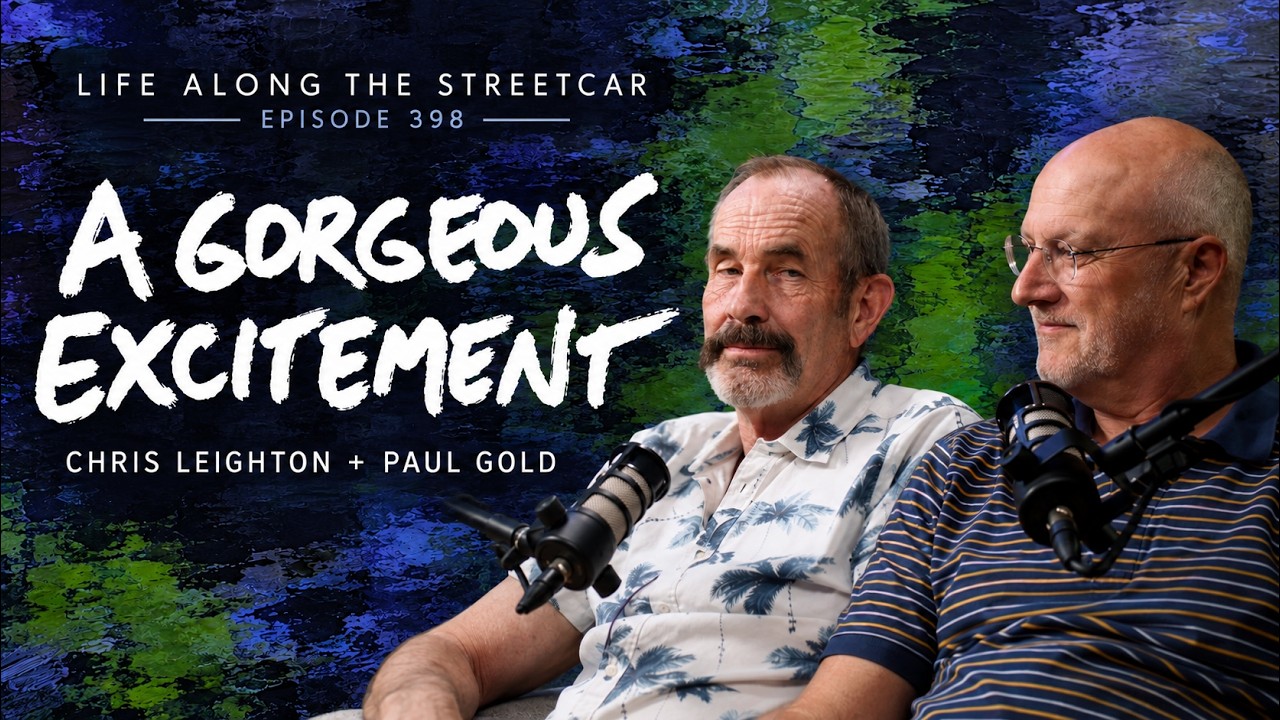
Episode Highlights
- 🎙️ Chris Leighton traces WAMO’s roots to a late-1990s planning effort focused on preserving affordable art space in downtown Tucson.
- 📍 WAMO operates Steinfeld Warehouse, Toole Shed Studios, and the Art Design Center, serving about 70 studios and additional art collectives.
- 📝 Paul Gold discusses moving from art advocacy, writing, collecting, and studio visits into his first large-scale curatorial projects for WAMO.
- 🎙️ A Gorgeous Excitement 2026 features 23 artists and 58 pieces in an invitational exhibition curated by Gold.
- 📍 The exhibition opens October 3 at Steinfeld Gallery and continues through November 14, with free admission, Saturday hours, and artist talks.
- 📝 Gold explains how exhibition sales are structured to benefit participating artists while also supporting WAMO’s operating needs.
- 📍 A newly made suspended dragon by a found-object artist is among the distinctive works created for the show.
Episode Description
Downtown Tucson’s arts ecosystem depends on more than a good opening night. It also depends on the practical work of keeping studios available, maintaining older buildings, and making room for artists as the city changes around them. In this conversation, WAMO Executive Director Chris Leighton and curator Paul Gold join Tom Heath to connect those long-term questions with a new exhibition at Steinfeld Gallery.
A Gorgeous Excitement 2026 brings together 23 artists and 58 pieces in a setting that is itself part of Tucson’s creative history. The show offers a reason to visit Steinfeld Gallery, while the discussion looks beyond one exhibition to the spaces, relationships, and financial realities that help sustain art downtown.
WAMO’s Work to Keep Creative Space Within Reach
WAMO, the Warehouse Arts Management Organization, grew from planning intended to preserve affordable art space downtown. Chris Leighton describes a familiar pattern in urban revitalization: artists often help activate an area, only to face rising costs that make it difficult to remain. WAMO’s purpose is to push back against that outcome by operating space for working artists at rents far below other downtown rates.
That mission is spread across several properties and communities. Steinfeld Warehouse at 101 West 6th Street is a central gathering point, with studios, gallery space, and a courtyard performance area that has seen recent improvements. WAMO also operates Toole Shed Studios on Toole Avenue and the Art Design Center on Grant Road. Across its spaces, the organization serves about 70 studios, along with collectives that bring the number of artists using its facilities higher.
The buildings carry their own complications and possibilities. Construction associated with Downtown Links affected access around Steinfeld and prompted WAMO to leave Citizens Warehouse during work nearby. Leighton notes that Citizens Warehouse remains a future possibility, while the Grant Road location has met a demand for Midtown Studios even as its building needs work. His longer-term hope includes live-work space, a need he sees extending beyond downtown.
From Art Advocate to Exhibition Curator
Paul Gold came to curating through a deep connection to Tucson artists rather than a conventional curatorial path. With a BFA from the University of Arizona, he has spent time visiting studios and openings, writing about artists, collecting work, and helping connect people with artists whose practices fit what they are seeking. That broad, ongoing engagement led WAMO to ask him to curate a large group show.
Gold’s first exhibition for WAMO involved 27 artists and 63 pieces. He says the experience gave him a new appreciation for the amount of work behind a gallery presentation: identifying artists, considering individual works, and determining whether pieces can share a room in a way that feels intentional. For the current exhibition, the selection is invitational rather than juried, with Gold choosing artists and, in some cases, specific works from their studios.
The show does not follow a single visual theme. Instead, Gold describes it as shaped by his own eye and by the challenge of making varied work coexist. Some selections are matched thoughtfully with others; some are created specifically for the exhibition. One such commission is a suspended dragon made by a found-object artist, a memorable example of the unexpected elements visitors may encounter in the gallery.
A Gorgeous Excitement and the Value of Seeing Art in Person
The exhibition title has an unusual origin. Gold found the phrase “a gorgeous excitement” in a New Yorker article that referenced Freud’s description of patients who were using cocaine. The phrase became the name of last year’s show and now serves as an annual identifier, with the year appended for each edition. Its slightly offbeat character suits an exhibition meant to reward slow looking and surprise rather than a prescribed theme.
A Gorgeous Excitement 2026 opens Saturday, October 3, from 4 to 8 PM at Steinfeld Gallery, with free admission. The exhibition continues through November 14, with Saturday gallery hours and artist talks planned during the run. November 7 will have evening hours for ARTWALK. Gold also invites groups, collectors, and others interested in a closer look to arrange private tours outside regular gallery hours.
For WAMO, sales are part of the exhibition’s practical purpose. Gold explains that works are consigned under an arrangement more favorable to artists than the typical equal gallery split, while proceeds also help provide operating funds for WAMO. That balance reflects the larger mission: supporting artists directly while helping maintain the affordable spaces where creative work can continue. In a period when brick-and-mortar galleries have faced pressure, the exhibition makes a case for the shared experience of encountering art in person.
Conclusion
Hear Chris Leighton and Paul Gold discuss the places and people behind this exhibition, then visit Steinfeld Gallery to experience A Gorgeous Excitement 2026 in person. It is a chance to see work by 23 artists while learning more about the ongoing effort to keep creative space part of downtown Tucson.
Transcript & Show Notes
Editorial note: This conversation has been lightly edited for clarity while preserving its substantive content and original sequence.
Welcome to WAMO and A Gorgeous Excitement
Tom Heath: Welcome back to another episode of Life Along the Streetcar, where we focus on the social, cultural, and economic impacts within Tucson’s urban core. We have defined that as the area from A Mountain to the University of Arizona, which happens to coincide with where the streetcar runs. Going into our 10th year, with close to 400 episodes, I’m always fortunate when people come in and share their projects. Please like, subscribe, and share to get the word out about amazing people doing wonderful things here in Tucson.
Tom Heath: Today is no exception, because we’ve got a dynamic duo from WAMO. We’ve got Chris and Paul here to talk about upcoming projects, a big show, and explain what WAMO is. Welcome in.
Guests: Thank you.
Tom Heath: Before we get into the organization, WAMO is the Warehouse Arts Management Organization. Did you come up with the name first and then decide how to put WAMO into the title?
Chris Leighton: I set up a master plan, and then the nonprofit started on its own. I don’t really know how they came up with the name. I think there are others with similar names in other cities.
Tom Heath: WAMO. It’s so appropriate for what you do.
A Downtown Arts Master Plan
Tom Heath: Before we get into that, let’s talk about the two people putting their time and effort into this. Chris, I know you from many different areas, and you’ve got this breadth and depth of knowledge about downtown. Tell us briefly about your background.
Chris Leighton: I started out with downtown doing the parking. There was really no point in fixing parking downtown if the rest wasn’t working, so I got involved with a lot of the master planning, creating the business improvement district, and actually wrote the language for the Rio Nuevo vote. The projects really never happened, but we had to do an aquarium. Downtown was making great progress, so we came up with the master plan because artists are some of the first ones to move in and help revitalize an area, but then they get priced out. The whole point of the Warehouse Arts District master plan was to create a nonprofit to keep affordable art space downtown.
Tom Heath: You bring a perspective because you’ve got the administrative and bureaucratic side, you’ve been in the private sector with property management, and you understand the bones and structures of some of these historic buildings. I think you’ve found a good role here with WAMO. I understand you also own very old houses and an RV that you are now fixing yourself. Paul, what is your role with WAMO, and how did you get encouraged to participate?
Paul Gold Begins Curating
Paul Gold: The WAMO folks last year asked me to curate a large show to give them a different kind of show. They have 60 or 70 studios, and they always do their own shows with their own artists. They said, “Why don’t you give us something different? Get some different traffic in here and get more exposure to what the nonprofit does here.” We did a show, and it took quite a lot of work. You go to a show and the stuff is up, but you realize what it takes to get it there when you do it.
Tom Heath: Was that your first time curating a show?
Paul Gold: That was the first show I curated, but then I did two other shows last year and more this year.
Tom Heath: Why did they reach out to you? What is your background?
Paul Gold: I think they found me because I do a ton of social media posts. I’m a self-proclaimed art advocate. I go into studios, go to openings, visit artists, write about artists, buy work from artists, and donate work from artists. One of the folks in the WAMO structure got the idea: “This guy knows a lot of people. Doesn’t mean he knows anything else, but he knows a lot of artists. Maybe he could bring a show in.” That’s how it started.
Tom Heath: And are you an artist yourself?
Art Advocacy and WAMO Leadership
Paul Gold: I have a BFA from the University of Arizona. I don’t make so much art anymore; the transference went to writing about art. But I still love to do it. Along the way, if you do what I do, you become a de facto dealer too, because I have all the exposure. People say, “I need or I want something like this,” and I can find an artist making metalwork or ceramics, et cetera.
Tom Heath: Do you work on the other end? If someone says, “I’ve just inherited this work from my grandparents’ estate and I don’t know much about it,” can they reach out to you?
Paul Gold: Yes. Even though I don’t have any high cred, it’s from experience.
Tom Heath: From the Tucson Gallery perspective, we get that call sometimes, so make sure we get your contact info. But enough about me. WAMO, you’ve been involved with it for a while?
Chris Leighton: Yeah. I set up the master plan to create a nonprofit.
Tom Heath: When was that?
Chris Leighton: Late ’90s. I was kind of the first person that started going to the International Downtown Association conference here. It used to just be me, and then 30 years later, there were more people. It’s got a lot of great pointers on how to make a downtown work.
Chris Leighton: I’m passionate about downtown Tucson, so I got in the middle of all of it to try to make it happen. The nonprofit got created by others and kind of limped along. We’re finally very stable, own two buildings, and are about to get a third.
Tom Heath: In your role with WAMO, you’re the executive director?
Chris Leighton: Yes.
Tom Heath: So you went from theoretical volunteer helping out, but now this is your gig.
Chris Leighton: Yes. Full-time, theoretically part-time.
Tom Heath: It pays part-time, full-time. Welcome to the artist’s world, right? You’ve got some properties. The one I’m most familiar with is where Downtown Radio is held, at Steinfeld Warehouse. We’re underground radio, and it’s perfect because we broadcast out of a basement of a warehouse. You mentioned other properties. Let’s walk through them.
Chris Leighton: Steinfeld is at 101 West 6th Street, although we’re going to have to change the address. They’ve made the new Downtown Links where it goes under the tracks 6th Street, so we don’t know what our address is anymore.
Studios Across Tucson
Chris Leighton: I’m probably going to change it to 9th Avenue. 9th Avenue and Franklin is probably the easiest way. Then we have the Toole Shed Studios on Toole Avenue.
Tom Heath: That always has different murals put up on it. Is the rest of that building part of the Toole Shed?
Chris Leighton: Yes. There are about 13 studios in there, and a skateboard shop.
Tom Heath: They do some pretty cool artistic skateboards. What else?
Chris Leighton: Right now we have the Art Design Center, as we’re calling it, on Grant Road in the middle of construction between Alvernon and Dodge.
Tom Heath: That seemed like an outlier.
Chris Leighton: We had to move out of Citizens Warehouse for Downtown Links construction. They were afraid because it is very sandy where they were digging, and worried the building might slide into the hole. They had us vacate during COVID. It’s that funky white building off Stone that’s isolated right now. The state has agreed to sole-source it back to us, but we’re waiting for a survey.
Tom Heath: It hasn’t fallen down, so I was wondering if you might put it back in.
Chris Leighton: No, that is a bunker. The building is actually designed to add, I think, six more floors. My dream is to build live-work space on top.
Tom Heath: That’d be fantastic, because that’s lacking in Tucson in general, not even just downtown. So we’ve got Citizens, the one on Grant, the Tool Shed, and Steinfeld. What’s the one on Grant called again?
Chris Leighton: Art Design Center. I don’t know if we’re going to stay there. There is demand for midtown studios; people seem to like it. The building needs a lot of work. It’s a building the city basically lent us while we’re out of Citizens.
Tom Heath: How many studios are there between all the different functions?
Chris Leighton: We have about 70 studios, plus art collectives. Probably 100 to 120 artists use our facilities.
Tom Heath: Are they paying to use the facilities?
Chris Leighton: Yes. Our rents are about one-third of other downtown rents.
Tom Heath: Which is exactly what your mission was in the 1990s: to keep it affordable. Otherwise, three times the rent is going to push them out of downtown for sure.
Funding Affordable Art Space
Tom Heath: WAMO is a nonprofit. Where does your funding come from?
Chris Leighton: Basically from rents. We did get quite a bit of funding and did a lot of improvements at Steinfeld with COVID money. We built a big deck, and there’s a performance space out in the courtyard. The courtyard is much nicer than it was.
Tom Heath: There was always a performance space, but it was a dirt lot. Now it’s a venue.
Chris Leighton: Yes. We did improvements to the gallery to make it nicer, with much better lighting. We’re always looking for grants, and there are a few patrons of the arts who donate.
Tom Heath: This show is airing in late September, and October 3 is the newest show Paul is curating. This is a moneymaker, right?
Paul Gold: We hope. I’m connected to many organizations—Phoenix Art Museum, Tucson Museum of Art, and the U of A. These are all institutions and bureaucracies. WAMO is the place I put my effort, money, and time because it’s a 501(c)(3), and its heart is in the right place.
Building an Annual Invitational Show
Paul Gold: It’s community, revitalization, and protection of downtown art space. It was very easy when they asked me to do this. This is my spot. I became one of them, if they can stand me.
Tom Heath: They invited you back.
Paul Gold: The first show last year had 27 artists and 63 pieces. It’s a group show, and it’s not juried; I picked them. We probably broke even last year, and that was expected. I thought we were going to have to do this show multiple years. Galleries are closing around here and in Phoenix too. COVID didn’t help people keep brick-and-mortar galleries. Online art auctions have become more popular, but people still want to see art in person.
Paul Gold: This year’s show has 23 different artists and 58 pieces. We’re hoping to build on that every year. We have really high-quality work. I want to bring in collectors, museum people, gallerists, dealers—anybody who’s interested. We’re not doing this for nothing. We want to help provide operating funds for WAMO.
Tom Heath: How does that work?
Tom Heath: Is there an admission cost, or is there a percentage of an artist’s sale that goes back to the organization?
Paul Gold: There’s a consignment setup, and it’s much more in favor of the artist than is typical in galleries. If you had a piece in a Santa Fe gallery, or almost anywhere, it’s usually 50-50. The gallery gets 50 percent of the sale and you get 50 percent. Ours is higher to the artist, but it is there to secure operating funds to go forward.
Paul Gold: The dream would be that not just the show I do, but all the shows at Steinfeld would be funded every year, and any sales would add honey to the pot.
Tom Heath: It will take place at Steinfeld. If you haven’t been to the warehouse, it is a fabulous place to see art because it is an iconic building. It’s old, but filled with good energy. It’s probably a little quieter now because the train doesn’t blow its whistle anymore.
Guest: They’re learning.
Tom Heath: Nothing like doing the radio show, Life Along the Streetcar, and hearing that train go by. Paul, is there a theme to the show?
The World According to the Curator
Tom Heath: You showed me a picture of a very large suspended dragon. Is there a theme?
Paul Gold: There actually isn’t. The theme of the show is the world according to me, which is daunting, to be honest. You think, “I have good taste. Do I? Who do I know? What artists do I put in? What artists do I leave out?” But I am connected to many of what I think are some of the best artists here. I really didn’t want to jury it. It is an invitational.
Paul Gold: The curating piece made me realize what a task it is. You can pick the right artists and the right pieces, but do they fit together? Do they curate correctly? Do they hang? I want people to walk into this place, like the Willy Wonka scene, look around, and go, “What do I eat? This is cool.”
Tom Heath: With the selection process, are you selecting the artists and giving them direction on what to provide, or giving them space to provide it?
Paul Gold: A little bit of both. In some cases, after I pick three, four, or five artists, I’ll think one will fit with another. I’ll go to their studios and pick specific pieces that I want. But in some cases, like the dragon we just put up, that was made for us.
Paul Gold: That artist is a found-object artist and said, “I’m going to make you something cool.” It’s cool to get something new that hasn’t been shown before. We’ll have a little bit of both, but the alchemy is figuring out how all these things fit together.
Paul Gold: People said last year, “Wow, I’ve never seen the warehouse look so good.” We moved walls, added lighting, and changed things. It’s been upgraded with all kinds of systems, and they just put in a sound system. I’m hearing people say, “Gee, I haven’t seen a show like this in a while.” That drove me to think that’s what we need. We need people to feel like there’s something to look forward to in the art world.
Tom Heath: There’s this collection that, in your brain, is brought together and sewn into a cohesive event that has no theme. Is The World According to Paul the title of the show?
Paul Gold: When we decided what to call the show, the titles we came up with all sounded pretty hackneyed. Here’s how this came about.
A Gorgeous Excitement 2026
Paul Gold: I was reading an article in The New Yorker one day, and there was a reference to Freud. Freud described his patients who were on cocaine, 100 years ago or more, as “a gorgeous excitement.” The name of the show is A Gorgeous Excitement. This year’s show is A Gorgeous Excitement 2026, so that’s the brand.
Tom Heath: That was the title last year, so it’s going to be the annual theme, with the year tagged on. It’s a funny name. Chris, we’ve got to have you back and talk more about WAMO, the volunteers, the board, and the artists. I really wanted to focus on the new exhibit today. How do people find out about the exhibit and WAMO?
Chris Leighton: On Instagram and Facebook. We have a website, wamotucson.org, with a calendar of events and all the shows coming up this year. The social media is Steinfeld Gallery.
Tom Heath: The whole WAMO brand is under Steinfeld Gallery?
Chris Leighton: No, there is a WAMO Tucson account. We also have a Steinfeld Gallery account.
Visit the Exhibition
Tom Heath: Do you have an event page for A Gorgeous Excitement?
Guest: Yes, we do.
Tom Heath: Is there a cost to attend?
Guest: No. All our events are free. The opening will have food—more than our usual snacks.
Tom Heath: Is it a one-day event?
Paul Gold: The opening is October 3, from 4 to 8 p.m. We are then open subsequent Saturdays through November 14, from noon to 4 p.m. The first Saturday will be open from 4 to 8 for November Art Walk. All those Saturdays, we have artist talks. These are people I think art aficionados will want to hear: how they made this, about their lives, or about pieces in the show. We’re trying to keep people coming back.
Paul Gold: Besides those short hours, I invite anybody who wants a personal tour—groups or collectors—to contact me, and I’ll set it up off-hours.
Tom Heath: How do they contact you?
Paul Gold: They can contact me through my website.
Paul Gold: I’ll do my own social media posts, but they’re connected to Steinfeld, and a lot of the artists have picked up the approach also. My website is paulgoldbooks.com.
Tom Heath: Paul Gold and Chris Leighton with WAMO, A Gorgeous Excitement coming up on October 3, and so much more to come with WAMO. Thank you for your time today.
Guests: Thank you.
Tom Heath: I appreciate your time as well for listening in to another episode of Life Along the Streetcar. Each week, Ryanhood provides a little ambiance as they let us use their song “Dillinger Days” to open and close our show. I want to thank James Portis, our executive producer. Like, subscribe, and share. It gets the word out about these events and the people doing wonderful things in our community. Keep checking in every Sunday for another episode of Life Along the Streetcar. Until next time, stay curious.