

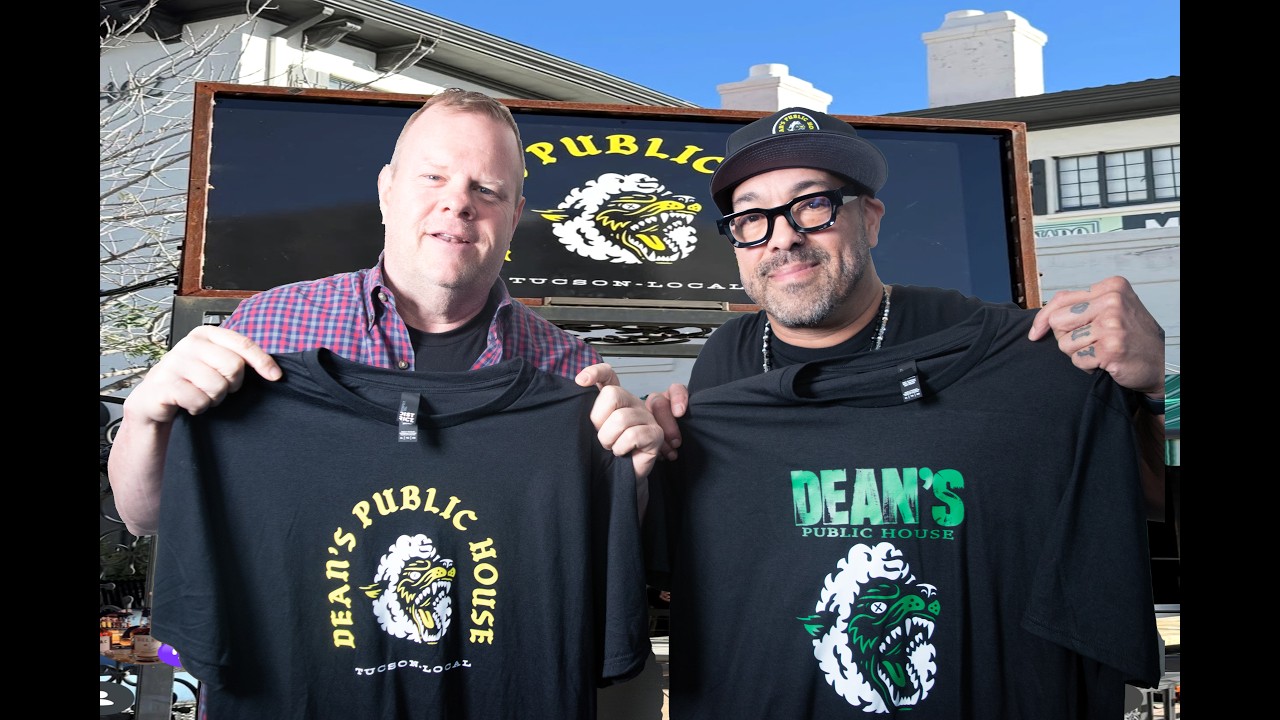
Dean’s Public House: A Fourth Avenue Story of Tucson and Hospitality
Episode Highlights
🌵 Dean’s Tucson Origin Story — Hear how Dean Howard fell in love with Tucson as a child through sunshine, lizards, and the unforgettable scent of orange blossoms.
⚽ From Soccer to Service — Discover how Dean’s connection with Vinnie Spina of Mama’s Pizza helped guide him from competitive soccer into a lifelong passion for hospitality.
🍕 Learning the Art of Hospitality — Dean shares how busy nights in the restaurant industry taught him that making guests happy can feel like winning a game.
🤝 A Place Where Strangers Become Friends — Learn why creating connections between guests is at the heart of Dean’s vision for a true public house.
🚋 Finding the Perfect Fourth Avenue Location — Dean recalls the moment he stepped onto the patio near the streetcar stop and knew the location had extraordinary potential.
📍 At the “Elbow” of Fourth Avenue and Downtown — Explore what makes Dean’s Public House ideally positioned between two of Tucson’s most vibrant urban destinations.
🍺 From Trackside to Dean’s Public House — Hear the story behind the name change, including early merchandise, a holiday-party pitch, and the moment Dean told his partners, “It’s time.”
🏡 More Than a Bar — Dean explains why “public house” captures the welcoming, community-focused experience he wants every guest to feel.
🍹 The Streetcar Cocktail Competition — Tom and Dean discuss a new competition bringing together bartenders from across Tucson’s urban core to create a signature cocktail inspired by the city.
🌆 An Invitation Back to Downtown Tucson — Dean welcomes locals to rediscover Fourth Avenue through a lively, affordable, and respectful gathering place built for community.
Episode Description
There are places that serve drinks, and then there are places that create belonging. In this episode of Life Along the Streetcar, host Tom Heath sits down with Dean Howard, the namesake behind Dean’s Public House, a welcoming Fourth Avenue gathering place located at what Dean calls “the elbow” between Fourth Avenue and downtown Tucson.
Dean’s story begins long before his name appeared on a sign. Born in Flint, Michigan, with family roots in South Bend, Indiana, Dean first encountered Tucson as a young child. What stayed with him was not a landmark or a single attraction, but the feeling of the place: orange blossoms in the air, lizards darting across the ground, sunshine overhead, and the immediate sense that he had found home.
From Tucson Childhood to a Life in Hospitality
After his family settled in Tucson, Dean grew up in the Flowing Wells community and developed a deep love for soccer. That passion eventually connected him with Vinnie Spina of Mama’s Pizza, who coached Dean on an all-star soccer team when he was 12 years old.
Years later, after competitive soccer had run its course, Dean went to work for Vinnie and the Spina family at Mama’s Pizza. It was there that he discovered a new kind of competition: the intensity, teamwork, and satisfaction of a busy restaurant service.
For Dean, hospitality offered the same sense of purpose he had found in sports. A packed Friday or Saturday night meant balancing pressure, speed, and constant demands while still making guests feel welcome. At the end of the evening, when people left happy, it felt like a win.
That experience shaped Dean’s understanding of hospitality: it is not simply about serving food or drinks. It is about creating an environment where people connect, where strangers strike up conversations, and where a night out can turn into the beginning of a friendship.
Finding the Perfect Spot on Fourth Avenue
Dean’s path to Fourth Avenue began with an opportunity involving the former Dillinger taproom at the historic Coronado Hotel property. When friends invited him to look at the location, Dean visited on a Saturday while a University of Arizona football game helped bring energy to the surrounding district.
As he walked down Fourth Avenue and stepped onto the patio, he immediately recognized the potential. The property sits near the streetcar line, close to downtown and directly connected to the rhythm of Fourth Avenue. For someone who had spent decades enjoying the area as a patron, the location itself was enough to make the opportunity impossible to ignore.
The space became Trackside, a name that reflected its proximity to the streetcar route. But as Dean poured himself into building the business, a larger vision began to form: a neighborhood gathering place rooted in the personality, warmth, and sense of community he wanted guests to experience.
How Trackside Became Dean’s Public House
The transformation from Trackside to Dean’s Public House did not happen overnight. Dean recalls an early conversation with business partner Brendan Scott, who casually suggested that perhaps one day Dean’s name could appear on the sign. Whether Brendan realized it or not, the idea stuck.
Dean began imagining what his own version of the space might become. He made notes in small notebooks, developed ideas for the bar, and worked with a friend on early designs for merchandise and signage. Before the name change was official, he even began selling shirts featuring the Dean’s Public House branding, believing they would either become the first merchandise for a real establishment or simply end up as reminders of an ambitious idea.
His decisive moment arrived at a holiday party. Dean brought two hoodies bearing the Dean’s Public House logo, handed them to his business partners, and simply told them, “It’s time.” After a brief conversation, the decision was made.
At the beginning of 2026, the social media accounts changed, online listings were updated, new signage began appearing, and Dean’s Public House officially became part of Fourth Avenue.
What Makes a True Public House
The name “public house” is intentional. Dean does not see his establishment simply as a bar, tavern, or nightlife destination. He sees it as a place where people are invited to gather.
The interior offers an intimate setting, while the patio provides a front-row seat to the character and movement of Fourth Avenue. Dean describes it as some of the best people-watching on the avenue, positioned perfectly at the “elbow” connecting Fourth Avenue with downtown Tucson.
More importantly, the spirit of the place is built around connection. Dean loves seeing guests arrive separately, meet at the bar, and later return together as friends. That experience is central to his vision: a welcoming environment where visitors, regulars, students, and longtime Tucson residents can all feel like they belong.
Tom shares his own experience visiting Dean’s Public House during a busy Wildcats tournament game. Even in a crowded room, he noticed the staff helping guests find space, connect with one another, and feel included. It was the kind of hospitality that makes a small bar feel like a neighborhood living room.
Celebrating Tucson Through the Streetcar Cocktail
The conversation also connects Dean’s Public House to a broader effort to celebrate Tucson’s urban core. Tom discusses his idea for a Streetcar Cocktail, a signature drink created through collaboration and competition among bartenders representing the districts connected by Tucson’s streetcar route.
The concept is rooted in the idea that Fourth Avenue, downtown, Main Gate, and the Mercado are not isolated destinations, but connected pieces of a shared urban experience. Each participating bartender is invited to tell a story of Tucson in a glass, drawing from the city’s history, culture, diversity, and sense of place.
Dean enthusiastically joined the effort, developing a cocktail entry of his own for the competition discussed in the episode. His participation reflects the larger role he hopes Dean’s Public House can play: not only as a bar on Fourth Avenue, but as an active contributor to Tucson’s cultural and social life.
An Invitation for Tucson to Gather
As the university season slows and Tucson locals begin returning to downtown and Fourth Avenue, Dean extends a simple invitation: come experience what Dean’s Public House has to offer.
While the location naturally attracts students and visitors, Dean is intentional about creating a different kind of Fourth Avenue atmosphere—one where people can enjoy affordable drinks, a lively environment, and a shared expectation of respect and hospitality.
In the end, Dean’s story is about much more than putting his name on a bar. It is about a child who fell in love with Tucson, a soccer player who found a new passion in service, and a hospitality professional who spent years imagining a place where people could come together.
From orange blossoms and childhood memories to the patio at the elbow of Fourth Avenue and downtown, Dean’s Public House is a Tucson story built around welcome, community, and the simple joy of bringing people together.
Transcript & Show Notes
Life Along the Streetcar
Dean Howard of Dean’s Public House
Edited Show Notes Transcript — Working Draft
This transcript has been edited for readability. False starts, filler words, repeated phrases, and transcription artifacts have been cleaned up while preserving the substance and tone of the conversation. Speaker labels have been identified as host Tom Heath and guest Dean Howard based on the episode context.
Welcome to Life Along the Streetcar
Tom Heath: Hey, welcome back to another episode of Life Along the Streetcar, where we cover all of the cultural, social, and economic impacts happening within the urban core. We define that as from A-Mountain to the University of Arizona. I’ve been doing this since 2017, and I’m excited to have you with us today.
Our guest is from right smack dab in the middle of this, on Fourth Avenue. He is the namesake of Dean’s Public House. We didn’t just go to one of the employees; we went to the namesake. We have in the studio today the very famous Dean Howard of Dean’s Public House. Dean, welcome.
Dean Howard: Thank you very much. Honored to be here.
Tom Heath: How do you get a bar named after you?
Dean Howard: Work.
Tom Heath: Okay. There you go.
Dean Howard: That’s an interesting question. Where do I begin?
Falling in Love with Tucson
Tom Heath: Let’s start with you. You’ve grown up most of your life in Tucson, right? Your family was originally from Indiana?
Dean Howard: My family is from South Bend, Indiana. I was born in Flint, Michigan. We came out here after there was a nasty blizzard in the Midwest in 1978. The first time we visited, I immediately fell in love with the place.
Tom Heath: At four years old?
Dean Howard: At four years old. I already didn’t like winter. Anybody who comes into the bar has heard this story a thousand times. We came out, and I absolutely fell in love with the place. I smelled orange blossoms for the first time. There were lizards running around and sunshine. And I mean this wholeheartedly: it was like coming home to a place you’d never been before.
Tom Heath: Nice. You experienced a lot at four years old. I don’t remember being four.
Dean Howard: I remember that.
Tom Heath: Since you were four, have you been in Tucson?
Dean Howard: No. We came out in the spring of, I believe, ’76, again in the spring of ’77, and then ended up moving for good in ’78 or ’79, something like that.
Tom Heath: At that point, you’re so young and you’ve been here so long. I know you’re not technically from here, but you really are a part of Tucson.
Dean Howard: Oh, yeah.
Tom Heath: Where did you go to school?
Dean Howard: I was in the Flowing Wells district, up around Orange Grove and Thorndale, when there was nothing out there. They were building what would become my elementary school. For the first year, I went to Laguna Elementary School, and then Richardson opened up. From there, it was Flowing Wells Junior High and then Flowing Wells High School.
Tom Heath: There you go. You got the whole circuit there.
Dean Howard: Caballeros for life, baby.
Soccer, Mama’s Pizza, and a Love for Hospitality
Tom Heath: Let’s fast-forward a little bit. At four years old, did you come to Tucson and think, “I can smell the orange blossoms. I love this weather. There are lizards. Someday I’m going to run a bar?”
Dean Howard: Not yet.
Tom Heath: How do we get from four years old to getting into the industry?
Dean Howard: I grew up playing soccer. It was my absolute favorite sport in the world. When I was 12, I got selected for an all-star soccer team. The coach of that team was Vinnie Spina of Mama’s Pizza.
Tom Heath: Oh, wow.
Dean Howard: Yeah. He made a huge impact on me. Just an incredible man. He had so much to do with me being who I am to this day.
I played for him on that all-star soccer team, then played throughout high school and eventually ended up at Pima. I was playing there, and that part of my life kind of ran its course. I ended up going to work for Vinnie and the Spina family at Mama’s, and that’s where I fell in love with the service industry.
For some reason, once I wasn’t playing competitive soccer anymore, I found the restaurant business very competitive. I like to win. On Friday and Saturday nights, we were insanely busy, and you were just going hard for hours and hours. I got such joy from providing that service for people and having that connection. At the end of the night, if everything went well and people were happy, you won. There was a victory.
Tom Heath: There is that adrenaline rush in the middle of the rush. You’re trying to balance 16 different top priorities, keep a smile on your face, and deal with all the challenges people aren’t seeing. The restaurant industry provides a really interesting space for competitive people.
Dean Howard: It does. The connection that you get with your guests is an absolute drug for me. I love it. I see such value in the connections that are made in the bar now.
One of my favorite things is seeing people who have never met before meet in front of me at the bar and become friends. Each of them walked in that day individually, with no idea who the other person was. Then I see them come back time and time again together. I love that.
Tom Heath: That’s fantastic.
Dean Howard: I love that.
Discovering the Opportunity on Fourth Avenue
Tom Heath: When I first heard about Dean’s Public House, I was interviewing Brendan Scott. We were talking about his new collaboration, Stage Left, and getting into his history. He casually mentioned that one of the places he has is Trackside, which would soon be renamed Dean’s Public House. He told us a little story, but I’m going to let you tell it, because he has a very specific version of how it got that name.
Let’s start with Trackside. When did you get involved with Brendan and that group? What was that like?
Dean Howard: We started Trackside with some friends of mine: David, John, and Mick. They knew the Dillinger guys, and Dillinger was doing their thing there.
Tom Heath: It was Dillinger’s tap house?
Dean Howard: Yeah.
Tom Heath: Let’s set the stage. We’re talking about the Coronado Hotel on Fourth Avenue, right there after the underpass. It had been a restaurant for a while. The Coronet moved out, and then it was Dillinger.
Dean Howard: Right. David, John, and I knew the guys. They made them an offer to buy the taproom. They kind of knew me through another life: they were guests of mine when I was at Topgolf. We had remained pretty close. I left Topgolf and went to Trident—another story—but we kept in touch.
They tapped me on the shoulder and said, “Hey, look, we’ve got an opportunity.” I said, “Let me go take a look.”
I came down on a Saturday. I remember it very vividly. The U of A was playing a football game. I came down Fourth Avenue, and the energy and buzz were in the air. You could smell food and hear music. You could see people. Then I took a couple of steps onto the patio of what is now our spot, turned around, and—based on location alone, and having come down to that area for 30 years—I couldn’t say no.
Tom Heath: You have this iconic hotel behind you. You’re right next to a streetcar stop. You’re close enough to downtown and on Fourth Avenue. You’re really kind of at that nexus.
Dean Howard: I call it the elbow.
Tom Heath: The elbow?
Dean Howard: The elbow between Fourth Avenue and downtown.
Tom Heath: I’m going to start calling it the elbow.
Dean Howard: Please do.
Tom Heath: Had you worked on Fourth Avenue before? Some of the places you worked were more outside the urban area.
Dean Howard: Never. I had never worked at any of the spots down there. I had only been there as a patron.
Tom Heath: So you had 30 years of coming down and having a feel for the vibe. Here you are on a Saturday. The game is playing, there’s probably a little sunshine hitting that patio, and your eyes light up and say yes.
Dean Howard: The place wasn’t hopping at that particular time, when it was Dillinger, but based on the location alone, I felt like I had to do this. I thought, “Okay, let’s do this.”
Tom Heath: And that became Trackside.
Dean Howard: Trackside, yeah. I knew from the very beginning that it was going to be quite a challenge. To say that we didn’t have a lot of funds would be a gross understatement.
David and John have a tattoo shop, and that shop needed their full attention. That’s when Brendan and Eric came in, and it was quite a boost for us. We had some things we could do. We had some funding.
From Trackside to Dean’s Public House
Dean Howard: This is my version of how the seed was planted for it to be called Dean’s.
I think it was one of the first times that Brendan and I talked. He’s probably going to dispute this, but this is the truth. He was walking out onto the patio, through the gate to get to the street, and in my memory he looked up and said, “You never know. Someday your name might be on that sign.”
That was when the seed was planted, and I ran with it very quietly.
With those guys coming on, new life was breathed into the place. I just went to work. I absolutely poured myself into it. Things started to get better, and business was growing.
I started making little notes to myself about my plans. I can’t remember exactly how I came up with “Dean’s Public House,” but it’s in one of my little notebooks. The things I wanted for the bar are written down in there as well.
A friend of mine made some designs for merchandise, signs above the place, or whatever we might want to use them for. I took one of those designs and started making shirts. I started selling those shirts, and I thought, “These are either going to be the first shirts ever made for Dean’s Public House, or they’re going to sit in the back of somebody’s closet getting dusty.”
I guess those original shirts are collector’s items now.
When I finally approached the guys, I took another design—this logo right here—and had some very nice hoodies made. I also had some stickers made. I figured I would take the holiday party as my big opportunity.
Tom Heath: This is where Brendan’s story and your story start to align. You’re at a holiday party. There are some cocktails, and you’re like, “Hey, I have an idea.”
Dean Howard: I had these two hoodies in Christmas bags. I went to the holiday party, went upstairs, and planned to get those two guys away from everybody else and make my pitch.
We were outside, and yes, there were some cocktails involved. That wasn’t part of the plan, but it didn’t hurt, I don’t think.
I started talking to them, picked up the bags, handed one to each of the guys, and said, “It’s time.” They looked at each other and talked for about 90 seconds, then said, “All right, let’s do it,” or something along those lines.
Tom Heath: Nice. Trackside has a great connection to the location, but Dean’s Public House is very unique as a name. It’s not a bar, a tavern, or a club. It’s a place where we come to gather.
Dean Howard: Very much so.
Tom Heath: Because of the location, you’ve got a really beautiful interior, but that patio provides that public atmosphere and connection.
Dean Howard: The best people-watching on the avenue.
Tom Heath: There’s a lot going on there, right at the elbow.
Dean Howard: At the elbow.
Making the Name Official
Tom Heath: How long has it been Dean’s Public House now—five or six months?
Dean Howard: It was right before Christmas. At one second after midnight going into 2026, I went to the social media accounts and changed the name. Then, with help from another friend of mine, we changed everything on Google and whatnot. After that, we had the signs put up, and now it’s full-blown.
Tom Heath: I think I remember going by at one point when the door had “Dean’s” on it, but the sign still said “Trackside.” Brendan had told me it would be happening soon, so I thought, “Breaking news. I’ve got to get over there.” Then I arrived and wasn’t sure what it was, because one sign was there and the other wasn’t.
That’s fantastic. The dream of what you’re doing has been in the minds of so many service-industry people: “I’m going to open my own restaurant. I’m going to open my own place.” To have the support of ownership and to have some creativity and control over it has to be so rewarding.
Dean Howard: It is. It really is. I can’t even explain it, because yes, it is the dream of a lot of people.
When we started as Trackside, it wasn’t even necessarily that the dream was there, although it was obviously somewhere. The way things have fallen into place has just been an absolute joy.
It’s nice to be able to take ideas going back years—decades, some of them—and put them into practice. Wherever you worked, whether it was corporate or mom-and-pop, you heard “no” a lot. In my heart, I believed a lot of the ideas I had would work.
They’re really simple. Some of the things I learned at Mama’s in the ’90s are simply about treating people like your guests. You don’t have to fool somebody into having a good time and enjoying themselves. It’s real simple—at least, it is for me. Not to toot my own horn, but I’m just throwing a party. That’s it, man. It’s not rocket science. It’s hard to explain sometimes. It’s just a feeling. I love it.
Creating a Community at the Elbow
Tom Heath: I don’t go out as much as I used to, but I did stop in when I had some things going on on Fourth Avenue. It was during one of the early games for the Wildcats in the tournament this year, and it was hopping.
Dean Howard: We had a great time.
Tom Heath: It was hopping. I went in and saw you. I knew who you were, but we hadn’t met at all. You were busy, so I wasn’t going to interrupt. You had a couple of other people working behind the bar.
That sense of community was very apparent. It’s kind of a small space, and they were connecting people to share space: “Okay, there’s room over here.” They were bringing people together. It had that public-house feeling of, “Come on in. You’re going to be part of the family.”
Dean Howard: Yeah, pretty much.
Tom Heath: It was a good experience.
A Streetcar Cocktail for Tucson’s Urban Core
Tom Heath: Switching gears a little bit, we don’t have as much time to talk about this as I would love to, but I do want to get this in.
In that interview with Brendan and Billy, we were talking about Stage Left and the Rialto Courtyard behind it, and coming up with ideas. Like you, I’ve had an idea percolating in my head for years: a way to unify the different districts on the streetcar route.
When I look at Fourth Avenue, Main Gate, Mercado, and downtown, I see an urban core. I don’t see four distinct places. If you’re coming from somewhere else and you hop on the streetcar, you’re in the urban core. You’re just visiting different stops along the way.
To help unify that, I came up with the idea of the Streetcar Cocktail. The bars along this urban core would all serve a version of a drink called a Streetcar Cocktail. What that version is, I don’t know yet.
The idea came up that, at the Rialto Courtyard on May 24, we would have a contest. We’re going to get bartenders and establishments from all four districts to create their own story in a glass of Tucson, reflecting the history, diversity, and layers of our culture and our people. Whoever wins that contest, that becomes the Streetcar Cocktail. Then we see it on menus across the urban core. We’ll see how it plays out.
You’re part of that.
Dean Howard: I am. I love it. I’ve got a cocktail that we’re going to roll out for that one.
Tom Heath: We’re going to have to have you back, because I need to talk more about how this idea of coming up with cocktails works. There’s so much behind the bar scene that we need to learn more about. You’d be willing to come back on a future show?
Dean Howard: Absolutely. Absolutely.
Inviting Tucson Locals Downtown
Tom Heath: This is airing toward the end of May. We’ve got the cocktail competition coming up on May 24. Is there anything coming up at the bar that we should know about?
Dean Howard: School is about out, and the students are going to be leaving. This is the time of year when, as I’ve noticed over the last couple of years, about two or three weeks after the university students go, the locals start making their way back downtown.
For me, it’s an invitation for locals to come down, give us a try, and see what we have to offer. Even during the school year, we’re down on Fourth Avenue, but we have a different vibe from the stereotypical college bar.
There will be college kids there. They like our prices; they’re incredible. But we also have a standard of behavior. While we’re all having fun, we’re going to be respectful, nice, and accommodating to each other.
My big push is to get all the locals I can back downtown, make an impression on them, and keep inviting them back.
Tom Heath: What are your social handles?
Dean Howard: Oh, geez. I’m not even sure, to be honest. I’d have to look at my phone.
Tom Heath: We can put them up.
Dean Howard: It’s all Dean’s Public House. Dean’s Public House on Instagram, Dean’s Public House on Facebook. I guess TikTok too, but I don’t really use that very much.
Tom Heath: We’re of the generation where we probably won’t go there.
Dean Howard: Yeah.
Closing
Tom Heath: All right. That has been Dean Howard, talking about the creation of Dean’s Public House and how we got there—from a four-year-old smelling orange blossoms to where we are today. I appreciate your time here on this episode.
You can find Life Along the Streetcar in all kinds of places, but the easiest is on our website, LifeAlongTheStreetcar.org. We’re also on social media, on many podcasting platforms, and on YouTube, all under Life Along the Streetcar.
If you have any topics or ideas for us, please don’t hesitate to reach out through the contact button on the website. You can also email us directly at contact@lifealongthestreetcar.org.
I hope you tune in every Sunday for another episode. Until next time, stay curious, Tucson.