

Preserving History: The USS Arizona Mall Memorial Tribute to the Fallen Heroes of Pearl Harbor with David Carter
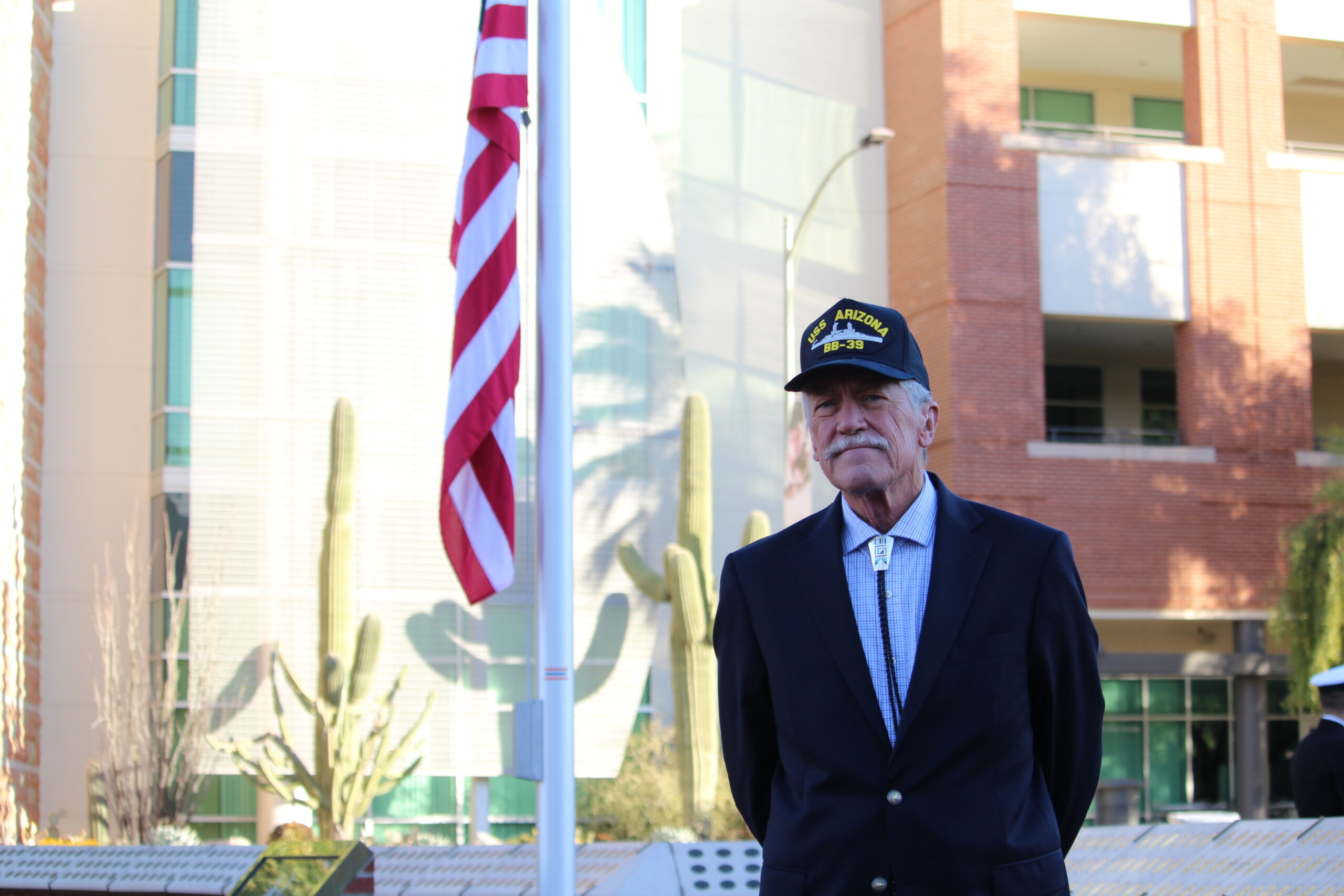
On this week’s show we’re gonna revisit our 2018 conversation with David Carter, the designer of the USS Arizona Mall Memorial. It’s a life-size outline of the ship and a memorial to the 1177 sailors and Marines who perished as a result of the attack on December 7th.
Today is May 28th, my name is Tom Heath and you’re listening to “Life Along the Streetcar”.
Each and every Sunday our focus is on Social, Cultural and Economic impacts in Tucson’s Urban Core and we shed light on hidden gems everyone should know about. From A Mountain to the U of A and all stops in between. You get the inside track- right here on 99.1 FM, streaming on DowntownRadio.org- we’re also available on your iPhone or Android using our very own Downtown Radio app. Reach us by email contact@lifealongthestreetcar.org — interact with us on Facebook at LifeAlongTheStreetcar and follow us on Twitter @StreetcarLife
Our intro music is by Ryanhood and we exit with music from The Accidentals, “Memorial Day.”
Transcript (Unedited)
Tom Heath
Good morning, it’s a beautiful Sunday in the Old Pueblo and you’re listening to KTDT Tucson. I want to thank you for spending a part of your brunch hour with us on your downtown Tucson community sponsored all volunteer powered or rock and roll radio station. On this week’s show we’re gonna revisit our 2018 conversation with David Carter the designer of the USS Arizona Mall Memorial it’s a life-size outline of the ship and a memorial to the 1177 sailors and Marines who perished as a result of the attack on December 7th. Today is May 28th, 2023. My name is Tom Heath and you’re listening to life along the streetcar.
Tom Heath
Each and every Sunday our focus is on social cultural and economic impacts in Tucson’s urban core and we shed light on hidden gems everyone should know about. From a mountain to the University of Arizona and all stops in between you get the inside track right here on 99.1 FM Streaming at downtown radio org also available on our iPhone or Androids by getting our very own downtown radio app And if you want to connect with us on the show, you can find us on Facebook and Instagram. And if you want more information on us, the book, or maybe any of our past episodes, you can head over to lifealongthestreetcar.org. And of course, you can always listen to our past podcasts there on iTunes, Spotify, and all kinds of places like that. Well, you may be celebrating with family this weekend, Memorial Day. It is a day of remembrance tomorrow, And in honor of that, we wanted to circle back to an interview we did early in the show. It was one of our first episodes back in 2018. And it was in that first year that we were launched. We talked with David Carter, who designed the USS Arizona Mall Memorial on the U of A campus. It’s a wonderful hidden gem that I’d love to talk about on the tours. And this interview is a little dated. Of course, it’s 2018. Some of the things that we’ve talked about have come to fruition. My thoughts really, given the spirit of this weekend and the memory of those
Tom Heath
who have perished in defense of our country that revisiting this conversation would be the right thing to do today. So this is from 2018 interview with David Carter, designer of the USS Arizona Mall Memorial.
David Carter
I’m David Carter. I was the creator and project designer for the USS Arizona Mall Memorial. We’ve thus far accomplished two of our three objectives with this attempt to have a mainland tribute to the 1, 177 sailors and marines who were killed on the USS Arizona at Pearl Harbor. Arizona Pearl Harbor.
David Carter
We have on the mall now since December 2016 a full-scale outline of the deck of the ship. It covers 1.3 acres, almost 600 feet long, almost 100 feet wide. It’s a little bit difficult to try to grasp the extent of it from any given position. You almost have to sort of walk that outline to get a get a sense of it. I had 15 seconds of fame day before the 75th anniversary of Pearl Harbor on on the CBS Evening News when I was explaining that in the original layout of the outline of the deck, we began at the curb in front of Old Main. When we got down to, there’s a concrete retaining wall in front of the desert garden. We had 5 eighths of an inch to spare. We ended up slightly tweaking that alignment but that was an example of something
David Carter
that was meant to be in this location on this spot? The outline of the ship explains something of the scale of the ship, but within this plaza, 39 feet wide, some 90 feet across, are three-inch brass medallions to each of the men who were killed on the ship. And that is the second step. That’s conveying the human scale of a loss. And we’re trying here to have something of an entree to younger people. So on each of these medallions, we have the year born and the year died. One fellow survived into 1st of February 1942, a day away from getting care in San Francisco before he died. All the others died in 1941, most of them on December the 7th during the attack when a Japanese bomb blew up the forward magazines, literally lifted the forward portion of the ship out of the water and instantly killing most of those 1177 sailors and marines. The third aspect that we hope we can have in place before too much longer is something that has a Wi-Fi aspect, where someone with a phone or ability to plug into Wi-Fi on the mall here will be able to call up any given name and where we have photos see on a phone a photo of that guy and read about him and his family. In the case of 26 families when the word came it was not that one son had been killed, but the two had died on the ship. So there are 26 pairs of medallions that have italic notations at the top saying brother of, and the initials of the other brother and then the corresponding inscription for the for the other brother. There’s also a similar inscriptions for a father and son who were killed on the ship.
David Carter
What research by my wife has made very clear, she now has compiled going on 400 profiles of the men killed on the ship, and is still working away on that. I hope to shortly be retired and be assisting her in completing that work. But What she has found is that it wasn’t just brothers and a father and son. There were dozens and dozens of cousins on the ship. There were uncles and nephews. There were scores of guys who were best friends, typically growing up in small towns.
David Carter
And then there was one man who grew up outside of Waterloo, Iowa, William Ball, Bill Ball. Five brothers who grew up with him, played ball with him, when they heard of his death on the Arizona, They went down to enlist and they insisted that they all be allowed to serve together.
David Carter
In November 1942, they were on the light cruiser USS Juno, which is a large ship, but it took two Japanese torpedoes. Four of the five brothers were killed almost immediately. The fifth brother survived for over a day before he also succumbed, before the Navy was able to rescue those who Who were still alive? So those were the five Sullivan brothers. It was in famous World War two movie made about them Not their experience. There was a destroyer named after them that is today tied up outside Buffalo, New York. Outside Buffalo, New York. So it was an Arizona connection to the worst of the incidents where brothers and relatives were perished.
Tom Heath
You had talked about age mathematics. The typical age of one of the names on these medallions. How old were these men? There was one guy from Tucson. He was still
David Carter
17 when he died. One quarter of the men who were killed were still teenagers when they died. Five of them were still 16 years old when they died because they had enlisted illegally, wandering. The late 1930s in much of the country was still the aftermath of the Great Depression. There were a huge number of men on the ship who
Tom Heath
were orphans. Their economic prospects were minimal. It seems then that the average age is somewhere in that 19 to 22, 23 range. That’s right. Which is exactly the average age
David Carter
of the student walking across this campus every day. Right. So we hope that we can have a number of different aspects to a third phase of this, where if you’re here at the University from St. Michigan, you want to see the men from your sea, you can do that in sequence. Or if you want to see the men who are the same age as you are now, you could also do that. Our hope is that we can have perhaps six different positions around the outline of the ship where from that position you can be able to see on a phone or a laptop a view of the ship from that position. I just got goosebumps. What would it look
Tom Heath
like? I just got goosebumps. That would be phenomenal. Just walking the outline of this is so inspiring, but just to get that view would be amazing. We are in the
Tom Heath
first segment of our interview with David Carter back from 2018, talking about the USS Arizona mall memorial on the U of A campus. My name is Tom Heath and you’re listening to Life Along the Streetcar and Downtown Radio, 99.1 FM and streaming on downtownradio.org.
Tom Heath
And we’re going to jump back into that interview with David Carter. This was recorded back in 2018 it was in that Around the first end of the first year that we were on the air This is I think was episode number 60 or something like that and today we’re episode number 249 time has progressed But in honor of the Memorial Day weekend, we thought it was appropriate to go back and talk about the history and the motivation for David Carter and his team on creating the USS Arizona Mall Memorial.
Tom Heath
This isn’t something that just happens. What drew you to this project in the beginning? Why did you think this was important and how did it end up on the
David Carter
U of A Mall? Well, I was a U of A student in the late 60s, early 70s, and was a journalism major. I wrote one article for the Wildcat, but was often dropping in visiting friends who worked on the Wildcat. It was on the second floor of the Student Union and across the hallway was a small museum with memorabilia from the USS Arizona.
David Carter
Years later, that first Student Union, which had the bell in a tower with grill work in front of it, where you couldn’t see the bell. And the small museum up on the second floor, where most people had no idea it existed. The replacement student union was built circa 2000. And you can now see the bell. It’s visible in the new tower. And directly around the corner from the tower, on the first floor, in a highly visible area, is the small museum. And a beautiful aspect of it is that it incorporates brass windows and doors from the first student union. So it’s a very nautical aspect to the museum. I was talking in 2012, Mark Kelly came to Centennial Hall to provide a community update on the rehab of his wife, Gabby Giffords, in the aftermath of the January 8th shootings here. There was a small gathering backstage beforehand, and I was talking with Frank Farias who for decades was the head of the bookstore. I knew that he had been part of the planning on the new Student Union and I was congratulating,
David Carter
I had been by recently and had seen the new tower at the Student Union, a small museum, and I was congratulating him on that. We were talking about it when, in my mind’s eye, I could visualize the nearly six-foot-long 1-100 scale model of the ship, which is in the museum here. It’s the ship as it was in 1935. It’s an excellent model, but from having
Tom Heath
visited
David Carter
World War II destroyers, similar to the one that my father served on, I knew that a model doesn’t begin to convey scale. It’s hard for anyone to translate the scale of a model, even if it’s a round number like 1 to 100, into the size. So I said to Frank, it would be great if we could outline the ship out on on the mall to convey that skin. And a fraction of a second later, I said and if we could include the names of each of the men who perished on that day on the ship, that would convey the human scale. So that was one of the steps, one of the steps to, and then gradually evolved the idea of trying to further expand what’s out here with the help of Wi-Fi.
Tom Heath
If
David Carter
we can have people be able to come out and see photos of, for example, three of the men, including a guy who at the time was 15, when they were at boot
Tom Heath
camp.
David Carter
That really is, it’s so powerful to see an image like
Speaker 2
that. What
Tom Heath
I would imagine for the families, we were just talking earlier before the interview of someone whose husband was the, the nephew of someone that was on the Arizona. And then the hearing about this was something that they, being today December 7th, that they wanted to come out and be a part of that. And this has been open for two years now, this has been open and been talked about for some time, so there’s still families just learning about this. And the research that you and your wife are doing, 400 stories, I would imagine that’s just opening up a whole other realm of historical perspective on this
Tom Heath
event.
David Carter
It’s something that
David Carter
Bobby Joe is taking the lead in trying to convey the personal aspects and the stories.
David Carter
The fact that, Well, last summer she was able to get hold of a fellow in Hillview, a small community about 70 miles north of St. Louis in corn country in Illinois. And he thought he could get a hold of a woman at at county or regional historical society. He did had her call back. And Bobby Joe had known that there were two men from Hillview that died on the Arizona. The woman talked with her for about half an hour explaining everything that she had been able to gather about these 2 men and Bob Joe was very appreciative, but she was thinking that well that this is great I need to get to work on it and she was began to thank the woman for her help. When the woman said well. Are you not interested in the other two men? My wife did not know that there were four men from Hillview, which in 1940 had a population of 540. That Two of them went on the ship initially The two others followed success successively And all four were killed. They were not related. They were within three years of each
David Carter
other in the local small high school. But even though not related, for a small town like that, every single person likely knew them and the impact of them. We set out everything here in alphabetical order irrespective of rank. The Tucson and Seaman second-class brand new to the Arizona immediately precedes in alphabetic order his medallion immediately precedes that of Captain Franklin Van Bolkenburg, the skipper of the ship.
Tom Heath
How are you figuring out what stories to investigate and what names to do first. It’s a bit of a mix.
David Carter
Some of it has been as something that’s readily available. And where it’s known or there’s a connection or someone calls in or emails and there’s a connection. But also partly it’s it’s trying to systematically work through the names. Early in 2019, the National Park Service at Pearl Harbor is expecting to finally post the high res scans that had been made of personal records called bricks. They were in cardboard rectangular containers in the executive officer’s quarters on the ship. They’re all singed from the fires that raged for, in the case of the Arizona, for three days before anyone could get on the ship. We’re hoping that The information in each of those bricks will be a real leg up on trying to compile the remaining profiles.
Tom Heath
I remember when this, the inaugural event in 2016, you had survivors of the USS Arizona. Are they still all living? Have they passed? There are today five Romanian survivors, And
David Carter
of those five, amazingly, two were up on the range finder platform
David Carter
in the port platform. They were partly sheltered by the 36-inch diameter of the foremast of the ship on which the bell that’s here today was hung. When the forward magazines exploded a bit to the starboard or right side of the number two turret.
David Carter
That blast killed all the men who were in the starboard fire control
David Carter
unit, the ones on the port side, because of the foremast and being a little bit further away, were able to get out. A line was passed to them from the Vestal, the repair ship tied up next to the Arizona. And a seaman there disregarded an officer’s orders to sever the line so the Vestal could try to get out into the
Tom Heath
harbor.
David Carter
So there were, I think it was eight or nine men from that fire control director, a steel box, that were able hand over hand to get off. Both Lauren Bruner, one of the survivors today, and Don Stratton, they were in hospital for nine months before returning to service throughout the war. But both of them in succeeding years have had operation after operation for skin grafts because of the burns that they received.
David Carter
Bruner came out here in 2016, in September, when the university played Hawaii at the football stadium here. And Brunner was introduced at halftime. Beforehand, that day, he had fielded questions for about 45 minutes from Navy and Marine ROTC students. One of those students, pretty sharp guy, managed to email him a couple months later. He knew that Brunner lives outside Los Angeles. He said that I’ll be graduating in June. I’ll receive my commission as Ninsen. Would you be willing to come over and give me my first salute?” And Bruner, who at the time was 94 or 95, said, Absolutely. So we hope to get posted
David Carter
on a website a video of that first salute. Wonderful.
Tom Heath
This is an amazing undertaking. Step one of the physical scale and step two of the human scale is quite amazing. I’m excited about step three of this historical perspective that’s coming with technology and time and energy. There’s so much to look forward to. Thank you for your time. Thank you for doing this and thank Bobby Joe for us.
Tom Heath
Thank you. David Carter, designer of the USS Arizona Mall Memorial on the U of A campus. And one of the feature stories of our book that we wrote called My Life Along the Streetcar was one of those influential interviews that we had early on in the show that not only shaped our community but helped to shape the focus of our show. My name is Tom Heath and you are listening to Life Along the Streetcar and Downtown Radio 99.1 FM and streaming at downtownradio.org.
David Carter
Thank you very much enjoy your evening Bye bye.
Tom Heath
And thank you for listening to episode number 249 here on Life Along the Streetcar Downtown Radio. Did a retrospective of sorts there. We went back to 2018 with an interview we did with David Carter. And I invite you to check out their Facebook page the USS Arizona Mall Memorial for updates as some of the things he has talked about like the historical project those have come to fruition so lots of updates to be seen Facebook’s best way to do it will link to it from our page as well I’ve been a man flying by May is done and we’re heading into June. I hope you have a restful and reflective Memorial Day weekend. And
David Carter
I’m going
Tom Heath
to leave you with music today by the accidentals from an album in 2017 called Odyssey and the name of the song is Memorial Day.
Tom Heath
My name is Tom Heath I hope you have a great week and Tune in next Sunday for more Life Along The Streetcar.